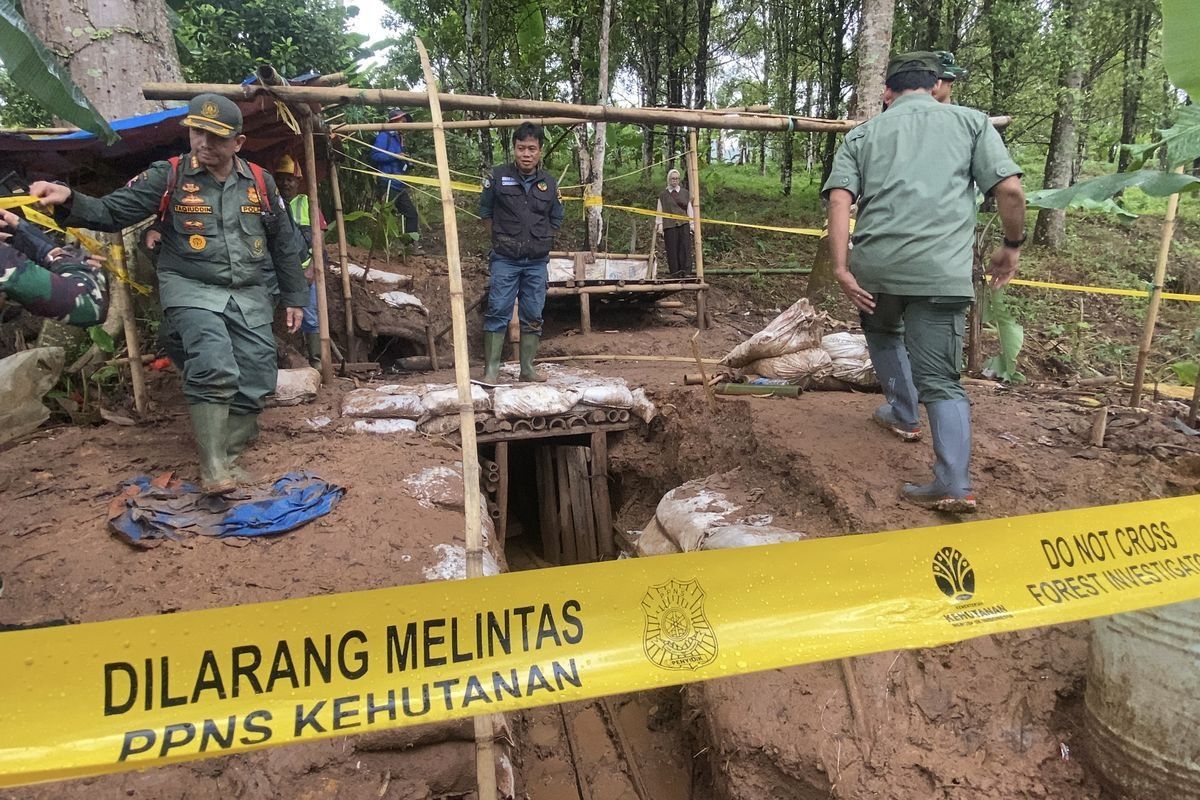
Indonesia has formally charged 24 foreign nationals as criminal suspects in connection with an illegal gold mining operation spanning the Gunung Botak area of Maluku, according to a statement from the country's energy ministry released on Thursday, June 25. The move represents a significant enforcement action against organised illegal mining, which has long plagued Indonesia's remote and resource-rich eastern regions and drawn international criminal syndicates seeking to exploit weakly policed territories.
According to Jeffri Huwae, an official with the energy ministry, the foreign suspects were engaged in constructing and operating infrastructure essential to the mining operation. This infrastructure extended beyond simple extraction sites to encompass road networks facilitating access and movement of materials, as well as processing facilities designed to refine raw ore into transportable gold. Such comprehensive development of mining infrastructure suggests a well-organised, capital-intensive operation rather than opportunistic small-scale prospecting, indicating the involvement of sophisticated smuggling networks with logistical capabilities.
The scope of the criminal charges carries substantial legal consequences. Indonesia's mining and natural resource laws prescribe maximum prison sentences of five years for those convicted of illegal extraction operations, a penalty intended to deter large-scale unauthorised mining ventures. However, the ministry's statement did not specify the nationalities of the accused individuals, nor did it disclose the quantity of gold extracted or the operation's estimated value, leaving significant gaps in understanding the scale and commercial importance of the scheme.
Reporting by state news agency Antara in the preceding month had identified the suspects as 24 Chinese nationals discovered working in the Gunung Botak region under the sponsorship of a local company registered as PT Harmoni Alam Manise. This detail suggests potential complicity or coordination with Indonesian business entities, a pattern frequently observed in illegal mining cases where foreign operators partner with domestic intermediaries to navigate regulatory frameworks and provide local legitimacy to their activities.
A critical complication in the enforcement action concerns the whereabouts and custody status of the accused. The energy ministry confirmed that only twelve of the twenty-four foreign nationals remain in Indonesian detention and subject to prosecution. The remaining half have evaded capture and remain at large outside Indonesia's jurisdiction, presenting a significant challenge to the investigation and suggesting that coordinated international cooperation mechanisms may be required to apprehend them. Their escape to neighbouring jurisdictions, potentially Papua New Guinea or the Philippines given the Maluku location, underscores the transnational nature of organised illegal mining networks operating across maritime boundaries in Southeast Asia.
Beyond the foreign nationals, Indonesian authorities have also named two domestic citizens as criminal suspects in connection with the same operation. These individuals likely occupy intermediary roles, potentially serving as local facilitators, government liaison contacts, or company representatives involved in PT Harmoni Alam Manise's operations. Their inclusion suggests that official complicity or enabling of the scheme through corruption cannot be ruled out, a structural problem that has persistently undermined mining enforcement across Indonesia's archipelago.
The Maluku case represents merely one incident within a broader pattern of foreign-led illegal mining penetrating Indonesia's vulnerable resource zones. The previous year witnessed the arrest of four Chinese nationals in Senggi district within Papua, Indonesia's easternmost province, demonstrating the recurring nature of Chinese-organised gold mining incursions into Indonesian territory. This pattern reflects international criminal networks' strategic targeting of Indonesia's weakly monitored eastern regions, where geographic isolation, limited government presence, and porous borders create operational opportunities unavailable in more densely administered regions.
For Malaysian observers and regional analysts, these developments carry important implications regarding transnational organised crime and the vulnerability of Southeast Asian resource economies. The consistent involvement of sophisticated foreign syndicates in illegal extraction suggests that individual national enforcement efforts, even when coordinated within Indonesia's bureaucracy, may prove insufficient without enhanced regional cooperation mechanisms. Malaysia, with substantial natural resource wealth and similar vulnerabilities in remote border regions, faces comparable risks from internationally organised illegal mining networks seeking to exploit extractive opportunities.
The broader context involves competition among Southeast Asian governments to assert control over resource extraction and capture taxation revenues from mining activity. When illegal operations succeed in establishing substantial infrastructure and extracting significant quantities of precious metals, they represent not merely criminal activity but challenges to state sovereignty and revenue collection. Indonesia's enforcement action, while notable, underscores the ongoing difficulties national authorities face in detecting and interdicting large-scale illegal mining before it achieves significant operational scope and geographic entrenchment in remote territories.

