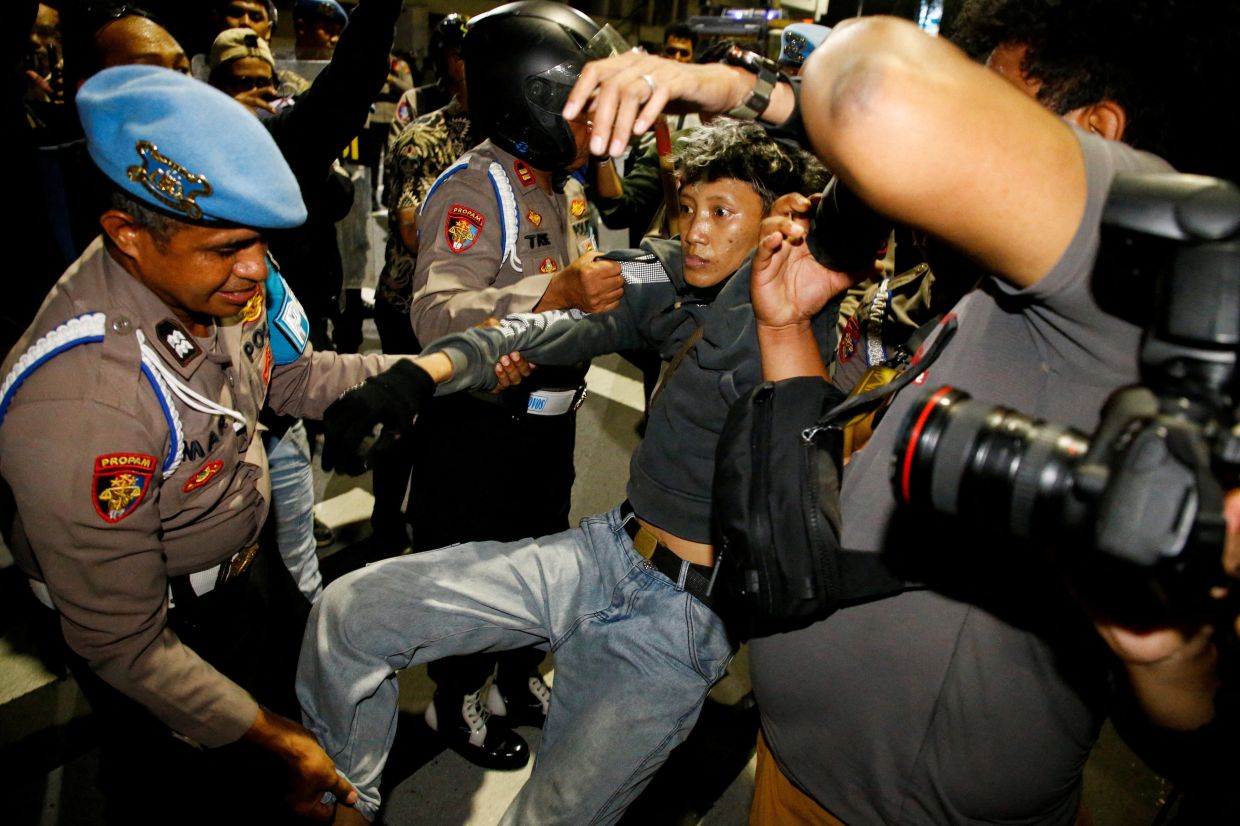
Indonesian police have formally charged four individuals in connection with an anti-government protest held in Surabaya, the nation's second-largest city, according to a statement released by local law enforcement on Sunday, June 28. The charges follow a demonstration on Friday that brought together approximately 100 people near a government building, marking one of several civil unrest incidents that have rippled across the archipelago in recent weeks as public frustration mounts over economic and social policies.
The Surabaya gathering represented broader discontent simmering throughout Indonesia's urban centres regarding two contentious government initiatives. Demonstrators expressed opposition to a substantial fuel price adjustment implemented earlier in June, which increased the cost of non-subsidised petrol by roughly 30 per cent. Simultaneously, protesters voiced concerns about a national free school meals programme that has become embroiled in scandal, with multiple accounts of contaminated food causing widespread illness among beneficiaries and allegations that public funds intended for nutrition support have been diverted through corrupt channels.
According to Surabaya police chief Luthfie Sulistiawan, the situation escalated when some participants began throwing objects at government infrastructure, including firecrackers and rocks, prompting law enforcement to implement what officials characterised as "firm actions" to clear the area and restore order. The police response resulted in the apprehension of 24 individuals on the day of the protest, though the vast majority were subsequently released without facing formal charges. The four individuals now charged face allegations of property destruction and assaulting police officers during the demonstration.
The investigation extends beyond those four formal charges. Authorities continue examining the cases of six additional detainees after drug screening detected controlled substances in their systems, adding a separate layer to the police inquiry. This broader enforcement approach underscores how authorities are treating the protests as involving multiple categories of alleged misconduct rather than purely political expression.
Indonesia's fuel subsidy adjustment emerged from compelling fiscal pressures bearing down on Southeast Asia's largest economy. The regional conflict in the Middle East has disrupted global energy markets, constraining crude oil supplies and driving up international prices. Despite Indonesia's status as an oil-producing nation, it remains a substantial net importer, meaning domestic energy costs rise alongside international benchmarks. Faced with mounting expenditure on fuel subsidies that drain the state treasury, the government made the politically contentious decision to allow market forces greater influence on pump prices for non-subsidised fuel grades.
The ripple effects of this economic decision have extended far beyond Surabaya's streets. In the capital Jakarta, student activists have mobilised demonstrations explicitly targeting both the fuel price increases and the government's signature free school meals initiative. These student-led movements reflect generational anxiety about the government's economic management and its ability to deliver on its welfare commitments without mismanagement or graft. For young Indonesians navigating a complex economy, the convergence of rising transport costs and tainted food safety scandals epitomises governmental dysfunction.
The free school meals scheme itself has become a symbol of institutional failure rather than social progress. Originally promoted by Jakarta as a mechanism for addressing childhood malnutrition and improving educational outcomes, the programme has instead become associated with mass food poisoning incidents. Since its launch, tens of thousands of students and their families have fallen ill after consuming meals distributed under the scheme, generating headlines globally and eroding public confidence in state administration. Compounding health concerns, investigative journalism and official inquiries have uncovered evidence that significant portions of allocated budgets have disappeared through embezzlement and bid-rigging by connected contractors and officials.
The government's response has involved partial suspension of the programme, a tacit admission that implementation mechanisms have broken down catastrophically. However, suspension rather than fundamental reform or genuine accountability has only deepened public scepticism about whether leadership genuinely prioritises citizen welfare. For Malaysian observers, Indonesia's experience offers instructive parallels regarding the challenges that afflict large developing economies when welfare expansion outpaces institutional capacity and anti-corruption mechanisms.
These protests must be understood within Indonesia's broader political economy. Fuel subsidies have long represented a contentious policy space, as removing them invariably triggers public backlash whilst maintaining them creates unsustainable fiscal drains. Previous administrations have struggled with this exact calculus, and the current government's decision reflects a judgment that fiscal consolidation now outweighs electoral costs. The concentration of unrest in major urban centres suggests that educated, middle-class Indonesians—those most aware of fiscal constraints and most capable of organising collective action—have concluded that government mismanagement spans multiple policy domains simultaneously.
Regional analysts tracking Indonesia's stability will note that these protests, while significant, have remained localised and have not escalated into coordinated national uprisings. This suggests that whilst grievances are real, they have not yet coalesced into a unified opposition capable of challenging government legitimacy fundamentally. The government's willingness to use police force to disperse demonstrations, coupled with selective prosecution of protest participants, indicates official determination to prevent escalation. Whether this approach proves adequate to manage accumulating discontent over the coming months will partly depend on whether food safety crises continue and whether fuel prices stabilise.
For Southeast Asia more broadly, Indonesia's experience underscores the political risks accompanying fiscal adjustment in welfare-dependent systems. Policymakers across the region contemplating subsidy reform or programme restructuring should observe how public anger crystallises not merely around individual policies but around perceptions of systemic dysfunction and leadership incompetence. The convergence of multiple policy failures—fuel pricing, food safety, and corruption—creates a volatile political environment that even capable governments struggle to navigate successfully.

