Indonesian law enforcement has successfully broken apart an international drug trafficking operation centred in Batam that relied on Malaysian suppliers to funnel narcotics into the Riau Islands. The National Narcotics Agency (BNN) and the Customs and Excise Directorate General announced the operation on Friday, revealing the arrest of six Indonesian nationals connected to the ring while intensifying the hunt for two Malaysian men identified as SL and WKC, believed to be the primary architects supplying etomidate and other dangerous substances to the Batam network.
The investigation began when Customs officers inspecting arriving parcels at Soekarno-Hatta International Airport in Jakarta discovered an apparently innocuous shipment labelled as Orange Fiber Xtra food supplement. Routine laboratory analysis at the Customs and Excise Laboratory (BLBC) in Jakarta exposed a calculated deception: the package concealed 3,4-Methylenedioxymethamphetamine (MDMA), ketamine, and additional controlled substances. This discovery prompted authorities to coordinate a comprehensive joint operation tracing the shipment's destination and distribution network.
According to Insp. Gen. Aswin Sipayung, the BNN's deputy for enforcement, the syndicate exhibited hallmarks of professional criminal organisation, demonstrating sophisticated knowledge of supply chains, concealment techniques, and distribution logistics. The operation functioned as a complete ecosystem, with members managing illicit border crossings through unregistered ports, repackaging contraband into civilian packaging to evade detection, and systematically distributing drugs throughout the Riau Islands. This structural sophistication suggests coordination at multiple organisational levels, with the Malaysian suppliers providing wholesale quantities while Indonesian operatives managed retail-level street operations.
The investigation moved quickly after authorities apprehended a suspect identified as BAP at Batam on Wednesday as he prepared to receive the intercepted package. His interrogation yielded critical intelligence that accelerated subsequent arrests. Officers rapidly moved to a Baloi hotel where they detained ED, identified as the individual who ordered the shipment, alongside NC and TFS. The coordinated arrests reflected the effectiveness of intelligence-gathering during the initial interrogation, allowing authorities to map the network's immediate contacts before suspects could alert associates or destroy evidence.
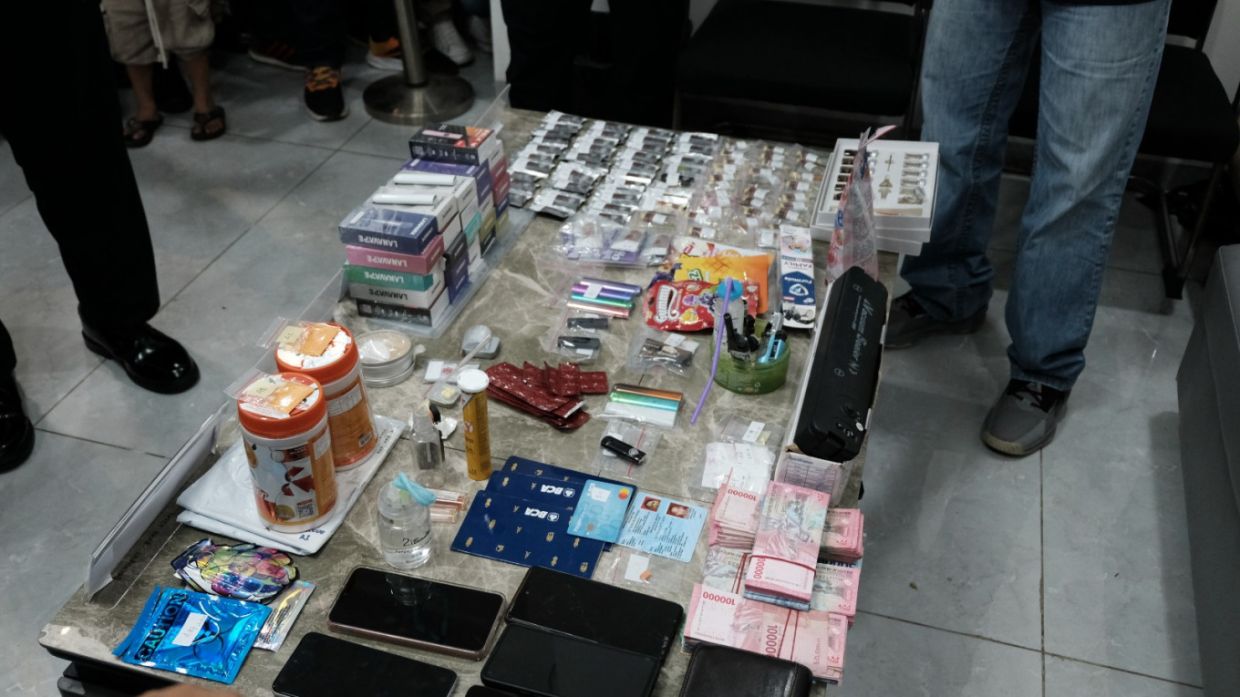
Raids on four separate locations uncovered an extensive inventory of narcotics and distribution infrastructure. At an apartment in Teluk Tering belonging to TFS and a shophouse in Batu Ampar's Sakura Garden area, officers discovered dozens of electronic cigarette cartridges filled with etomidate, sabu (methamphetamine), Happy Five (H5) tablets, and sachets containing Happy Water drinks. The utilisation of vape technology for etomidate distribution represents an evolution in smuggling tactics, exploiting regulatory gaps surrounding electronic nicotine delivery devices. Officers also recovered 1,076.18 grams of MDMA, 50 grams of sabu, 25.6 grams of ketamine powder, alongside 86 H5 tablets, 10 ecstasy pills, and 170 etomidate-filled vape cartridges, along with paraphernalia and weighing scales indicating commercial-scale operations.
Parallel to these arrests, Customs officers at Batam Centre International Ferry Terminal interdicted a separate smuggling attempt, intercepting 48 etomidate cartridges from a Malaysian passenger identified as PS who had just arrived from Stulang Laut International Ferry Terminal in Johor Bahru. This seizure demonstrates the porous maritime border between Johor and Batam, where smaller-scale smugglers operate independently or as freelancers supplying retail networks. The incident underscores how narcotics trafficking exploits existing ferry infrastructure designed for legitimate passenger movement, with individual couriers transporting contraband across official border checkpoints.
The syndicate's operational tradecraft relied heavily on deception and misdirection. Narcotics and etomidate cartridges were deliberately packaged inside dried food products and food supplement sachets, which were then professionally resealed using plastic devices to maintain the appearance of legitimate commercial goods. This strategy exploits the sheer volume of food and health products crossing international borders daily, making detection exponentially more difficult for customs inspectors relying on visual inspection. By embedding contraband within seemingly innocuous categories of goods, traffickers reduce the likelihood that packages trigger the laboratory testing that ultimately exposed this particular shipment.
Beyond the narcotics themselves, authorities seized four vehicles—a Toyota Alphard van, Toyota Agya hatchback, Chery SUV, and two motorcycles—indicating the syndicate's capacity for ground logistics and distribution. These vehicles likely served multiple functions: transporting bulk shipments from entry points to storage locations, facilitating retail distribution to dealers and consumption venues, and providing mobile platforms for street-level transactions. The seizure of such assets represents a significant financial blow to the operation, as replacement vehicles require capital reinvestment.
Agung Widodo, head of the Batam Customs and Excise Office, estimated the enforcement action prevented potential harm equivalent to 6,770 individuals requiring rehabilitation, with associated public healthcare costs totalling approximately Rp10.8 billion (US$599,000). This calculation reflects Indonesia's growing concern about drug-driven public health burdens, particularly given etomidate's status as a novel psychoactive substance increasingly prevalent in Southeast Asian markets. The availability of etomidate in vape cartridges presents particular challenges for regulators, as this delivery mechanism obscures the substance's presence and appeals to younger consumers.
The investigation continues exploring potential connections between this syndicate and a factory raided separately by BNN and Customs officers in Batam, suggesting the possibility that arrested individuals were merely distribution nodes within a larger manufacturing ecosystem. If confirmed, this connection would indicate more elaborate operations than initially apparent, with in-country production supplementing Malaysian imports. The two Malaysian suspects remain at large and formally on the wanted list, with authorities evidently deploying transnational law enforcement channels to locate them.
The charged suspects face prosecution under multiple sections of Indonesia's Law No. 35/2009 on Narcotics, specifically Article 114(2) in conjunction with Article 132(1), and Article 112(2) in conjunction with Article 132(1). These provisions carry sentences ranging from five years' imprisonment to capital punishment, with fines up to Rp10 billion. The severity of potential penalties reflects Indonesia's hardline approach to narcotics trafficking, particularly cases involving international dimensions and commercial-scale operations. The case underscores how Malaysian-sourced drugs continue flowing into Indonesia via maritime routes and ferry terminals, presenting ongoing challenges for regional law enforcement cooperation despite improved coordination mechanisms between neighbouring agencies.

