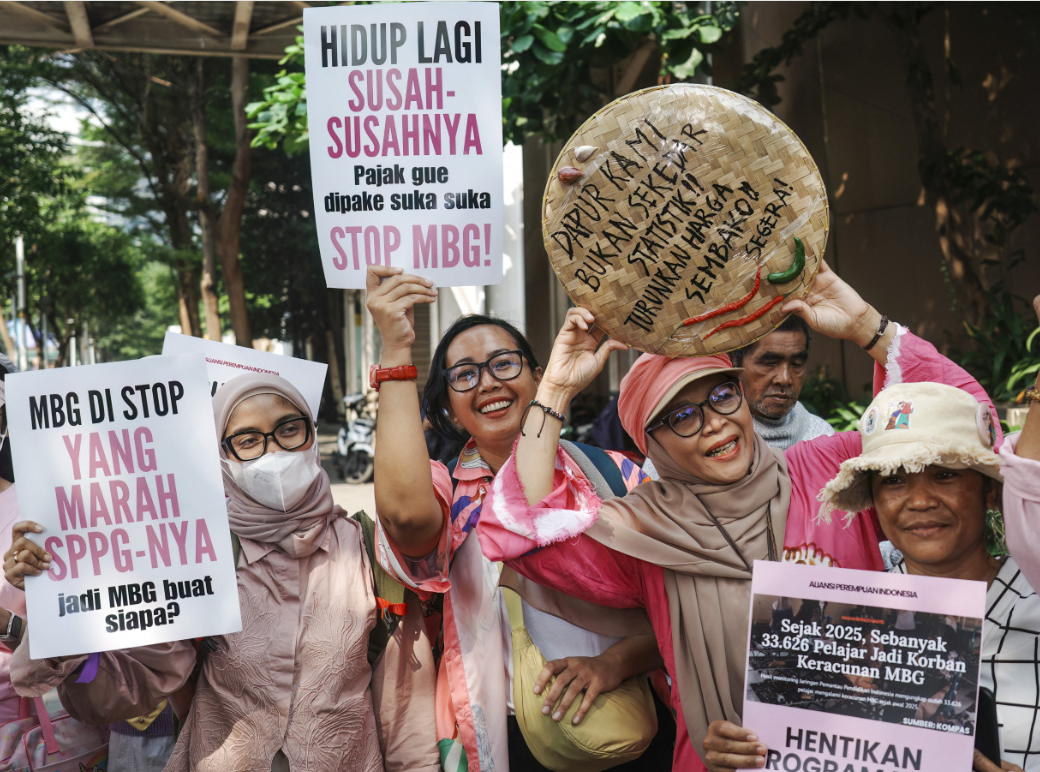
President Prabowo Subianto's signature nutritious meal programme, designed to address childhood stunting across Indonesia, faces a mounting crisis of public confidence as beneficiaries and advocates openly question whether the multi-billion-dollar initiative delivers genuine value. Rather than remaining silent, some recipients are taking the unprecedented step of declining the free meals entirely, signalling that they would rather forgo government assistance than accept what they perceive as substandard nutrition for their children. This shift in beneficiary sentiment reveals deeper fractures in how the programme has been implemented, and raises fundamental questions about whether Indonesia's investment in child nutrition is achieving its stated aims or simply transferring public resources to poorly-managed service providers.
The crisis crystallised around a particularly striking incident when Nesti Nagari, a mother from Kediri in East Java, posted images of her eight-month-old baby's allocated meal—described as an unidentifiable clump of white paste—on social media. The photograph resonated sharply with other parents, accumulating over 11,000 engagements within hours and sparking broader conversation about the quality of meals being distributed. Nagari's response was decisive: she fed the meal to her chickens and withdrew from the programme, explaining to journalists that she possessed the means to provide adequate nutrition for her child and saw no value in accepting substandard government food. Her public rejection of the assistance challenged the underlying assumption that all beneficiaries lack alternatives, and highlighted how poor implementation can undermine even well-intentioned policy design.
Another beneficiary, Diah Farika from Semarang in Central Java, documented a pattern of deteriorating meal quality across several months of participation. She submitted photographs showing portions she considered nutritionally inadequate alongside an unripe orange, and described how her repeated concerns to the nutrition fulfillment service unit responsible for meal preparation were dismissed without meaningful response. Despite initially supporting the programme's objective, Farika concluded that the execution was fundamentally broken. She became vocal in advocating for a temporary suspension, arguing that the National Nutrition Agency should conduct comprehensive inspections of all 27,000 kitchens currently operating before resuming service. Her position reflects a pragmatic assessment: the idea is sound, but the kitchen management systems require overhaul before the programme can be trusted with children's nutrition.
These individual cases have catalysed broader institutional criticism. On Thursday, dozens of women's rights activists organised under the Indonesian Women's Alliance staged a coordinated rally in Central Jakarta demanding that the government halt the programme and conduct a thorough review. The demonstration signalled that concerns about meal quality and programme integrity extend beyond isolated complaints to form a cohesive advocacy position. This public pressure comes at a sensitive moment for the Prabowo administration, which has positioned the free meal initiative as a flagship anti-poverty measure and a demonstration of commitment to social welfare spending.
The programme's financial scale intensifies scrutiny of its shortcomings. The 2026 budget was originally allocated at Rp 335 trillion, equivalent to approximately US$18.74 billion, before being reduced to Rp 268 trillion following public pressure regarding the programme's cost and implications for education funding. This represents one of Indonesia's largest single social interventions, making inefficiency or poor targeting a matter of substantial national concern. The Centre of Economic and Law Studies released research estimating that around 34 per cent of current beneficiaries—approximately 61 million children and pregnant women—do not actually fall within the groups most requiring government assistance, including households with adequate economic security and existing nutritional sufficiency. This finding suggests that approximately one-third of the allocated budget may be reaching recipients who could meet their needs through market mechanisms or existing household resources.
A recent corruption scandal involving former National Nutrition Agency leadership has compounded institutional credibility problems. The agency's new leadership responded by halting further expansion of the kitchen network, prompting significant anxiety among private operators and investors. Dozens of service providers reportedly visited the agency's offices seeking assurances about the programme's future and demanding guarantees regarding return on investment, given that many had committed hundreds of billions of rupiah to establish infrastructure. Some kitchens experienced temporary closures in early June due to delayed funding disbursements, creating operational uncertainty and further undermining public confidence in programme sustainability. These behind-the-scenes tensions reveal an investment ecosystem that may have become more focused on commercial returns than nutritional outcomes.
MBG Watch, an independent oversight platform established by civil society organisations, has documented how these compounding problems have systematically eroded public trust. Isnawati Hidayah, a policy researcher at the Centre of Economic and Law Studies and one of MBG Watch's initiators, articulated the central question now animating public debate: what exactly is this enormous budget actually delivering, and who ultimately benefits from its expenditure? This formulation shifts focus from abstract programme design to concrete outcomes, asking whether resources are genuinely reaching vulnerable children or becoming lodged within service provider networks. The question resonates particularly in a Southeast Asian context where infrastructure corruption and elite capture of social programmes remain persistent governance challenges.
In response to mounting criticism, the National Nutrition Agency has initiated corrective measures centred on beneficiary targeting refinement. Deputy head and spokesperson Agustina Arumsari announced that the agency is narrowing the beneficiary pool by removing recipients deemed capable of meeting nutritional needs independently. As of Thursday, 76 schools across Java had been dropped from the programme, affecting more than 39,000 beneficiaries. Simultaneously, the agency is implementing austerity measures including elimination of daily kitchen incentives during non-operational periods and performance reviews targeting underperforming facilities. These adjustments suggest acknowledgement of the programme's operational problems, though they address symptoms rather than addressing the underlying structural issues that allowed poor implementation to persist across thousands of kitchens.
The beneficiaries' willingness to forgo assistance if quality cannot be assured presents a particular challenge to programme defenders. Rather than demonstrating disengagement from social support, this stance reflects a sophisticated assessment that accepting poor-quality assistance may represent worse value than relying on existing household resources or market alternatives. Mothers like Nagari and Farika are articulating a preference for either genuine improvement or honest programme termination over continued participation in what they perceive as a broken system. This perspective should inform Indonesia's policy response, as it suggests that maintaining a large but poorly-implemented programme may ultimately damage public support for social spending more significantly than acknowledging failures and undertaking genuine reform.
For Malaysia and other Southeast Asian economies, Indonesia's experience offers instructive lessons regarding the implementation challenges facing large-scale social programmes. Even well-resourced initiatives with clear mandates and substantial budgets can falter when quality control mechanisms, institutional accountability, and beneficiary input structures are inadequate. The Indonesian case demonstrates that programme scale and per-beneficiary cost matter less than whether actual service delivery matches policy intentions. As Malaysia considers its own approaches to addressing childhood nutrition, stunting prevention, and targeted social assistance, the Indonesian experience suggests that implementation quality, transparent kitchen management, responsive complaint mechanisms, and meaningful beneficiary participation warrant as much policy attention as budget allocation.

