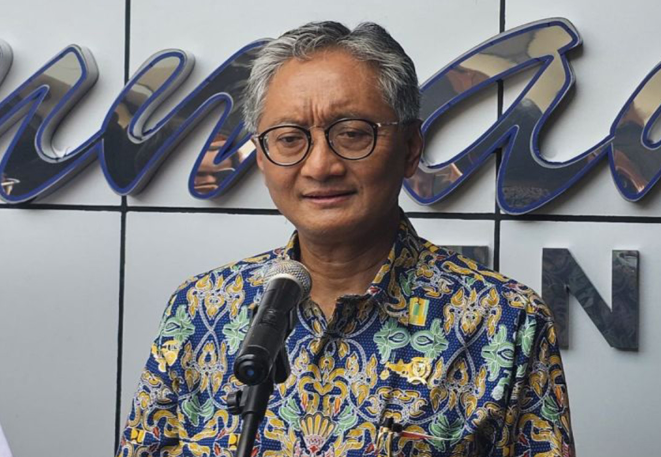
Indonesia's Public Works Ministry faces mounting internal instability after the public exposure of a document listing Minister Dody Hanggodo's wife and daughter among delegates scheduled to attend a United Nations meeting in New York from July 13 to 19. The revelation has ignited a political firestorm, with allegations of misuse of state resources dominating public discourse and prompting the ministry to cancel the trip entirely. The incident has become emblematic of deeper governance challenges within one of the country's most critical infrastructure agencies.
The controversy began when a ministry letter bearing the signature of secretary-general Apri Artoto, dated June 29, circulated on social media in early July. The document identified eight officials designated to participate in the UN gathering scheduled for July 16 and 17, but notably among the names were Irma Hermawati, the minister's wife, and Aurellia Tsabitha Meidirama, his daughter. This inclusion prompted swift public backlash on social media platforms, with critics questioning the propriety of family members attending an official government delegation and whether taxpayer money would support their participation. The mounting pressure forced the cancellation of what was intended to be an important international engagement for the ministry.
Despite the public controversy, Ministry officials offered explanations for the family members' inclusion. Apri stated during a press briefing on July 7 that Irma and Aurellia were listed to expedite visa application procedures through the Foreign Ministry's intervention, a common administrative practice in Indonesian bureaucracy. He further asserted that state funds would not finance the family members' presence at the meeting, attempting to deflect accusations of financial impropriety. However, these clarifications failed to quell public anger, and Apri pledged to investigate the leak's source while threatening legal action against any ministry employee responsible for publicizing the document.
The aftermath of the leaked document has triggered what appears to be a sweeping retaliation campaign within the ministry's ranks. Social media posts proliferated with allegations that Dody had ordered the reassignment of numerous officials to regional postings, predominantly outside Java, purportedly as punishment for the leak. When confronted by reporters on Wednesday, Dody acknowledged the transfers but categorically denied they represented retaliatory measures. His defensive response—"I have 38,600 employees, why shouldn't I be allowed to reassign them?"—suggested irritation at the suggestion that his personnel decisions warranted scrutiny, yet the timing and scope of the reassignments have fueled speculation about their true motivation.
The current turbulence represents merely the latest chapter in Dody's tumultuous tenure since assuming office in October 2024. The 60-year-old Democratic Party politician, whose background spans engineering and business connections to South Kalimantan entrepreneur Andi "Haji Isam" Syamsuddin Arsyad, has orchestrated multiple waves of personnel restructuring. Social media compilations have documented over 100 employee reassignments during his leadership, ranging from prominent director-general positions to lower-ranking civil service posts. This pattern of continuous reorganization has created an atmosphere of institutional instability that observers fear may undermine the ministry's capacity to execute essential infrastructure programs.
The most recent major reshuffle occurred in May when Dody implemented extensive changes at the secretariat level, including elevating Apri to secretary-general. This appointment replaced Wida Nurfaida, who had occupied the position for less than a year following an earlier restructuring in July 2025. The rapid succession of leadership changes at such a critical administrative position indicates either persistent problems within the ministry that Dody believes require constant intervention, or organizational instability stemming from his management approach. Either interpretation raises concerns about the ministry's ability to function effectively during periods of leadership uncertainty.
Legislators monitoring the ministry have grown increasingly alarmed by the frequency and severity of the reshuffles. During a House of Representatives Commission V meeting in June focused on infrastructure oversight, Yasto Soepredjo Mokoagow from the Indonesian Democratic Party of Struggle (PDI-P) voiced concerns that disciplinary actions, including demotions from senior roles to non-structural positions, have created widespread anxiety among civil servants. His observation that "civil servants at the ministry are now afraid to carry out programs" reflects a troubling erosion of institutional morale and suggests that personnel instability may be translating into operational paralysis. This dynamic represents a significant threat to program implementation across Indonesia's crucial infrastructure sector.
Dody has publicly attributed the organizational turbulence to what he characterizes as a "deep state" within the ministry, employing the metaphor of termites undermining the institution's structural integrity. This framing justifies his continuous restructuring efforts as necessary purges of entrenched bureaucratic interests. However, critics interpret such explanations as potentially masking either incompetent management or an authoritarian approach to oversight that prioritizes loyalty over competence. The lack of transparency regarding the criteria for reassignments and the absence of clear institutional reform objectives have deepened parliamentary skepticism about the minister's governance philosophy.
Simultaneously, the ministry has grappled with serious corruption allegations affecting senior personnel. The Jakarta High Prosecutor's Office named multiple suspects in June related to investigations into water resources projects, including former water resources director general Dwi Purwantoro and former acting irrigation director Yosiandi Radi Wicaksono. When confronted with news of the suspect designations, Dody pledged to neither protect wrongdoers nor interfere with law enforcement investigations targeting his subordinates. This commitment to transparency regarding corruption cases stands in stark contrast to the opacity surrounding his personnel decisions, creating an inconsistent approach to institutional accountability that has further damaged public confidence.
The minister's handling of staff interactions has also attracted negative scrutiny. Video footage circulating on social media captured Dody reprimanding a subordinate during an April site visit to a school construction project in East Java, with the minister visibly pointing and referring to the employee's explanations as "dumb excuses." Such interactions, amplified across digital platforms, have reinforced perceptions of an abrasive leadership style that may contribute to the institutional anxiety reported by parliamentary observers. For Malaysian observers monitoring Indonesian governance, these developments illustrate how personnel management crises can cascade into broader questions about institutional effectiveness and leadership legitimacy.
The convergence of the family travel scandal, extensive personnel reshuffles, corruption investigations, and documented instances of harsh staff management has created a perfect storm of institutional instability within Indonesia's Public Works Ministry. As the nation pursues ambitious infrastructure development goals requiring sustained bureaucratic coordination and expertise, the ministry's internal dysfunction poses risks to project implementation timelines and quality. Whether Dody's restructuring efforts ultimately strengthen institutional capacity or exacerbate organizational dysfunction will depend on whether the reassignments produce genuine improvements in ministry performance or merely reflect personalistic power consolidation at the expense of meritocratic governance.

