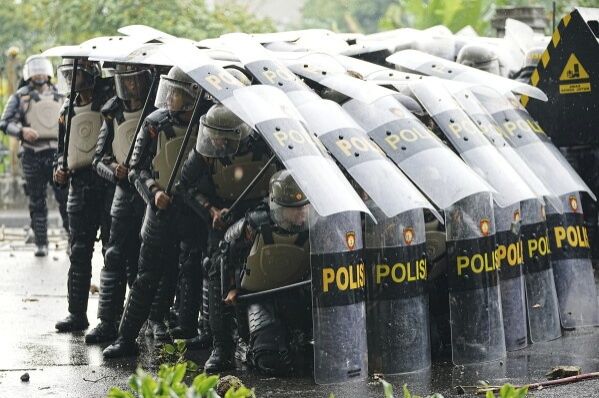
Indonesia's security establishment faces mounting strain following a series of dramatic police raids across Jakarta that have exposed fault lines between law-enforcement agencies and drawn scrutiny to one of the country's most powerful prosecutors. The operations, which netted gold bars, cash and foreign currencies worth tens of millions of dollars, have triggered a broader crisis of institutional confidence at a moment when the newly inaugurated Prabowo administration is still establishing its governing priorities.
The police operations, conducted over the course of a week, targeted multiple locations as part of interconnected investigations into corruption and money laundering. Officers seized rupiah and foreign currency exceeding $3 million from a concealed safe standing two metres high at a South Jakarta restaurant, along with additional funds from an adjacent money-changing business. A separate search of a residential property in the southern suburbs yielded 74 kilograms of gold bars, foreign currencies and cash distributed across seven locked suitcases within a safe, bringing that single haul to approximately $26.3 million. Police connected these discoveries to at least three distinct investigative threads, including alleged irregularities in coal procurement affecting power-generation facilities that have recently caused widespread blackouts, suspected misconduct in legal proceedings tied to state insurers Asabri and Jiwasraya, and financial irregularities surrounding Krakatau Steel debt settlements.
The most combustible element of the operation centred on the residence of Deputy Attorney General for Special Crimes Febrie Adriansyah, whose office oversees the Attorney General's prosecution unit responsible for pursuing Indonesia's highest-stakes corruption cases. Febrie commands significant institutional authority, having directed investigations into prominent entities including state mining concern Timah, oil giant Pertamina and the national carrier Garuda Indonesia, while also investigating former education minister Nadiem Makarim and scrutinising the Prabowo administration's flagship free-meals initiative. His involvement intensified the political temperature surrounding the raids, transforming what might have been routine police work into a statement about accountability at the apex of the state apparatus.
The subsequent deployment of armed military personnel to Febrie's Jakarta property marked a decisive escalation in the standoff. Military authorities framed the move as a protective measure, citing established protocols for safeguarding prosecutors and claiming the decision emerged at the Attorney General's Office request. This characterisation, however, rang hollow to observers alert to the symbolic weight of uniformed troops encircling a senior judicial official's home during an active investigation. The optics suggested either defensive positioning against police operations or a boundary-setting exercise intended to signal institutional solidarity within the prosecution service.
Febrie responded to the discovery of assets at his property with a carefully calibrated statement acknowledging ownership of the residence while categorically denying any connection to the seized valuables. He emphasised that the Attorney General's Office respected the investigative process and awaited police conclusions, while simultaneously cautioning against premature judgements based on social media speculation or media reports. His invocation of the presumption of innocence carried particular resonance given his position as architect of the prosecution apparatus, and implicitly framed the investigation as a challenge to institutional independence rather than a routine criminal matter.
President Prabowo's public commentary on Friday offered a characteristically indirect intervention, veiled within remarks delivered while inaugurating a dam project on Lombok island. He exhorted military officers, police personnel, government officials and prosecutors to reflect upon their constitutional purpose, reminding them that their authority and symbols of office ultimately derived from the people they served. The president's specific inclusion of the Attorney General's Office in this admonition suggested awareness of the brewing institutional confrontation, while his broader appeal to institutional humility appeared designed to lower temperatures without directly addressing the substance of the investigations.
Civil society organisations seized upon the military deployment as evidence of a dangerous trajectory. Amnesty International Indonesia warned that the stationing of armed troops risked fundamentally corroding civilian supremacy—a foundational principle of Indonesia's constitutional order—while simultaneously compromising the credibility of law-enforcement institutions. The international human rights group called for explicit assurances that investigators would face no harassment, intimidation or obstruction, implicitly questioning whether such safeguards currently existed.
Expert analysis from within Indonesia's policy community underscored deeper structural pathologies beneath the surface controversy. Nicky Fahrizal, a researcher at the Jakarta-based Center for Strategic and International Studies, characterised the unfolding standoff as symptomatic of broader institutional decay across the security sector, warning that continued escalation would accelerate what he termed a "creeping militarization" of civilian law enforcement. His assessment suggested that this confrontation, rather than representing an isolated episode, exemplified systemic vulnerabilities in Indonesia's democratic governance architecture. Should such tensions persist and intensify, Fahrizal cautioned, public and investor confidence in the foundations of Indonesian rule of law would deteriorate precipitously, with consequences extending far beyond immediate law-enforcement jurisdictions.
The raids and subsequent military response arrive at a delicate juncture for the Prabowo administration, which has positioned itself as an anti-corruption government committed to institutional reform. Yet the visible friction between police and prosecution services, mediated by military intervention, sends contradictory signals about whether the administration intends to rationalise Indonesia's fractious security architecture or merely to manage competing power centres. For Malaysian observers and regional investors monitoring Indonesia's institutional stability, these developments carry sobering implications about the durability of democratic safeguards in Southeast Asia's largest economy.
The unfolding controversy also highlights the persistent vulnerability of Indonesia's prosecution service to political pressures and institutional competition. Febrie's prominent role investigating cases touching the presidential administration—from free-meals programmes to mining operations—may itself illuminate the underlying dynamics driving the police action. Whether the raids represent genuine corruption investigation or a strategic repositioning of institutional power within the security apparatus remains unclear, but the ambiguity itself constitutes the central problem. Until Indonesia's security agencies establish transparent protocols for managing inter-institutional conflicts and investigations, public confidence will continue eroding, undermining both democratic accountability and institutional legitimacy across the region.

