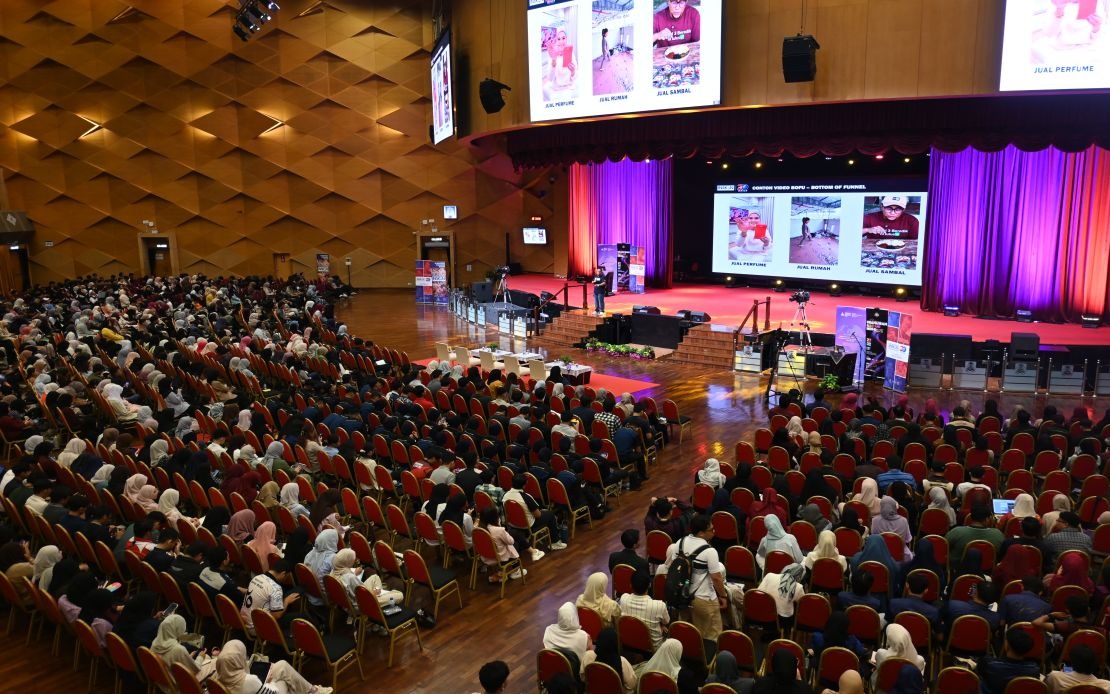
A landmark entrepreneurship summit held at Universiti Teknologi MARA's Shah Alam campus has set a new national record for student participation. The Usahawan MADANI Mega 2026 seminar, organised by the National Entrepreneurship Institute (INSKEN) alongside the Malaysian Academy of SME and Entrepreneurship Development and UiTM itself, drew 6,877 participants across physical and online venues on June 23. The Malaysia Book of Records formally recognised the event as the largest student turnout for an entrepreneurship seminar in the nation's history, signalling a significant shift in how Malaysia's younger generation views business creation as a viable career pathway.
The scale of participation reflects deepening enthusiasm among university students for entrepreneurial pursuits at a time when Malaysia is positioning itself as a regional innovation hub. Datuk Mohamad Alamin, deputy minister for Entrepreneur and Cooperatives Development, attended the event and remarked that such strong engagement demonstrates entrepreneurship's rising appeal among the youth. He contextualised this enthusiasm within Malaysia's broader economic strategy, noting that starting and scaling businesses has become integral to national prosperity in an increasingly globalised marketplace where traditional employment pathways face disruption.
The government's commitment to nurturing entrepreneurial talent extends beyond one-off seminars. Through the Ministry of Entrepreneur and Cooperatives Development, the MADANI administration has outlined a multifaceted approach to building what officials term an inclusive, sustainable, and high-impact entrepreneurial ecosystem. This strategy encompasses capacity-building programmes that equip founders with practical skills, financing mechanisms to unlock capital for ventures, market access initiatives connecting entrepreneurs with customers and suppliers, digitalisation support helping businesses compete online, and comprehensive business development assistance spanning strategy through scaling. Such infrastructure addresses a persistent gap where Malaysian entrepreneurs—particularly those from younger cohorts—often struggle to translate ideas into sustainable enterprises without institutional backing.
Entrepreneurs create jobs, strengthen domestic supply chains, and drive the innovation essential for Malaysia to compete globally. Datuk Mohamad Alamin emphasised these economic contributions whilst addressing seminar participants. Beyond their direct economic impact, successful founders inspire others and demonstrate that self-employment offers genuine alternatives to corporate careers. This cultural dimension matters deeply; when students see peers launching successful ventures, entrepreneurship shifts from abstract concept to attainable reality. The record-breaking attendance suggests this cultural narrative is resonating across Malaysian universities.
Insken's board chairman, Datuk Mustaffa Kamil Ayub, articulated a vision extending beyond entrepreneurship as mere career choice. Instead, he framed it as a mindset and movement capable of reshaping Malaysia's economic trajectory. This distinction carries weight: treating entrepreneurship as an isolated professional option differs fundamentally from embedding it as cultural norm. Countries succeeding in the startup economy—from Singapore to South Korea—have invested precisely in this cultural shift, making business creation respectable, celebrated, and accessible. Malaysia's push toward such cultural transformation, evident in the seminar's scale and government backing, suggests recognition of this principle.
The seminar's curriculum centred on the MOFA approach, a pedagogical framework addressing four fundamental business dimensions: marketing, operations, finance, and business administration. Rather than generic motivational content, MOFA grounds entrepreneurship education in concrete operational realities. Founders learn how to identify and reach customers, manage production and logistics, structure finances and manage cash flow, and establish administrative systems enabling scalability. For students with little business experience, this practical grounding proves invaluable. The framework acknowledges that entrepreneurial success depends less on inspiration than on disciplined execution across multiple domains simultaneously.
INSKEN's broader programme portfolio complements the seminar's immediate impact. The institute continues rolling out specialised initiatives including the INSKEN Masterclass offering advanced training to promising founders, BANGKIT providing accelerated development for growth-stage ventures, and PROTÉGÉ connecting entrepreneurs with mentors possessing deep industry experience. These programmes create a pipeline supporting founders from initial concept through scaling. Few countries succeed in entrepreneurship without such scaffolding; isolated seminars generate enthusiasm but rarely translate into sustained venture creation. Malaysia's structured approach increases probability that SUM MEGA 2026's 6,877 participants convert interest into action.
The event also highlighted collaboration between previously siloed stakeholders. Government agencies, universities, financial institutions, business development organisations, and industry players gathered to align around shared entrepreneurship goals. Such coordination addresses chronic mismatches where entrepreneurs lack bank financing, banks lack entrepreneurs meeting lending criteria, and government support remains fragmented across competing programmes. When government, finance, and industry operate in concert, friction diminishes and entrepreneurial ecosystems function more efficiently. Malaysia's initiative to orchestrate this collaboration suggests policy maturation around entrepreneurship development.
The timing aligns with Malaysia's National Entrepreneurship Policy 2030, a long-term strategic blueprint aiming to establish entrepreneurship as central to national economic identity. SUM MEGA 2026 functions as concrete manifestation of this ambition, translating policy into lived experience for thousands of students. Whether this cohort converts participation into actual venture creation will determine whether the event constitutes genuine impact or merely impressive attendance figures. Malaysian policymakers understand this distinction; programmes measuring success purely through participation metrics tend toward hollow performance.
For Southeast Asian observers, Malaysia's push toward mass entrepreneurship education offers instructive lessons. The region hosts over 700 million people and remains significantly underpenetrated by digital business models, fintech, and modern supply chain approaches. Countries cultivating entrepreneurial cultures—particularly among youth—position themselves to capture disproportionate regional economic growth. Malaysia's record-setting seminar demonstrates that appetite for entrepreneurship exists among younger Malaysians; the challenge now involves converting this enthusiasm into sustainable venture creation and job generation at sufficient scale to justify the investment.

