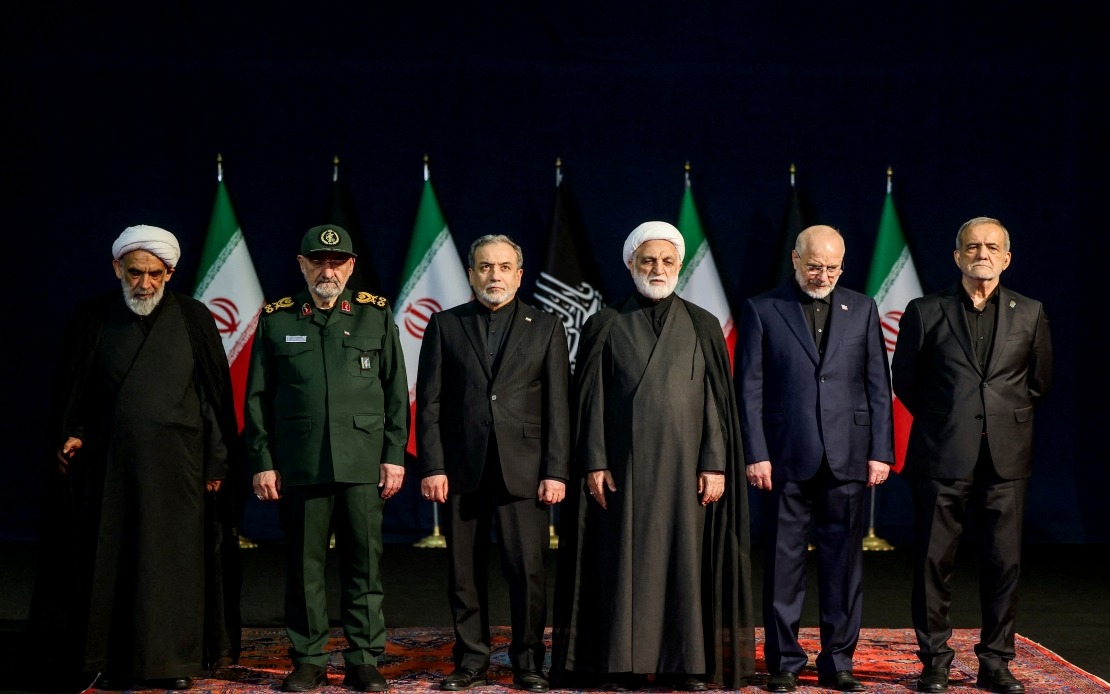
Iran's political establishment and a constellation of regional leaders assembled in Tehran on Friday to honour Ayatollah Ali Khamenei, the nation's Supreme Leader who was killed in a military strike earlier this year. The ceremony, held at Imam Khomeini's Mosalla prayer hall in central Tehran, represented one of the most significant gatherings of Iran's ruling hierarchy alongside an exceptional display of international diplomatic presence.
The domestic participation underscored the continuity of Iran's governance structures during a period of transition. President Masoud Pezeshkian, Parliament Speaker Mohammad Baqer Qalibaf, and Judiciary Chief Gholamhossein Mohseni-Ejei all attended the proceedings, alongside Sadeq Amoli Larijani, who chairs the Expediency Discernment Council—a body tasked with arbitrating disputes between the executive and legislative branches. The breadth of attendance from Iran's senior institutions suggested efforts to project governmental stability and unified leadership following the February incident that claimed Khamenei's life.
The international dimension of the ceremony reflected Iran's enduring diplomatic relationships across South Asia, the Caucasus, and the broader Middle East. Pakistan's representation was particularly notable, with Prime Minister Shehbaz Sharif and Chief of Army Staff Field Marshal Syed Asim Munir both present, signalling continued commitment to the Iran-Pakistan partnership despite regional tensions. The attendance of Armenian Prime Minister Nikol Pashinyan and Georgian President Mikheil Kavelashvili indicated engagement with post-Soviet states where Iran maintains significant geopolitical influence. Iraq's participation, through both President Nizar Amedi and Kurdistan Region President Nechirvan Barzani, underscored Tehran's centrality to Iraqi politics and security arrangements.
Major power brokers also sent delegations, with senior officials from both China and Russia attending—reflecting the triangular dynamics that have increasingly defined Middle Eastern geopolitics. Moscow and Beijing's presence acknowledged Iran's role within their respective spheres of influence, particularly as sanctions and international isolation have pushed Tehran closer to these powers. The gathering thus functioned simultaneously as a domestic ritual and a statement of Iran's continued relevance within complex networks of regional and global engagement.
Beyond formal state representatives, the ceremony drew a diverse assembly of religious scholars, tribal leaders, and community figures, reflecting Iran's hybrid political system that blends theocratic and democratic institutions. This broader participation served to demonstrate that Khamenei's authority extended across multiple layers of Iranian society, from secular governmental structures to religious institutions to traditional tribal arrangements.
Khamenei's death on February 28 resulted from a coordinated strike attributed to the United States and Israel, marking one of the most dramatic escalations in decades-long tensions between Iran and Western powers. His passing triggered an unprecedented succession process, culminating in March with the selection of his son, Mojtaba Khamenei, as the new Supreme Leader. This dynastic transition represented a departure from previous successions and raised questions about institutional stability that the public commemoration sought to address through displays of governmental coherence and continuity.
The ceremonial schedule extended far beyond the Friday gathering. Planners announced that funeral rites would continue through July 9, with additional processions scheduled for Qom and Mashhad—Iran's most significant religious centres—as well as commemorative events in Iraq, reflecting both Khamenei's influence within Shia Islam and Iran's ties to Iraqi religious establishments. Iranian authorities implemented extraordinary security and logistical measures, declaring public closures and airspace restrictions in Tehran and Mashhad on key dates, while designating Thursday as a national day of mourning to allow broader public participation and grief.
For Malaysian and Southeast Asian observers, the ceremony illuminated the organisational capacity of Iran's state institutions and the strength of its diplomatic networks despite international isolation. The attendance of regional rivals and powers from different geopolitical camps suggested that Khamenei's death, while significant, had not fractured Iran's standing or regional relationships. The rapid succession and public continuance of state functions indicated institutional resilience that could shape Iran's trajectory under new leadership.
The gathering also demonstrated the persistence of Middle Eastern sectarian and geopolitical alignments that indirectly influence Southeast Asian states through energy markets, maritime security, and transnational religious networks. Iran's strategic positioning between the Persian Gulf and Central Asia, combined with its influence over Shia communities across the region, means its political stability carries implications extending well beyond the Middle East.

