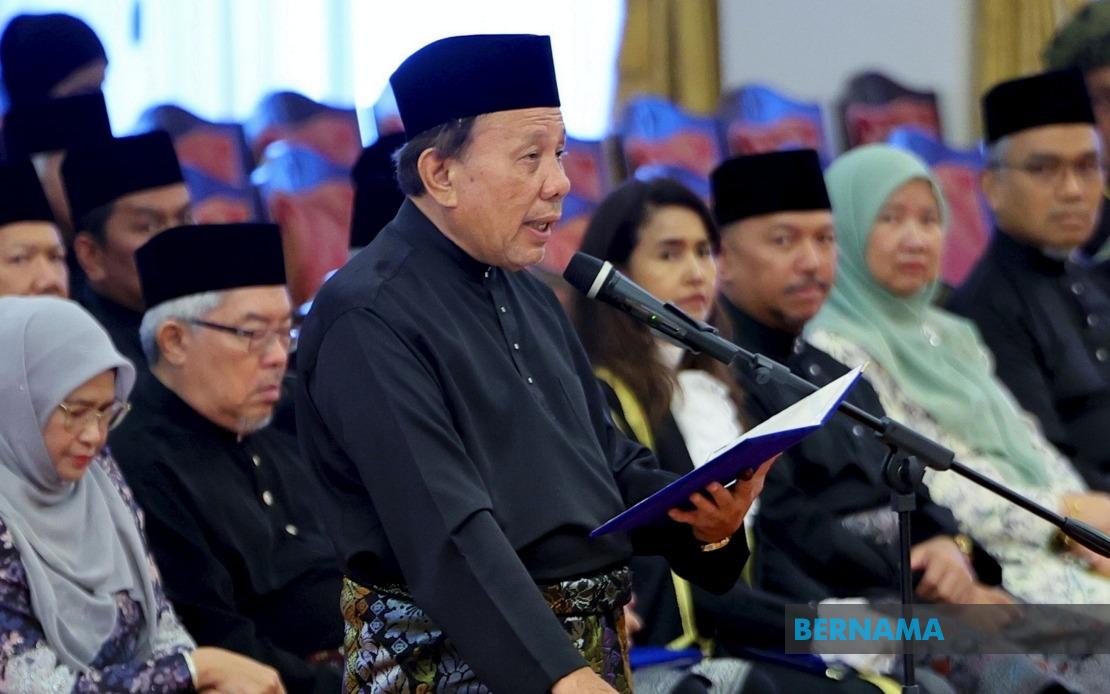
Datuk Ismail Lasim was formally sworn in as Negeri Sembilan's Menteri Besar on August 2 at Istana Besar Seri Menanti in Kuala Pilah, pledging to govern with integrity, fairness and transparency in response to the electoral mandate granted by voters in the 16th State Election. Standing before the Yang Dipertuan Besar Tuanku Muhriz Tuanku Munawir, Lasim emphasised that the public's confidence represents not merely ceremonial recognition but a solemn duty to demonstrate that government administration operates with genuine accountability and responsiveness to citizens' needs and aspirations.
The new Menteri Besar framed his appointment as an acknowledgment of the responsibility borne by elected leaders to validate the democratic process through competent, ethical governance. He stressed that the electorate's decision to entrust his administration with leadership authority would guide every major policy decision and institutional reform undertaken during his tenure. This framing reflects a broader Malaysian political concern about restoring public faith in state-level governance, particularly following periods when rival administrations faced scrutiny over resource management and developmental priorities.
Lasim's remarks highlighted Negeri Sembilan's distinctive position within Malaysia's constitutional architecture, particularly the state's unique system of governance rooted in Adat Perpatih—a customary legal framework emphasising consensus, collective deliberation, justice and social wisdom. He committed to ensuring that contemporary state policies and development initiatives remain grounded in these foundational principles, recognising that Negeri Sembilan's identity as Malaysia's only matrilineal state carries cultural significance extending beyond administrative convenience. This emphasis on preserving and transmitting customary traditions to future generations suggests that Lasim intends to balance modernisation pressures with protection of the state's distinctive institutional heritage.
The economic dimension of Lasim's administration features prominently in his vision for state development. He outlined intentions to strengthen Negeri Sembilan's economic foundation through targeted investment attraction, strategic job creation, and enhanced living standards across both metropolitan and rural constituencies. This approach acknowledges that infrastructure development and gross domestic product growth, while necessary, remain insufficient measures of genuine progress unless accompanied by tangible improvements in household income, employment security and access to essential services. Such framing aligns with contemporary Malaysian discourse around inclusive economic development that reaches beyond urban centres.
Education, healthcare, housing and agricultural modernisation emerged as critical sectoral priorities in Lasim's inaugural address. By explicitly designating these domains as integral to state advancement, the new Menteri Besar signals that his administration will pursue comprehensive human development rather than narrowly focusing on construction projects or headline-grabbing infrastructure investments. This diversified approach reflects lessons learned across Southeast Asia regarding sustainable state development, where focusing exclusively on physical infrastructure without concurrent investment in social services generates incomplete and potentially inequitable growth patterns.
Lasim pledged unwavering respect for constitutional monarchical principles and parliamentary democratic norms, positioning his administration firmly within Malaysia's established institutional framework. He committed to upholding the Yang Dipertuan Besar's constitutional prerogatives, seeking royal guidance on significant matters, and implementing state governance in alignment with both federal and state constitutional provisions. This formal deference to constitutional limitations and royal authority carries particular significance in Malaysia's federal system, where state leaders must navigate complex power-sharing arrangements with federal authorities while maintaining legitimacy with their own electorates.
The new Menteri Besar emphasised that effective governance depends fundamentally on the state civil service's dedication, professional standards and sense of responsibility. He pledged to foster an administrative culture characterised by trust, integrity and operational efficiency, recognising that state bureaucratic capacity ultimately determines whether policy ambitions translate into concrete deliverables. This institutional focus acknowledges that even well-intentioned governance mandates fail without competent implementation mechanisms and personnel committed to impartial, professional administration.
Lasim's commitment to consensus-building and receptiveness to constructive criticism suggests an administrative philosophy that views public dialogue and critical feedback as essential inputs rather than obstacles to executive decision-making. By explicitly embracing diverse viewpoints and emphasising long-term collective interests over short-term political advantage, he positioned his administration as servant-oriented rather than authoritarian. This rhetorical stance reflects evolved expectations among Malaysian voters, who increasingly demand participatory governance and transparent rationales for major policy choices.
The new Menteri Besar extended formal recognition to his predecessor Datuk Seri Aminuddin Harun, acknowledging the developmental foundation and administrative experience accumulated during the previous administration. This deliberate continuity messaging suggests that Lasim intends to build upon established initiatives rather than undertaking wholesale policy reversals, thereby maintaining momentum on multi-year development projects and avoiding disruption to ongoing programmes. Such pragmatism reflects mature governance approaches that distinguish between legitimate policy innovation and counterproductive institutional discontinuity.
Lasim's emphasis on strengthening harmonious relationships among the Royal Institution, state and federal governments, civil service, private sector and community organisations underscores his understanding that state development requires coordinated action across multiple institutional spheres. By identifying these diverse stakeholders as essential partners rather than competing interest groups, he articulated a collaborative governance vision that transcends zero-sum political calculations. This approach carries particular relevance for Negeri Sembilan, a state that must balance development aspirations with preservation of distinctive customary institutions and manage relationships with federal authorities across multiple policy domains.
The inaugural address reflects broader currents within Malaysian state politics toward emphasising accountability, consultation and inclusive development frameworks. Lasim's repeated commitments to transparency, listening to public aspirations and grounding administrative action in constitutional principles address persistent public concerns about political rent-seeking and unresponsive governance. While such pledges remain common among newly appointed officials, their salience indicates that Malaysian voters increasingly demand substantive performance against explicitly stated governance benchmarks, creating pressure for administrations to deliver measurable improvements in public service delivery, infrastructure maintenance and equitable resource distribution.
For Malaysian observers and regional analysts tracking governance trajectories across Southeast Asia, Lasim's appointment and inaugural commitments offer insight into contemporary state-level political dynamics. His emphasis on customary institutional preservation alongside modern development represents attempts to navigate tensions between globalisation pressures and cultural distinctiveness that confront regional governments. The specific articulation of governance principles—encompassing transparency, participation, constitutional respect and inclusive development—reflects internationalised standards increasingly demanded by educated electorates while remaining contextualised to Malaysia's particular constitutional and cultural framework.

