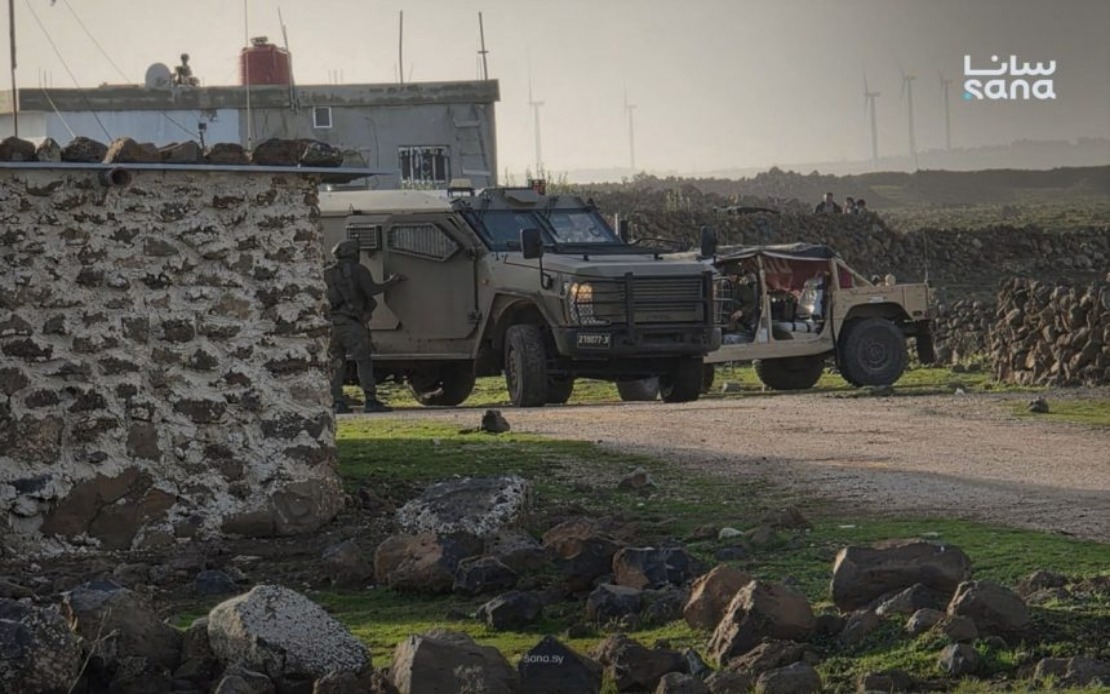
Israeli military forces crossed into Syria's southwestern Quneitra province on Saturday with a convoy of six vehicles, according to reports from Syria's official news agency. The advancing units made their way toward the Kudna Dam in the central Quneitra countryside, where unmanned aerial systems maintained surveillance over the region. The operation represents the latest in a pattern of Israeli military movements that have accelerated dramatically across southern Syria in recent months, raising concerns among regional observers about the stability of the frontier region.
The incursion underscores the broader deterioration in Syrian territorial integrity since the collapse of Bashar al-Assad's government in December 2024. For decades, the 1974 disengagement agreement had established a precarious framework governing Israeli-Syrian military interactions along their shared border, creating what functioned as a buffer zone between the two nations. When Assad's regime fell, Israel swiftly moved to dismantle this arrangement, effectively removing the diplomatic constraints that had previously governed cross-border operations and establishing a new military reality in the region.
Since al-Assad's departure, southern Syria has transformed into a zone of recurring Israeli military activity that extends far beyond occasional border patrols or limited tactical operations. The pattern includes coordinated raids targeting specific locations, comprehensive search operations across populated areas, detention of individuals deemed security threats, and the installation of permanent military checkpoints that restrict Syrian civilian movement. These activities have created a situation where Israeli forces exercise de facto control over substantial portions of the Syrian frontier zone, fundamentally altering the geopolitical landscape that Malaysian and Southeast Asian policymakers must navigate.
For Malaysia and other regional players monitoring Middle Eastern developments, the escalation carries significant implications. The transformation of southern Syria into an arena of intensive Israeli military presence affects regional stability calculus, influences humanitarian concerns, and potentially reshapes alliances and partnerships across the broader Middle East. The situation also demonstrates how rapidly a political transition, particularly the sudden collapse of a long-standing regime, can fundamentally alter security arrangements and create power vacuums that neighbouring states rush to fill.
The use of drone surveillance alongside ground vehicle movements indicates a comprehensive approach to Israeli operations in the region, combining persistent aerial observation with ground presence. This multi-layered operational posture suggests Israeli forces are not conducting simple transient incursions but rather establishing and maintaining sustained capacity to project power and gather intelligence throughout southern Syria. The coordination between different asset types reflects sophisticated military planning and resource allocation dedicated to the frontier region.
The broader context of Israeli sovereignty violations in Syria must be understood against the backdrop of decades of tension between the two nations. Israel and Syria have maintained a state of hostility since the 1967 war, with the 1974 disengagement agreement representing one of the few mechanisms that brought relative predictability to their interaction. The post-Assad environment has eliminated even this minimal framework, leaving Syrian territory vulnerable to external military action without the diplomatic or institutional structures that previously constrained such activities.
The fall of al-Assad fundamentally altered the strategic equation in ways that regional observers are still processing. Assad maintained a deterrent capability against certain Israeli actions through backing from regional powers and through the structure of the disengagement agreement itself. With Assad's departure and the transitional nature of Syria's current political situation, this deterrent capacity has evaporated. Syrian armed forces face internal consolidation challenges and lack the coherence necessary to respond to external military pressure, creating a security vacuum that Israel has methodically filled.
For Malaysian foreign policy and regional diplomacy, the situation presents several analytical challenges. Malaysia has historically maintained diplomatic positions based on support for Palestinian rights and non-interference in regional conflicts, yet the Syrian situation illustrates how rapidly geopolitical circumstances can shift and create new realities that complicate traditional positions. The escalating Israeli military presence in southern Syria demonstrates how weakness in one state's governance can have spillover effects that reshape regional security architecture and challenge established international norms.
The drone operations merit particular attention as they suggest an intelligence-gathering and surveillance infrastructure that extends beyond immediate military needs. By maintaining persistent aerial observation over Quneitra and other areas, Israeli forces establish real-time intelligence capabilities that can inform future operations and maintain awareness of any potential resistance or organised activity. This surveillance dimension represents a form of territorial oversight that blurs the distinction between military occupation and temporary incursion.
The international response to these escalating Israeli operations remains notably muted, with few regional or global actors issuing strong objections or implementing consequences. This pattern of escalation without significant pushback may encourage further Israeli military activities and suggests that the post-Assad period will likely witness continued Israeli consolidation of military advantages in southern Syria. The absence of a strong Syrian response or intervention by other regional powers creates an environment where Israeli operations face minimal resistance.
For Malaysia and Southeast Asian nations tracking Middle Eastern developments, these events serve as important reminders of how rapidly security situations can evolve when established frameworks collapse. The post-Assad Syrian environment demonstrates that transitional periods in governance create opportunities for external powers to reshape regional arrangements according to their own strategic interests. Understanding these dynamics becomes essential for Malaysian policymakers seeking to navigate increasingly complex Middle Eastern developments while maintaining consistent principles regarding sovereignty and international law.

