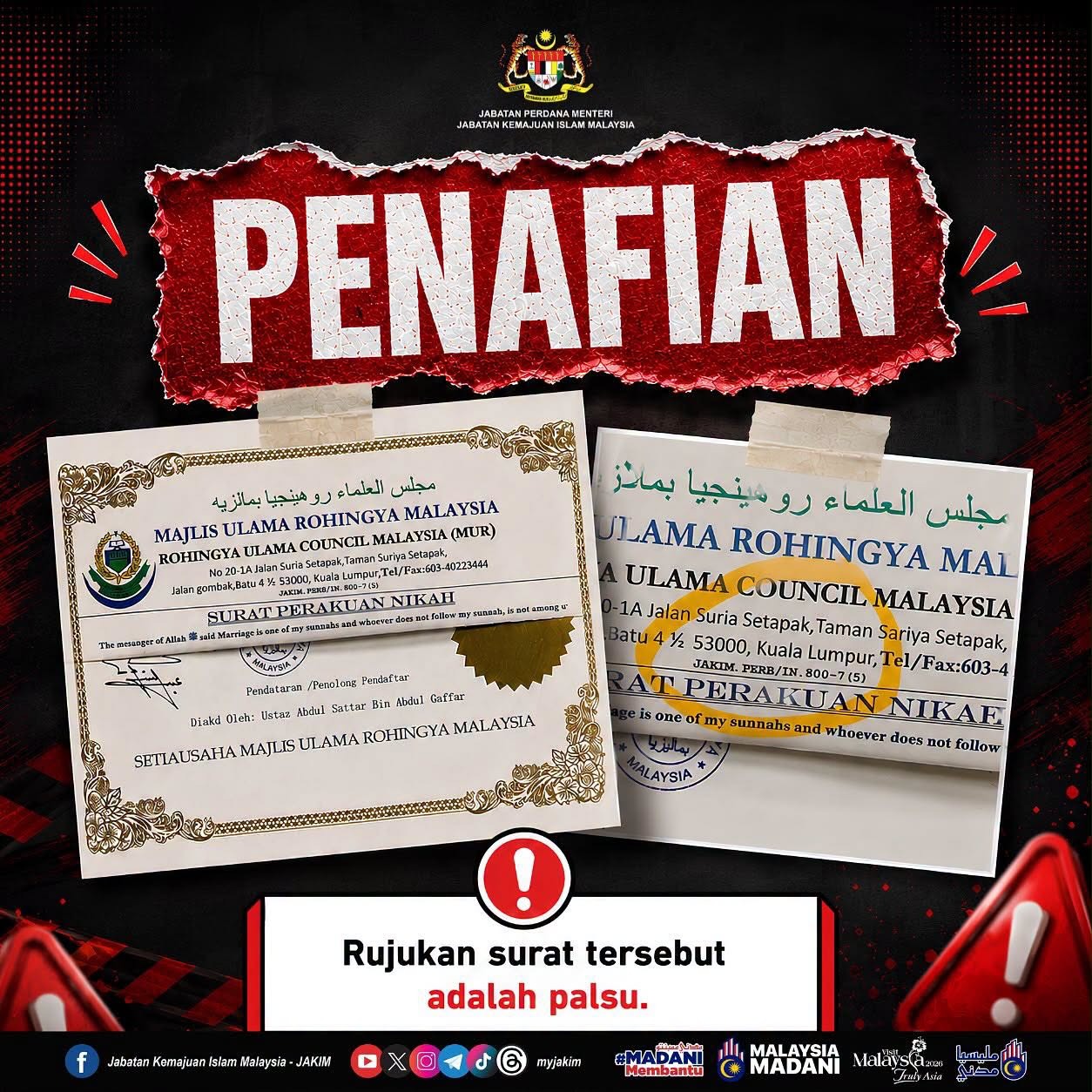
The Department of Islamic Development Malaysia (JAKIM) has moved swiftly to counter misinformation circulating online, declaring on July 15 that a widely shared marriage authorisation letter bearing what appeared to be an official departmental reference number is entirely fraudulent. The statement, released through JAKIM's official Facebook page, marks an important reminder of how easily forged religious documents can spread through digital channels in Malaysia, potentially deceiving vulnerable citizens seeking legitimate religious services.
The problematic letter allegedly originated from the Malaysia Rohingya Ulama Council and contained the reference designation "JAKIM.PERH/LN.800-7(5)", which was designed to lend credibility to claims that the organisation had been officially authorised to handle marriage-related administrative matters. However, JAKIM's investigation concluded that no such authorisation had ever been granted, and the reference number itself was a fabrication with no connection to any legitimate department system.
In its formal clarification, JAKIM emphasised that neither the department nor any of Malaysia's state Islamic religious councils and departments have ever sanctioned external organisations to manage or certify marriage documentation. This distinction is crucial, as it protects the integrity of Malaysia's Islamic administrative framework, which operates through established state-level religious authorities and centralised federal oversight. The forgery represents a potential vulnerability in the system that could be exploited by bad actors seeking to exploit people's trust in official-looking credentials.
The emergence of this fake document underscores broader concerns about document fraud in the religious and administrative sphere. Malaysia's citizens, particularly those from marginalised communities or with limited access to official channels, may be especially susceptible to such deceptions. The forged letter could have facilitated illegal marriage registration, created false documentation for vulnerable individuals, or been used as a tool for financial exploitation by actors claiming to provide legitimate religious services.
Dr Zulkifli Hasan, the Minister in the Prime Minister's Department (Religious Affairs), indicated that authorities would pursue a formal investigation once complete information had been gathered. This governmental commitment suggests that the incident is being treated with appropriate seriousness at the ministerial level, reflecting the significance of protecting Malaysia's religious administrative systems from fraudulent interference.
The incident highlights the importance of public vigilance in an era when official-looking documents can be created with relative ease through digital means. JAKIM has consequently appealed to Malaysian citizens to adopt a verification protocol: any religious document of uncertain provenance should be confirmed directly with JAKIM or the appropriate state Islamic religious authority before acceptance. This simple but essential step can prevent individuals from being misled by convincing-looking forgeries that purport to carry official sanction.
For the broader Malaysian public, the episode serves as a cautionary tale about the risks of accepting religious documentation without proper authentication. The viral nature of the fraudulent letter demonstrates how misinformation can spread rapidly across social media platforms before authorities have opportunity to intervene, reaching potentially hundreds or thousands of people who might act upon the false information.
The specific targeting of marriage matters is particularly concerning given the sensitive nature of matrimonial records in Malaysia's legal and religious framework. Marriage registration intersects with inheritance rights, spousal benefits, child custody arrangements, and numerous other legal consequences. A forged marriage letter could thus create cascading problems for individuals who rely upon it for official purposes.
The case also raises questions about how such sophisticated forgeries are being created and distributed. The fabrication of an official-sounding reference number suggests either insider knowledge of JAKIM's administrative systems or educated guessing based on publicly available information. Either scenario warrants investigation into the source and intended use of the fraudulent document.
For Malaysians and regional readers, this incident underscores the necessity of institutional transparency and accessibility. Citizens should have straightforward, convenient mechanisms to verify the authenticity of official documents from religious authorities. JAKIM's appeal for public verification, while well-intentioned, places the burden partly on individuals to initiate authentication checks rather than establishing proactive systems to prevent fraud at the source.
The broader implications extend to the credibility of Malaysia's Islamic institutional framework at a time when such trust is increasingly important. Effective management of religious affairs depends fundamentally on public confidence that official documents are genuine and that proper channels exist for verification. This incident, while concerning, also demonstrates that authorities are willing to act quickly and publicly to counter false claims made in their name, which should provide some reassurance to the public.

