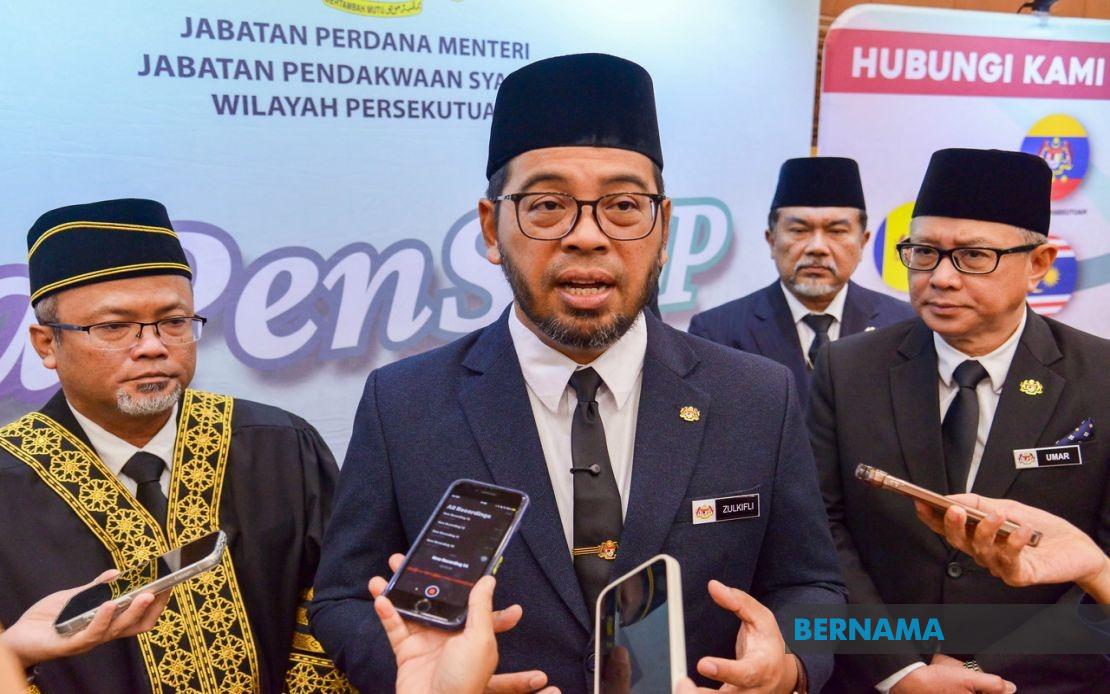
The Prime Minister's Department (Religious Affairs) has launched an investigation into allegations that a Department of Islamic Development Malaysia (JAKIM) reference number appeared on marriage declaration letters purportedly issued by the Malaysia Rohingya Ulama Council. Minister Dr Zulkifli Hasan announced the inquiry on July 15 in Putrajaya, acknowledging that he had yet to receive comprehensive details about the matter when questioned by reporters following his address at the second Malaysian Syariah Prosecutors Conference (PePSSM) 2026.
The controversy emerged when a marriage declaration letter attributed to the Malaysia Rohingya Ulama Council went viral across social media platforms, bearing what appeared to be an official JAKIM reference number: "JAKIM.PERH/LN.800-7(5)". The document's circulation sparked immediate concerns among state religious authorities about whether it represented genuine institutional approval or constituted an unauthorised use of government identification markings.
State-level religious authorities have moved swiftly to distance themselves from the document's validity. The Perak Islamic Religious Department (JAIPk) explicitly stated that it does not recognise the letter as an official marriage document, emphasising that marriages involving Rohingya community members cannot be registered through conventional channels. The department attributed this restriction to broader policy considerations being actively reviewed by state religious bodies, indicating that the matter remains unresolved at the administrative level.
The Rohingya marriage registration issue reflects deeper jurisdictional complexities within Malaysia's dual Islamic governance structure. While federal bodies like JAKIM provide technical and advisory functions, state religious departments retain primary authority over matters of Islamic family law and the registration of marriages. This division of responsibility has created gaps where informal religious ceremonies may proceed without corresponding legal recognition, leaving vulnerable populations—particularly refugees and displaced persons—without statutory protection for marital relationships.
Beyond the immediate marriage document controversy, Dr Zulkifli signalled that the government is simultaneously addressing another regulatory challenge: the proliferation of unaccredited religious lectures distributed through social media channels. He acknowledged that this phenomenon has attracted official attention, though he emphasised that responsibility for overseeing religious teaching standards remains fundamentally a state government function rather than a federal matter.
The minister explained that states bear the constitutional obligation to regulate religious teaching accreditation and to approve qualified individuals permitted to deliver religious instruction to their populations. This federal-state distinction has practical implications for enforcement, as the centre cannot unilaterally mandate accreditation standards across all thirteen states and three federal territories, each of which maintains its own religious administration.
Despite these structural constraints, the Prime Minister's Department continues examining approaches to address online religious content lacking proper accreditation. Dr Zulkifli acknowledged that formulating an effective response involves navigating complex legal terrain, suggesting that any federal solution must carefully balance religious freedom, public safety, and constitutional limitations on federal religious authority. The deliberative pace reflects awareness that heavy-handed intervention could provoke constitutional objections from state governments jealous of their Islamic jurisdiction.
At the departmental level, the government has instituted its own internal standards requiring accreditation verification for religious speakers appearing on government-affiliated platforms and broadcasts. This administrative measure, while limited in scope, demonstrates an attempt to establish baseline quality controls within areas where the federal government maintains direct operational authority.
Dr Zulkifli used the prosecutors' conference to articulate a broader vision for strengthening Malaysia's Syariah legal framework against emerging threats, particularly crimes facilitated by digital technology. He called for intensive coordination between multiple agencies including the Malaysian Communications and Multimedia Commission (MCMC), the Royal Malaysian Police (PDRM), and the Attorney General's Chambers to enhance investigation and prosecution capabilities across jurisdictional boundaries.
The minister specifically emphasised that Syariah prosecutors must develop sophisticated expertise in areas such as digital forensics, data analysis, and technology investigation methods. This upskilling requirement acknowledges that contemporary religious crimes—including online fraud, cyber defamation, illicit financial transfers, and digital exploitation—demand technical competencies far beyond traditional Islamic jurisprudence training. The emphasis reflects regional trends across Southeast Asia, where religious extremism, financial crime, and social manipulation increasingly operate through digital channels.
For Malaysian readers, these developments carry several implications. The Rohingya marriage document investigation represents a potential vulnerability in how government reference numbers and institutional credibility can be appropriated through social media, affecting not only refugee communities but potentially other groups seeking to legitimise informal ceremonies or transactions. The concurrent focus on unaccredited online religious content acknowledges a genuine challenge posed by the democratisation of religious teaching through digital platforms, where boundaries between authentic scholarship, commercial preaching, and misinformation remain poorly defined.
The institutional response also highlights the persistent tension within Malaysia's federal religious system, where enthusiasm for regulating religious content at the national level continuously confronts constitutional constraints on central authority. These investigations and policy discussions will likely shape how Malaysian authorities approach emerging challenges of religious legitimacy, digital verification, and cross-border communities in the coming years.

