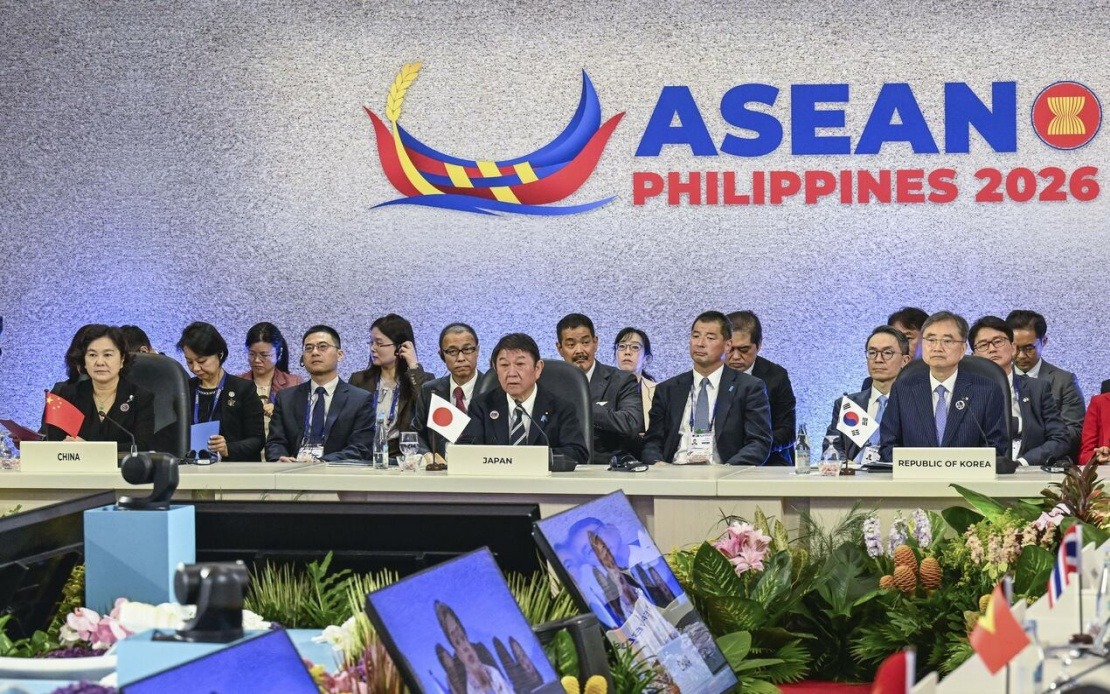
Japan has signalled its intention to deepen ties with Southeast Asia, China and South Korea across critical areas including energy resilience and cybercrime prevention, in a move that underscores Tokyo's commitment to regional stability amid shifting geopolitical dynamics. The pledge came during a foreign ministers' gathering in Manila on Thursday, where Japanese Foreign Minister Toshimitsu Motegi outlined Tokyo's strategic priorities for the ASEAN-plus-three grouping, which brings together the ten-nation bloc with its three major East Asian partners.
The energy security component of Japan's proposal carries particular significance for Malaysia and the region, given ongoing tensions in West Asia and the growing importance of diversified fuel supply chains for Southeast Asian economies. Meeting participants specifically flagged the necessity to strengthen energy networks across the region in response to developments in West Asia, recognising that economic growth in ASEAN depends heavily on stable and affordable energy supplies. Japan's emphasis on this area reflects Tokyo's own vulnerabilities as an energy importer and its desire to help stabilise regional markets through coordinated approaches.
Motegi stressed the economic weight and influence of the ASEAN-plus-three framework, noting that the combined GDP of these nations now exceeds one quarter of global economic output. This figure is particularly relevant for Malaysian policymakers and businesses, as it illustrates the substantial leverage that regional cooperation can exert in global economic discussions and negotiations. The sheer scale of the grouping's economic footprint positions it as a force capable of shaping international standards and economic arrangements that would directly affect Malaysian trade and investment flows.
Another critical component of Japan's agenda involves combating online scams, a problem that has reached epidemic proportions across Southeast Asia in recent years. Malaysia has been particularly affected by romance scams, investment fraud and other cybercriminal schemes originating from organised criminal networks operating in the region. Japan's willingness to coordinate anti-scam efforts with regional and major power partners suggests a recognition that these crimes require cross-border intelligence sharing, coordinated law enforcement operations and technical collaboration on cybercrime prevention and detection.
Motegi reaffirmed Japan's support for ASEAN centrality and unity, core principles that have underpinned regional diplomacy for decades. More notably, he expressed Tokyo's backing for the ASEAN Outlook on the Indo-Pacific, a framework adopted by the bloc to preserve peace, freedom and prosperity in the strategically vital Indo-Pacific region. Japan's alignment with this initiative demonstrates a calculated effort to work through ASEAN mechanisms rather than pursuing bilateral great power competition, a positioning that benefits smaller and mid-sized regional economies like Malaysia by preserving multilateral institutional space.
Tokyo's free and open Indo-Pacific vision, a cornerstone of Japanese foreign policy articulated repeatedly by recent governments, shares fundamental principles with the ASEAN Outlook framework. By emphasizing this convergence, Motegi signalled Japan's intention to coordinate with both China and South Korea to advance shared regional objectives through ASEAN-plus-three mechanisms. This approach seeks to prevent the formation of rigid competing blocs in the region and instead build overlapping frameworks of cooperation that can accommodate multiple interests and perspectives.
China's representation at the meeting by Vice Foreign Minister Hua Chunying rather than Foreign Minister Wang Yi may warrant careful observation, though such substitutions are not uncommon in multilateral diplomatic settings. The ASEAN-plus-three framework itself has historical roots stretching back to the 1997 Asian financial crisis, when the grouping was established to enable practical cooperation among member states facing shared economic challenges. That historical context underscores how regional multilateralism has proven resilient and valuable during periods of crisis and uncertainty.
The timing of these commitments is noteworthy given the broader strategic environment in East Asia. Japan's recent election outcomes and the continuation of its engagement with ASEAN reflect Tokyo's conviction that stability in Southeast Asia remains essential to Japanese security and prosperity. For Malaysian readers, Japan's renewed emphasis on energy cooperation and cybercrime prevention represents concrete areas where bilateral and multilateral engagement can deliver tangible benefits to ordinary citizens and businesses navigating an increasingly complex operating environment.
Motegi's subsequent bilateral meeting with newly appointed British Foreign Secretary Ed Miliband highlighted Japan's intention to maintain partnerships beyond the immediate Asian region. His expression of hope that Japan and Britain would continue collaborative efforts on global challenges signals that Tokyo views regional stability in Asia as inseparable from broader international security and economic cooperation. This perspective has implications for Malaysia's own external relations, particularly in maintaining constructive engagement with major powers and established democracies.
The ASEAN-plus-three framework, with its economic heft representing over a quarter of global GDP, possesses considerable potential to influence global standards in areas ranging from energy transition to digital governance and cybersecurity. Japan's proactive engagement in advancing cooperation on these fronts suggests Tokyo recognises that regional institutions offer an effective avenue for shaping outcomes that align with Japanese interests while remaining acceptable to diverse member states with varying strategic priorities and economic models.

