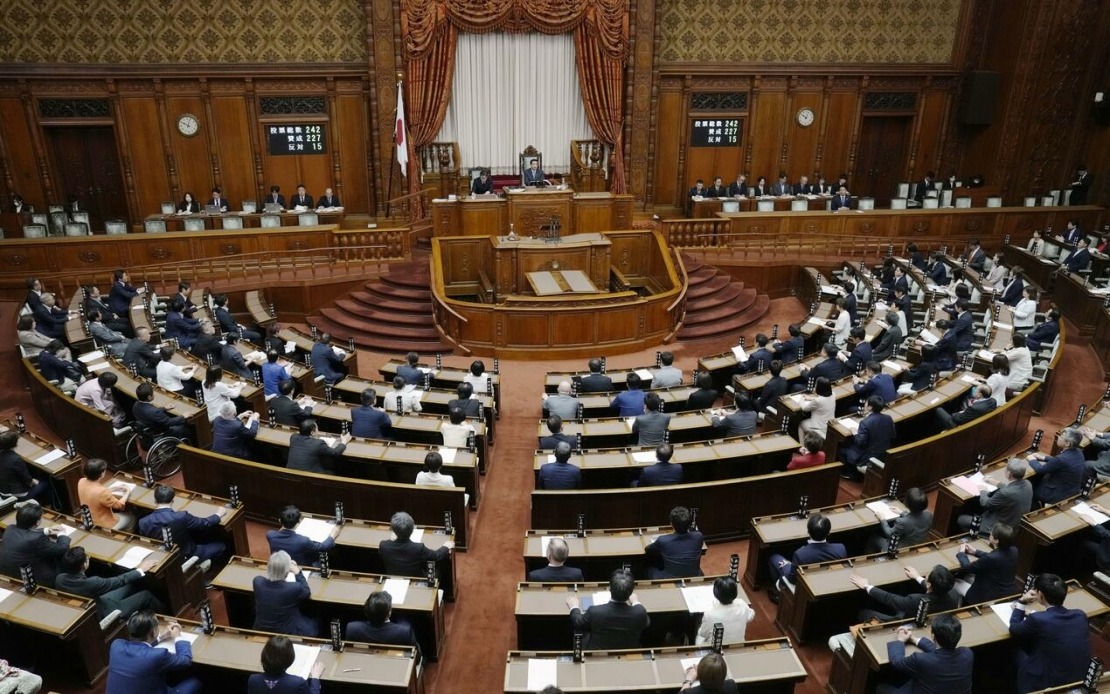
Japan's parliament has formally approved sweeping reforms to its military structure, centring on an overhaul of the Air Self-Defence Force that will formally recognise space as a critical operational domain. The legislative package, which passed the House of Councillors on Friday, marks a significant shift in how Tokyo approaches national defence in an increasingly contested security environment across East Asia. The restructuring will take effect during the fiscal year ending March 2027 and represents one of the most substantial changes to Japan's defence architecture in recent years.
The renamed Air Self-Defence Force will now incorporate explicit space operations capabilities, underpinning Japan's recognition that modern military effectiveness depends fundamentally on control and access to orbital assets. To operationalise this mandate, the government will establish a dedicated space operations group under the command of a lieutenant general, signalling the elevated status accorded to this domain within the military hierarchy. This command structure will focus specifically on enhancing space domain awareness—the ability to track and understand activity in the orbital environment—and expanding satellite surveillance capacity. Such capabilities have become essential for contemporary military operations across reconnaissance, communications, navigation, and early warning functions.
Defence Minister Shinjiro Koizumi framed the reorganisation not merely as a military necessity but as a response to the pervasive role of space infrastructure in everyday civilian life. During his news conference, Koizumi emphasised that Japanese citizens depend entirely on space-based systems, whether through satellite navigation driving personal vehicle route planning, location services embedded in smartphones, or meteorological forecasting that shapes disaster preparedness and agricultural planning. This broader characterisation reflects growing global recognition that space is no longer exclusively a military or scientific frontier but foundational civilian infrastructure requiring strategic protection. Japan's expansion of military space capabilities thus reflects this dual civilian-military imperative.
The legislation simultaneously authorises the appointment of a second senior vice defence minister, a structural innovation designed to distribute workload pressure across Japan's defence leadership. This additional position carries particular significance during contingencies and major natural disasters, when defence ministry personnel must coordinate with multiple agencies and manage competing demands. The role will also facilitate expanded high-level defence exchanges with the United States and other security partners, enabling more frequent and substantive dialogue on shared strategic challenges. Given Japan's alliance architecture and its positioning as a central node in American strategic planning for the Indo-Pacific, such enhanced capacity for diplomatic engagement carries implications extending beyond bilateral relations.
Southwestern island defence receives substantial reinforcement through the legislation's upgrade of the Ground Self-Defence Force's 15th Brigade, stationed in Naha, Okinawa Prefecture. This unit will be elevated to full divisional status, reflecting Japan's determination to strengthen military presence in its remote southwestern territories at a moment of heightened tension over maritime boundaries and territorial claims. The upgrade directly responds to what Tokyo characterises as China's increasingly assertive maritime posture in waters surrounding Japan's outlying islands. For Southeast Asian nations watching the evolution of great power competition in the region, this Japanese response carries implications for regional stability and the broader security architecture that many smaller states have relied upon.
Recrutiment and retention challenges facing the Self-Defence Forces receive attention through provisions raising post-retirement benefits for SDF members. The SDF's existing recruitment difficulties reflect demographic pressures, competing economic opportunities in Japan's private sector, and the demanding nature of military service. Mandatory retirement ages, which vary by rank but typically occur earlier than standard civil service positions, have previously disadvantaged SDF careers relative to alternative employment paths. By enhancing retirement security and benefits packages, the legislation aims to make military service more attractive to potential recruits and improve retention among serving personnel. This addresses a long-standing structural vulnerability that has complicated Japan's force modernisation efforts.
The summer appointment of the additional senior vice minister will commence immediately following parliamentary approval, accelerating implementation of one key reform measure. This timing permits the defence ministry to begin distributing responsibilities and preparing institutional processes before the broader military restructuring takes effect in 2027. The staggered implementation approach allows both civilian and military defence institutions to prepare for the more substantial organisational changes ahead without precipitating disruption to operational readiness.
These reforms occur within a strategic context of escalating great power competition and regional military modernisation. China's expanding military capabilities, particularly its space warfare potential and anti-satellite systems, have driven Japanese strategic planners to prioritise space operations as a defensive necessity. The restructuring also reflects lessons drawn from Russia's February 2022 invasion of Ukraine, where satellite communications and space-based reconnaissance proved decisive to Ukrainian resistance and NATO support coordination. Japanese defence planners have absorbed these lessons, recognising that space control directly influences conventional military effectiveness in contemporary conflict scenarios.
For Southeast Asian observers, Japan's military reorganisation signals Tokyo's intention to deepen its strategic engagement across the Indo-Pacific while simultaneously strengthening deterrence against Chinese military expansion. The emphasis on space capabilities and southwestern island defences aligns with broader Japanese strategy to secure maritime commons and maintain freedom of navigation in waters critical to regional commerce. Since many Southeast Asian nations depend on similar sea lanes and face comparable concerns regarding great power pressure, Japan's force modernisation carries implications for regional power dynamics and the maintenance of a rule-based international order that smaller states have historically relied upon for security and prosperity.

