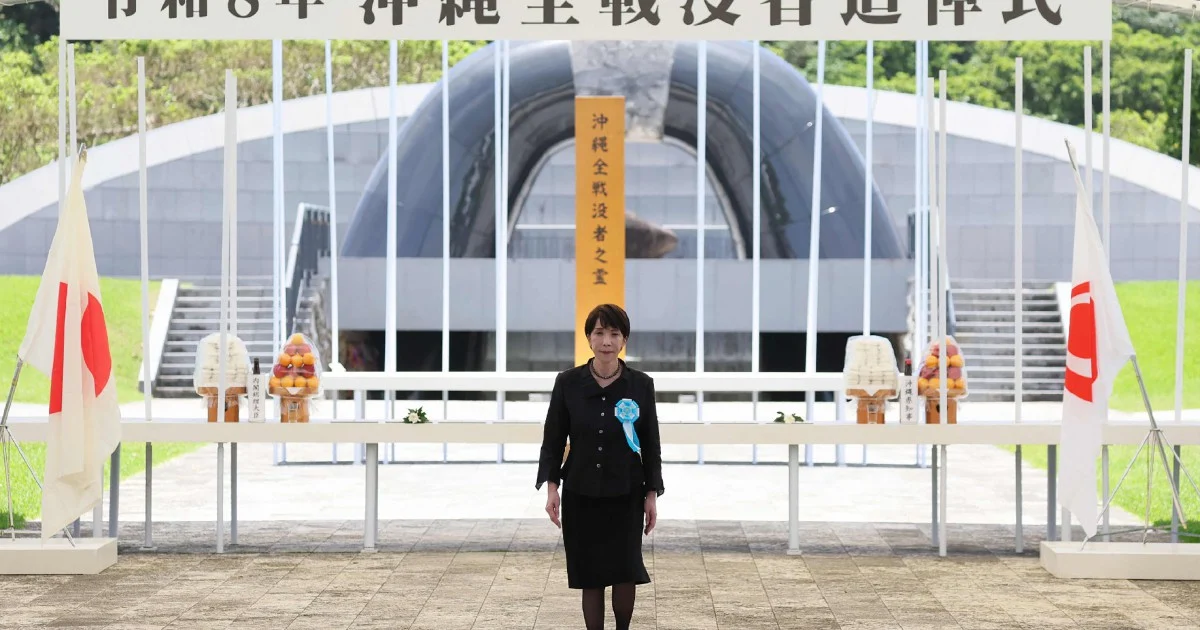
Japanese Prime Minister Sanae Takaichi encountered vocal opposition during an appearance at a World War II memorial ceremony, with protesters expressing deep concern about the government's accelerating military buildout and departure from the nation's longstanding commitment to pacifism. Television coverage captured the disruption, highlighting the political tensions simmering beneath Japan's carefully managed foreign policy debates.
The incident underscores a fundamental fissure in Japanese society as the administration pursues one of the most significant strategic reorientations in the country's postwar era. For nearly eight decades, Japan has anchored its national identity around pacifism, enshrined in its Constitution's famous Article 9, which renounced war as a means of settling disputes. Yet current government policy is systematically testing and stretching the boundaries of that commitment, with successive administrations authorizing record defence budgets and expanding operational capabilities.
Takaichi's presence at the memorial ceremony carried particular symbolic weight. As a prominent conservative politician, she represents a faction within Japan's leadership that views traditional pacifism as constraining the nation's ability to respond to evolving regional security challenges, particularly China's military assertiveness and North Korea's weapons programs. The public heckling reflects how contentious these strategic choices have become among ordinary Japanese citizens who cherish their pacifist heritage.
Japan's military spending has climbed to levels unseen since World War II's aftermath, with the government committing to a multi-year defence modernization programme. This includes acquiring advanced fighter jets, expanding naval capabilities, and developing long-range strike weapons. For proponents within government and security establishment circles, these investments are rational responses to a deteriorating regional security environment. For critics, they represent a dangerous gamble that risks unraveling the social consensus that has defined Japan's role in international affairs.
The memorial event itself carried significance beyond the immediate policy debate. World War II remains a sensitive and contested historical space in Japan, where memories of wartime suffering coexist with unresolved questions about responsibility and accountability. Many Japanese citizens view the pacifist constitution as both a moral statement about the horrors of war and a practical guarantee against future militarism. When government leaders appear at war memorials while simultaneously championing military expansion, it creates cognitive dissonance that prompts public resistance.
Protester turnout at such events has become more visible in recent years, suggesting that public anxiety about military policy is not confined to marginal peace movements but reflects broader concerns across society. Older generations who remember wartime devastation particularly worry about repeating historical mistakes, while younger Japanese increasingly question whether military buildup genuinely enhances national security or provokes regional instability.
The timing of Takaichi's appointment as Prime Minister placed her immediately at the centre of this debate. Her track record on defence issues is well known within Japanese politics, positioning her as someone committed to accelerating the military modernization agenda. This makes any public appearance a potential flashpoint for organized opposition and spontaneous protests from citizens uncomfortable with the direction of policy.
Regionally, Japan's military shift carries implications well beyond Tokyo's borders. Southeast Asian nations, which depend on stable Japanese-American security arrangements and free navigation through contested waters, watch these developments with mixed feelings. Some appreciate Japan's willingness to counterbalance Chinese military growth, while others worry that Japanese rearmament could trigger an arms race or escalate tensions.
The heckler incident also reflects how Japan's democratic institutions continue to function despite government insistence on particular policy trajectories. Unlike authoritarian neighbours, Japan permits public dissent and protest, even when directed at sitting prime ministers at official events. This democratic resilience, however, creates ongoing friction between government security preferences and public sentiment that remains deeply shaped by pacifist values.
Moving forward, the Takaichi administration faces a political balancing act. It must demonstrate that military investments serve genuine defensive purposes while respecting the pacifist principles that remain meaningful to much of the population. The memorial ceremony disruption served as a reminder that this balance cannot be taken for granted. As Japan continues modernizing its defence posture in response to regional challenges, public debate and contestation will likely intensify rather than fade.
The incident ultimately crystallizes a broader question confronting Japan: whether the nation can successfully navigate the transition from historic pacifism to active military engagement without fracturing the domestic consensus that has enabled peaceful development since 1945. The answer will shape not only Japan's future security trajectory but also regional stability across Asia for decades to come.

