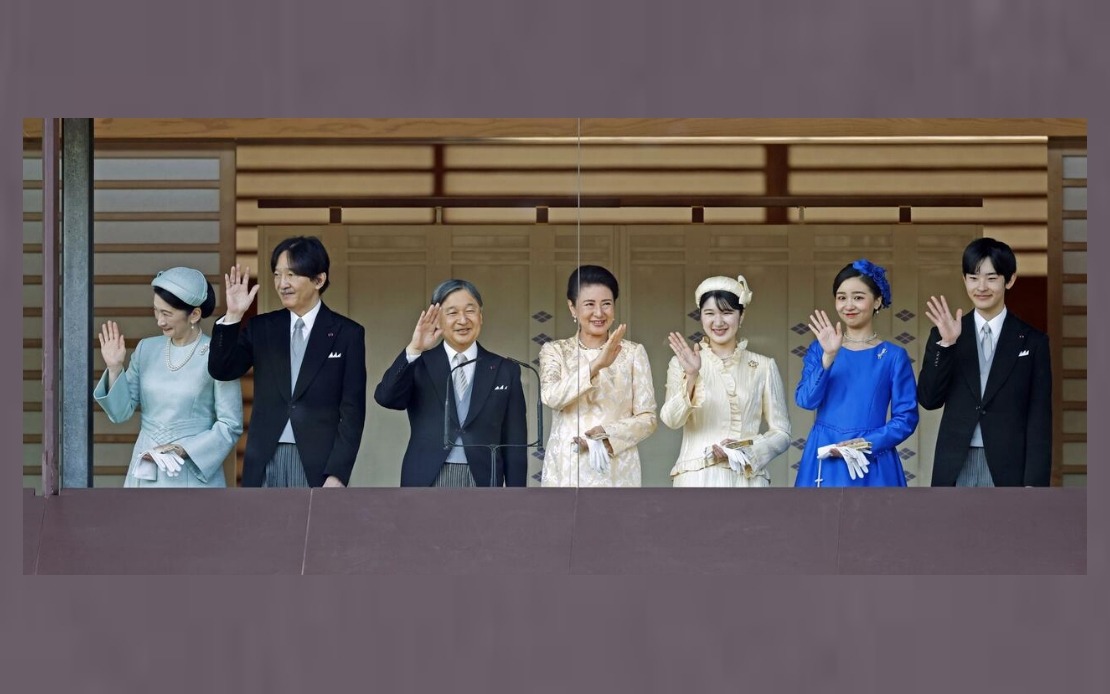
Japan's parliament has given final approval to a revised Imperial House Law that represents the first substantive overhaul of the 1947 statute, yet the reform falls short of addressing what many see as the monarchy's core vulnerability: a severe shortage of male heirs to the Chrysanthemum Throne. The legislation, backed by Prime Minister Sanae Takaichi's ruling coalition, attempts to stabilize the imperial family through targeted amendments while deliberately sidestepping the increasingly contentious question of whether women should be permitted to reign, a prospect that public opinion polling suggests most Japanese citizens now accept.
The amendment package introduces two principal modifications to Japan's centuries-old imperial system. First, it permits the adoption of unmarried males aged 15 and older from the 11 former branch families that were stripped of their imperial status following World War II, when American occupation authorities dramatically restructured Japanese institutions. Second, the law now enables female members of the imperial household to maintain their imperial standing even after marrying outside the family, a reversal of the previous rule that automatically removed women upon such marriages. These changes represent genuine shifts in how the monarchy manages its human resources, yet they operate entirely within the existing patrilineal framework that has governed succession since the 1947 law took effect.
The timing of this reform reflects genuine institutional pressure within the palace itself. Emperor Naruhito currently has only three male heirs in the entire imperial family—a precarious position for an institution that has maintained unbroken male succession for over a millennium. The pool of potential successors has contracted dramatically since the post-war period, when American officials removed 51 members of the imperial branches in an effort to modernize Japan's governance. That earlier purge created a succession crisis that decades of diplomacy have failed to resolve, making the new adoption provisions a pragmatic, if limited, attempt to expand the available candidate pool without fundamentally altering tradition.
The legislative path to passage reveals significant tensions within Japan's political establishment. The conservative coalition led by Takaichi has faced pointed criticism from opposition lawmakers who argue that the deliberations were insufficiently thorough given the magnitude of the decision. More substantially, opposition parliamentarians have challenged what they view as ideological resistance to female succession, suggesting that the ruling Liberal Democratic Party and its junior coalition partner, the Japan Innovation Party, prioritized preserving patrilineal customs over addressing the monarchy's sustainability. Although months of cross-party negotiations produced a legislative consensus across 13 parliamentary parties and groups, that consensus conspicuously avoided endorsing female or maternal-line succession—effectively kicking the most transformative question down the road.
Under the revised framework, male descendants adopted from the former branch families would immediately become eligible to ascend the throne, a significant shift from previous interpretations that had rendered such adoptions theoretically impossible. This pathway theoretically injects new blood into the succession line, though the practical impact depends on whether unmarried males from these families can be persuaded to give up their current lives and enter the constrained world of imperial duty. The government has maintained that this mechanism satisfies constitutional requirements without requiring the more radical step of permitting women to reign—a position that prioritizes institutional continuity over demographic flexibility.
For Malaysian and Southeast Asian observers, Japan's approach offers instructive lessons in how traditional monarchies navigate modernization pressures. The Japanese case demonstrates that even institutions with profound historical legitimacy and deep cultural roots face real constraints when demographic realities diverge from succession rules. Japan's imperial system, by most international measures the world's oldest continuous hereditary monarchy, cannot simply wish away the shortage of male heirs, yet the nation's political leadership has chosen to expand the recruitment pool rather than fundamentally alter the gender rules. This represents a middle path between wholesale tradition and radical reform—though whether such incremental adjustments prove sufficient remains an open question.
Public sentiment in Japan appears to have moved beyond the government's current position. A May poll conducted by Kyodo News found that 83.0 per cent of respondents expressed support for allowing female emperors, with only 13.1 per cent opposed. This substantial gap between public opinion and legislative outcome is not unusual in Japan's political system, where consensus-building often privileges institutional stability over majoritarian preferences. Nevertheless, the polling data suggests that if the adopted-male strategy fails to produce sufficient successors, political pressure for female succession may become irresistible, potentially forcing another round of contentious constitutional reexamination within the next decade.
Prime Minister Takaichi herself embodies some of the complexity surrounding this reform. As Japan's first female premier, she leads a government that has consciously rejected extending female succession rights to the imperial institution, a position that carries obvious symbolic weight. Her administration has framed the reform as responsive to genuine sustainability challenges while insisting that male-line preservation remains compatible with modern governance. This framing allows the government to present the changes as reform-minded while maintaining that fundamental principles remain sacrosanct—a delicate balance that satisfies neither those who view the changes as insufficiently bold nor those who fear that any alteration of tradition undermines the monarchy's essential nature.
The historical context remains vital to understanding contemporary resistance to female succession. The 1947 Imperial House Law itself was imposed during the American occupation, meaning Japan's current succession rules were authored by foreign administrators rather than emerging organically from Japanese political tradition. This external origin paradoxically strengthens the hand of those defending male-line succession, as they can frame female emperors as a Western import rather than a Japanese innovation. Yet this same history also complicates the traditionalist position, since the rules themselves represent a rupture with pre-war arrangements, and the removal of the 11 branch families occurred through military decree rather than constitutional consensus.
The coming years will likely test whether the adoption mechanism proves adequate or whether Japanese society will revisit the female succession question. Demographic trends suggest that Japan's population will continue to contract and age, potentially intensifying the palace's succession challenges. If the current imperial family continues to produce primarily female heirs, or if none of the adopted males from the branch families are willing to assume imperial responsibilities, the political pressure for allowing female emperors will almost certainly resurface. The May poll showing 83 per cent public support indicates that the cultural resistance to female succession may be concentrated among older conservatives rather than representing deeply held values across generational lines.
For regional observers, the Japanese experience illustrates how monarchies in developed democracies must ultimately align institutional structures with both demographic reality and popular expectations, even when doing so requires abandoning centuries of tradition. Malaysia's own constitutional monarchy operates within a different framework, with a rotating throne selected from among the sultans, but shares Japan's interest in maintaining hereditary monarchical institutions in contemporary settings. The Japanese reform, though modest compared to what many hoped for, demonstrates that even the world's most historically rooted monarchies cannot remain entirely static when confronted with succession pressures and generational shifts in public opinion.

