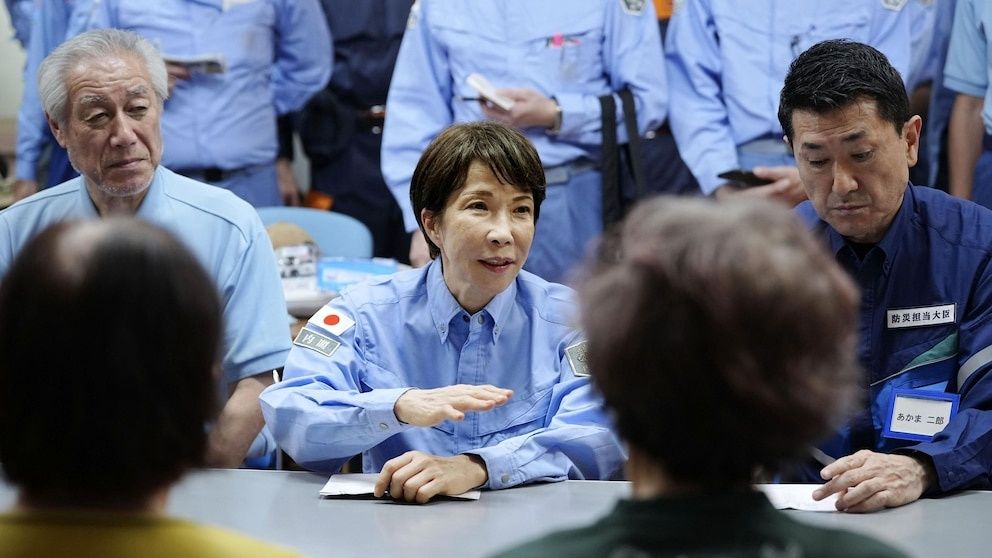
Japan's Prime Minister Sanae Takaichi has made her initial tour of Kumamoto Prefecture in the wake of a devastating magnitude 7.1 earthquake that struck the southwestern prefecture on Kyushu's main island on Tuesday, August 4. The visit comes as residents begin the mammoth task of clearing debris and damaged goods from their properties, with local authorities confirming that 38 people died in the disaster. The death toll underscores the earthquake's destructive power and the vulnerabilities facing those displaced by the disaster.
The challenge facing recovery efforts extends far beyond initial rescue and body recovery operations. The intense heat gripping the region has become an unexpected killer in itself, with authorities confirming that at least one person died from apparent heat stroke while sheltering in a vehicle, and another death remains under investigation. This grim pattern highlights the compounding nature of the crisis facing Kumamoto residents, where natural disaster intersects with extreme weather conditions to create conditions ripe for secondary health emergencies.
Water scarcity has emerged as perhaps the most pressing immediate concern for the affected population. More than 46,000 households remain disconnected from water supplies, while fuel shortages simultaneously threaten both transportation and heating capabilities in the sweltering environment. The Japan Meteorological Agency warned that temperatures could climb to nearly 40 degrees Celsius, intensifying risks for heat-related illnesses among vulnerable populations already traumatized by the quake.
Thousands of residents remain trapped in improvised accommodation with minimal resources. Over 8,500 people are sheltering in crowded emergency centres including converted community halls, school gymnasiums, and converted classrooms—many of which lack functional air-conditioning systems. Beyond formal shelters, thousands more are attempting to survive in parked cars at municipal parking lots and public parks, or camping outside their destroyed homes. These conditions create a secondary humanitarian crisis, as experts have consistently warned that inadequate shelter provision in disaster situations breeds sanitation failures, disease transmission risks, and severe psychological strain on already vulnerable populations.
Governor Takashi Kimura pressed Prime Minister Takaichi during their meeting to acknowledge what he termed the "abnormal heat" compounding hardship for residents already struggling with displacement and loss. He appealed for enhanced government intervention to upgrade conditions at evacuation facilities, emphasizing critical shortfalls in clean water availability and medical care provision. The governor's direct advocacy reflects growing concern that the state's emergency response mechanisms may prove inadequate to meet the scale of need in the region.
Takaichi's visit itself proved controversial in certain quarters. Rather than touring standard shelters, the Prime Minister visited one of the area's most well-equipped facilities, complete with cardboard partitioning systems, dedicated bed spaces, and air-conditioning units. Her helicopter tour of affected areas, while providing aerial perspective, drew social media criticism suggesting that her carefully managed itinerary presented a sanitized view rather than the harsh realities most evacuees faced. The criticism underscores ongoing tensions between political communication and ground-level disaster response.
In response to the governor's appeals, Takaichi committed to expedited governmental examination of support measures, pledging to "move proactively" in addressing disaster-affected communities' needs. The statement, while affirming central government engagement, offered limited specifics regarding resource allocation or timeline for relief measures. Such measured responses are typical of early disaster management phases but may prove insufficient if basic utilities remain unavailable for extended periods.
A troubling dimension of the disaster involves corporate responsibility in the tragedy. Two employees of Habita, a local convenience store operator with a shop in the collapsed Aeon Mall in Kashima town, died in a subsequent explosion that devastated the shopping centre. Company executives attending the wake of one victim, 22-year-old Kurumi Otake, acknowledged that management had instructed the two workers to return into the building to secure sales proceeds in a safe, despite ongoing seismic hazards. The bereaved mother's heartbreaking plea—"I wish someone had stopped her"—captures the human cost of decisions that prioritized financial safeguarding over worker safety.
The shopping mall disaster claimed seven additional lives beyond the two Habita workers, with rescue operations recovering five survivors from the rubble. The mall's operator attributes the explosion to a gas leak occurring after approximately 3,000 shoppers had been evacuated to the parking area following the initial earthquake, though some employees remained inside conducting business-related tasks. The incident raises critical questions about corporate decision-making during post-earthquake phases when ongoing structural integrity and utility safety remain uncertain.
The broader damage assessment reveals the earthquake's devastating scope across the prefecture. Approximately 700 homes have been completely destroyed, whilst over 11,300 buildings sustained varying degrees of damage. This widespread structural destruction, combined with utility failures and extreme weather conditions, has created a cascading humanitarian emergency that extends well beyond the initial seismic event itself. Across Kumamoto Prefecture, 114 people sustained injuries requiring medical treatment.
For Malaysia and Southeast Asia more broadly, Kumamoto's experience offers instructive lessons in disaster preparedness and response. The region's vulnerability to earthquakes mirrors similar risks facing other Pacific Rim nations, including the Philippines, Indonesia, and parts of Malaysia such as Sabah and Sarawak. Japan's sophisticated emergency management systems—despite their strengths—have been tested by the compound challenges of extreme heat, infrastructure failures, and inadequate shelter provisions, suggesting that even advanced disaster response frameworks struggle when multiple crises overlap.
The incident also highlights the precarious position of frontline workers and low-income employees in disaster situations. The deaths of young retail workers compelled to return to a potentially unsafe building underscores how economic imperatives can override safety considerations in crisis conditions. This pattern of risk displacement onto workers and vulnerable populations demands policy attention across jurisdictions grappling with earthquake preparedness.
As recovery operations continue, Kumamoto faces weeks of sustained effort to restore utilities, clear debris, and provide dignified temporary housing for thousands of displaced residents. The convergence of seismic hazard, extreme weather, infrastructure failure, and corporate accountability issues creates a complex recovery landscape. Prime Minister Takaichi's commitment to expedited support represents a necessary but potentially insufficient response to the multifaceted challenges confronting the prefecture's population during what remains an acute humanitarian emergency.

