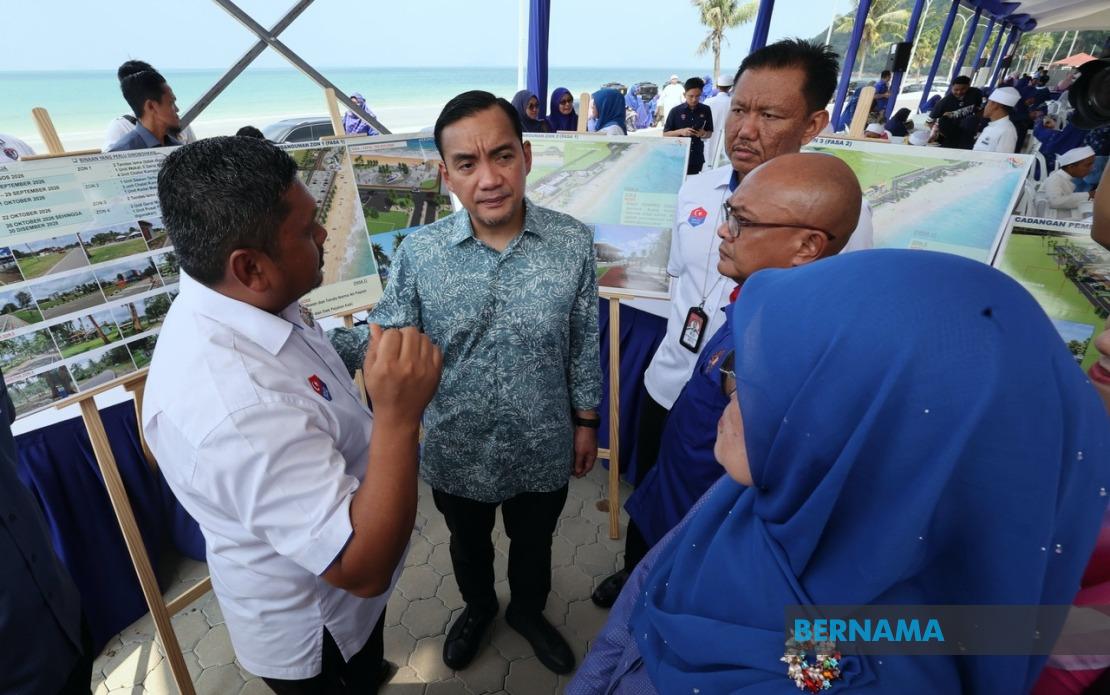
Johor Menteri Besar Datuk Onn Hafiz Ghazi has announced a RM1.5 million development allocation for Mersing district, signalling the state government's determination to translate its broader economic agenda into tangible improvements for smaller communities beyond the capital. The funding package, unveiled at the Mersing District gathering, represents a deliberate strategy to ensure that prosperity generated by Johor's economic transformation reaches residents in peripheral areas, bridging the urban-rural prosperity divide that often characterises Malaysian development patterns.
The financial commitment underscores a fundamental principle articulated by Onn Hafiz: that economic growth loses its purpose when confined to major urban centres. With Mersing's population of 80,000 residents, many employed in tourism-related sectors or agriculture, the allocation targets sectors that directly affect daily livelihoods and community wellbeing. This approach mirrors development strategies successfully deployed in Johor Bahru, where concentrated infrastructure investment created multiplier effects across the wider economy. The Menteri Besar's vision explicitly links economic growth to employment creation, particularly for younger demographics facing limited opportunities in traditional rural economies.
The centrepiece of the allocation is RM500,000 designated for upgrading the Mersing Hospital Haemodialysis Unit, addressing critical healthcare infrastructure gaps in the district. Adequate kidney dialysis facilities are essential for managing chronic conditions prevalent in rural populations, where access to specialised treatment often necessitates lengthy travel to urban medical centres. This investment recognises that economic development without corresponding healthcare improvements perpetuates inequalities in quality of life, a concern particularly acute in Malaysian districts where medical resources remain concentrated in state capitals and major towns.
The remaining RM1 million targets community amenities and religious infrastructure, reflecting a balanced development approach that extends beyond purely economic considerations. RM400,000 has been allocated towards mosque and sports facilities, including RM200,000 to replace carpets at Kampung Sri Lalang Mosque and RM200,000 split between new and renovated futsal courts at Taman Sri Mersing and Felda Nitar respectively. These investments in community gathering spaces and recreational infrastructure serve multiple purposes: enhancing quality of life, fostering social cohesion, and providing affordable leisure options that might otherwise be unavailable in resource-constrained districts.
Special attention within the allocation addresses the Orang Asli communities of Kampung Peta and Kampung Tanjung Tuan, each receiving RM100,000 for solar-powered streetlight installations. This targeted spending acknowledges that indigenous communities in rural Johor face particular infrastructure deficits, and renewable energy solutions offer cost-effective approaches to improving safety and extending productive hours in villages where conventional grid connectivity remains incomplete. The decision to prioritise solar technology reflects broader Malaysian sustainability objectives while delivering practical benefits to marginalised populations.
Additional allocations include RM100,000 for upgrading the Kami Anak Felda Malaysia building in Felda Tenggaroh Timur and RM80,000 for constructing a sepak takraw court in Felda Tenggaroh 6. These investments in Federal Land Development Authority communities acknowledge the specific needs of settlement areas where residents, often smallholder farmers, require upgraded community facilities and recreational outlets. Sepak takraw, a traditional Southeast Asian sport, receives particular emphasis, reflecting the government's commitment to preserving cultural heritage whilst providing youth engagement opportunities.
Beyond immediate infrastructure spending, Onn Hafiz outlined strategic initiatives with longer-term implications for Mersing's development trajectory. A proposed petrol station for Special Forces Group personnel at Camp Iskandar will be coordinated through local assemblyman Mohd Youzaimi Yusof and the Mersing District Officer, creating a collaborative governance model that links state-level decisions with ground-level implementation. This institutional approach, seemingly procedural, actually addresses a chronic Malaysian development challenge: the disconnect between planning decisions and local administrative capacity.
More substantially, the government intends to establish a Religious Affairs Office in Mersing, formalising administrative structures for religious and community affairs currently handled through Johor Bahru-based offices. This decentralisation improves service delivery for matters ranging from halal certification to Islamic education programmes, recognising that administrative proximity enhances responsiveness to community needs. Simultaneously, plans to develop a Technical and Vocational Education and Training campus within the Johor Economic Transformation Plan framework addresses a critical gap in Malaysia's education landscape for non-university pathways.
The TVET campus proposal carries particular significance for Mersing residents, especially youth without academic trajectories leading to university admission. Malaysia's heavy emphasis on tertiary education has historically created bottlenecks in vocational skills development, leaving school-leavers with limited intermediate pathways. A campus in Mersing would eliminate travel costs and logistical barriers preventing rural youth from accessing skills training in electrician, plumbing, hospitality, and automotive sectors—trades offering stable employment across Johor's tourism and manufacturing industries.
The Johor Economic Transformation Plan itself frames these Mersing investments within a state-wide development vision spanning short, medium, and long-term horizons. Rather than ad-hoc allocations, the structured approach ensures that district-level spending aligns with broader sectoral priorities and inter-district coordination mechanisms. This systematisation, whilst administratively complex, reduces the fragmentation characterising development efforts in many Malaysian states where projects proceed without coherent strategic frameworks.
For Malaysian observers, Johor's Mersing allocation demonstrates how state governments can operationalise equity principles within market-oriented development frameworks. Rather than viewing inclusive growth as conflicting with economic competitiveness, Onn Hafiz's approach posits that broader-based prosperity strengthens overall state economic resilience by expanding consumer bases, reducing social inequality pressures, and distributing developmental benefits across political constituencies. Whether this model translates into sustained improvements depends substantially on implementation effectiveness—a persistent Malaysian challenge where budgetary allocations frequently exceed execution capacity.
The involvement of assemblyman Youzaimi and assemblywoman Alwiyah signals political commitment extending beyond the Menteri Besar's office, suggesting cross-party acknowledgement of Mersing's development needs. Such bipartisan support, whilst arguably basic democratic practice, remains notable in Malaysian contexts where development spending sometimes reflects factional political calculations rather than genuine community prioritisation. The Mersing package, comprising diverse investments from healthcare to sports to indigenous community infrastructure, represents a genuinely comprehensive approach addressing multiple dimensions of district wellbeing rather than symbolic token allocations.

