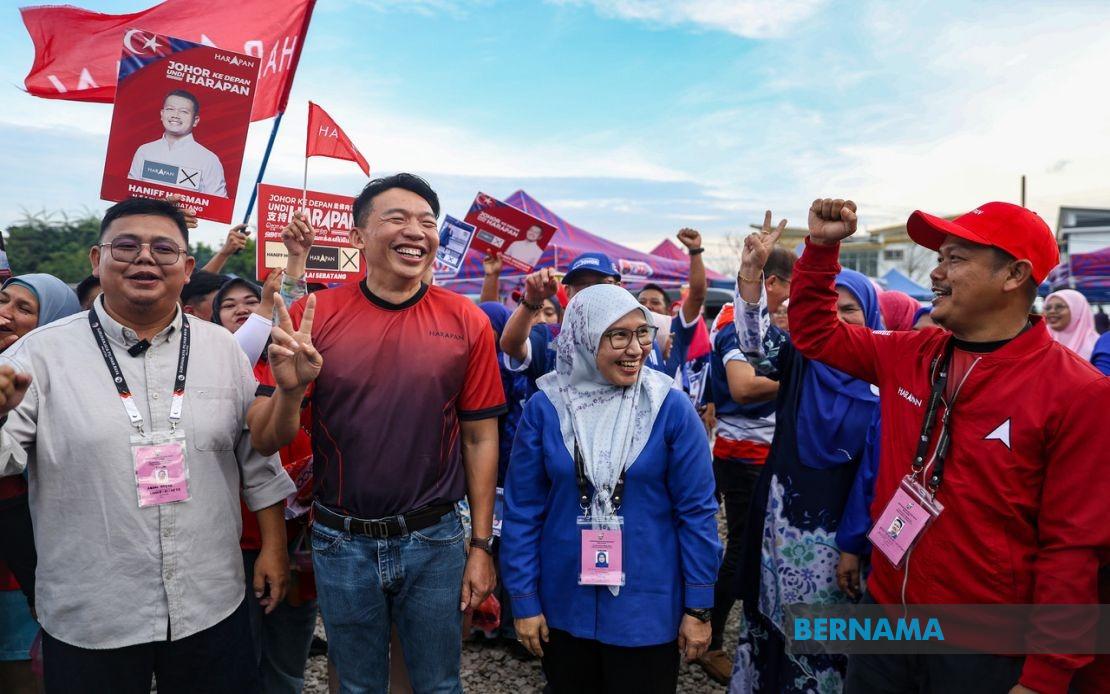
The Johor state election campaign reached a notable moment of civility when four candidates representing opposing political alliances crossed paths during evening constituency work at the Taman Megah night market in Pontian. The unscripted encounter between the three Pakatan Harapan contenders—Haniff @ Ghazali Hosman from Pulai Sebatang, Abd Razak Ismail from Benut, and Cheah Chee Hong from Kukup—and Barisan Nasional's Hasrunizah Hassan, also running in Pulai Sebatang, captured the attention of voters and market visitors who momentarily paused their shopping to observe the exchange.
What began as a potentially tense intersection of two campaign teams, one bearing red banners and the other blue, quickly transformed into a display of professional courtesy. Rather than the confrontational atmosphere sometimes associated with electoral campaigns in the region, the candidates greeted each other warmly before resuming their separate engagement with traders and constituents. The moment underscored a contrast to more fractious election periods witnessed elsewhere, signalling that competitive political processes need not descend into hostility at the grassroots level.
Haniff characterised the spontaneous meeting as emblematic of the democratic principles underpinning Malaysian politics, emphasising that peaceful campaigning and respectful interactions between political opponents remain achievable. Speaking to accompanying media representatives, he highlighted the absence of disruptions or aggressive conduct in Pontian's campaign activities, framing the encounter not as an aberration but as evidence of a functioning democratic tradition. His comments reflected a broader narrative that even as candidates worked to persuade voters of their competing visions, personal animosity need not characterise their professional engagements.
Cheah, representing the Kukup constituency, used the occasion to reinforce his coalition's messaging while acknowledging the collaborative spirit within the PH campaign team. He drew attention to the shared platform his three PH colleagues were pursuing, asking voters across the three constituencies to maintain their support for the coalition's candidates. The unified appearance of multiple opposition candidates at the same venue represented a strategic effort to demonstrate cohesion and organisational capacity ahead of polling day.
Hashnizah's perspective on the encounter provided insight into how even candidates confident of their respective positions view occasional political intersections during campaigns. She normalised such meetings as routine elements of electoral processes, suggesting that encounters between opposing candidates reflect institutional and cultural maturity rather than any failure of party discipline or security arrangements. Her assertion that the campaign period remained controlled despite its intensifying competitive nature indicated that local electoral administrators and political party leadership had managed campaign dynamics effectively.
The characterisation of campaign-period peace in Johor carries particular significance for Malaysian state politics. The Johor state assembly has historically been dominated by Barisan Nasional, and the July 11 election represented a competitive test of whether opposition parties could consolidate support or whether the incumbent coalition would maintain its traditional electoral advantage. Cordial exchanges between candidates therefore signal confidence among all parties that the outcome would reflect genuine voter preference rather than being determined by intimidation, violence, or extra-legal interference.
The Pontian night market setting itself merits consideration as a campaign venue. Night markets in Malaysia serve as crucial community gathering points, drawing diverse voter demographics including traders, service workers, families, and elderly citizens. Campaigns conducted in such settings necessarily engage with actual constituents rather than curated party audiences, and the peaceful coexistence of rival campaign teams in such spaces demonstrates public comfort with electoral competition. Voters observing friendly interactions between candidates from opposing sides may develop greater confidence in the legitimacy of electoral processes and the acceptability of accepting results across party lines.
The scheduling of the Johor state election for July 11, with early voting on July 7, provided a defined campaign window during which such encounters occurred. The proximity of the election date means that campaign intensity would naturally increase as voting approached, making demonstrations of restraint and civility particularly notable. Candidates and party machinery managing increasingly vigorous persuasion efforts while maintaining cordial personal relations speaks to institutional expectations and cultural norms that transcend party affiliation.
For Malaysian politics more broadly, the Johor campaign's measured tone offers a counterpoint to periodic concerns about electoral conduct in various state and federal contexts. The performance of democratic values—the capacity of candidates to compete vigorously for voter support while treating opponents as legitimate participants in a shared political system—receives less media attention than scandals or disruptions but constitutes the essential foundation of sustainable democratic governance. When candidates can meet at public venues, exchange greetings, and resume campaigning without incident, the underlying democratic architecture operates as intended.
The encounter also reflected evolving expectations around political communication in Malaysia's increasingly digitally connected society. Voter surveillance of campaign activities through social media documentation and real-time information sharing has raised the visibility of politician behaviour and interactions. Candidates and parties increasingly understand that actions at ground level are likely to be recorded and circulated, creating incentives for professional and courteous conduct that might have been less carefully monitored in previous electoral cycles.
Looking forward to the July 11 polling date, the Pontian episode provided a brief window into the campaign's character and the broader question of whether Malaysian voters would determine the outcome through their individual voting decisions or whether extraneous factors might intervene. The peaceful nature of campaign activities, as evidenced by the candidates' friendly exchange, suggested that the electoral process would proceed without major disruptions, allowing the result to reflect genuine constituent preferences across Pulai Sebatang, Benut, Kukup, and the other 53 state assembly constituencies in Johor.

