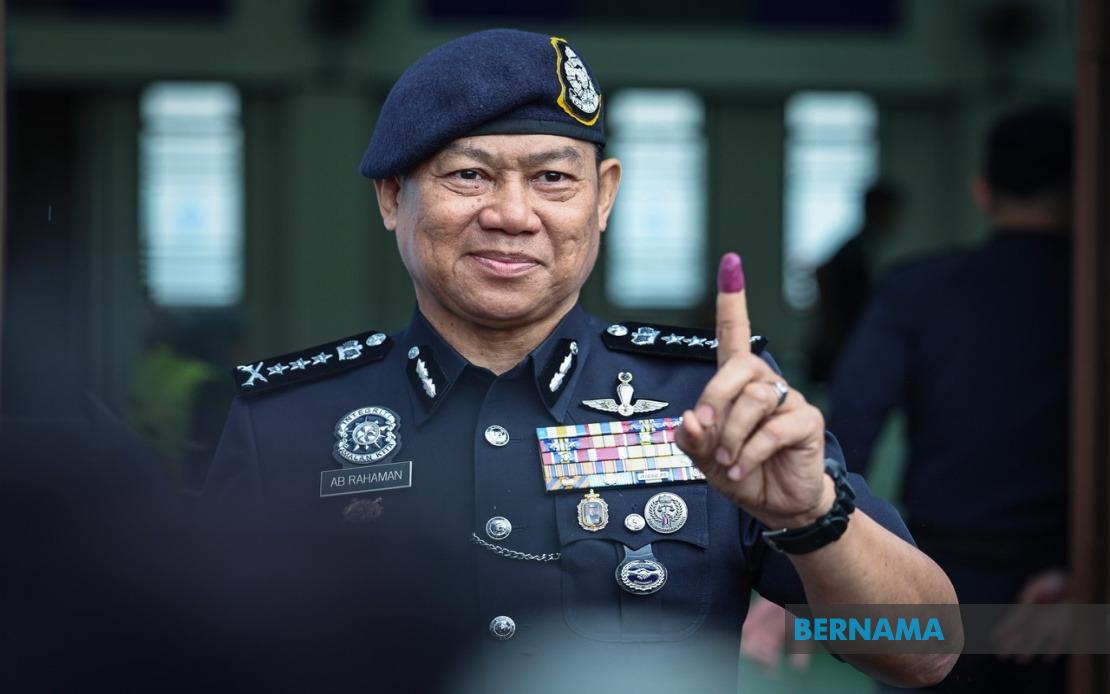
The 16th Johor state election is proceeding without major disruptions as security personnel took advantage of early voting arrangements, with police turnout indicating solid engagement among uniformed voters ahead of the wider ballot scheduled for Saturday. By 10.30 am on July 7, approximately 4,257 of Johor's eligible police officers—representing 36.3 per cent of those entitled to vote early—had already cast their ballots at dedicated polling centres throughout the state. This measured pace suggests stable participation among this demographic, traditionally seen as among the most disciplined voting groups in Malaysia's electoral cycle.
Johor police chief Datuk Ab Rahaman Arsad provided assurance that the early voting exercise, which encompassed both police personnel and members of the Malaysian Armed Forces, unfolded without complications or security concerns. All 53 early voting centres distributed across Johor operated without incident, according to the police chief, who highlighted the collaborative coordination required to facilitate this staggered voting process. His comments underscore the logistical complexity involved in managing simultaneous early polls for uniformed personnel while maintaining regular government operations and law enforcement duties.
The early voting framework reflects Malaysia's electoral administration's attempt to accommodate security personnel whose regular duties might prevent them from voting on the main polling day. The arrangement allowed 20,607 registered early voters to participate when 64 polling centres opened at 8 am, with closures staggered between noon and 6 pm depending on voter density and geographic location. This phased approach aims to minimise disruption to security deployments while ensuring comprehensive participation among those who maintain public order during elections.
Datuk Ab Rahaman noted that the final voter turnout figures would only emerge once all polling centres completed their operations later that afternoon, a reminder that early voting metrics, while instructive, represent only a partial snapshot of electoral engagement. His measured approach to discussing participation rates reflects professional restraint typical of police leadership during contested elections, avoiding premature judgments about overall voter enthusiasm or support distribution among competing factions.
Campaign-period policing revealed a familiar pattern of electoral transgressions focused primarily on vandalism rather than violence. Police reports filed during the lead-up to voting documented numerous incidents involving damaged party flags, defaced billboards, and compromised campaign materials across constituencies. Such offences, while technically infractions, typically receive relatively light enforcement attention and reflect the competitive but largely non-violent nature of Malaysian state electoral contests, at least in their manifestation through official police records.
A more significant controversy emerged surrounding Datuk Dr Mohd Puad Zarkashi, the former Johor State Assembly Speaker, whose public statements alleging Palace involvement in the legislative assembly's dissolution prompted police investigation. The matter generated sufficient concern to trigger 153 reports nationwide by the afternoon of early voting, an unusual volume suggesting either heightened political sensitivity or coordinated reporting by competing factions. Police maintained that investigations continued without indicating whether allegations would advance to formal charges or proceed further.
The allegation itself touches upon fundamental constitutional questions within Malaysia's monarchical system regarding the exercise of discretionary powers by state rulers. Such matters occupy delicate terrain politically, as they involve the relationship between elected representatives and constitutionally-protected royal prerogatives—a tension that resurfaces periodically in Malaysian politics and generates defensive responses from interested parties. The decision to treat these reports as requiring investigation rather than summary dismissal reflects the seriousness with which authorities regard claims of executive overreach, even when they touch upon sensitive institutional relationships.
Johor's 16th state election encompasses an unusually large and competitive field, with 172 candidates contesting 56 seats across a state that consistently determines national political direction. The presence of such substantial candidate numbers across fewer than 60 constituencies indicates fragmented opposition or intra-party competition, a development that could reshape the state's traditionally predictable political alignment. The election assumes importance beyond Johor itself, as results often signal shifting voter sentiment across the broader Malaysian federation.
With more than 2.7 million registered voters entitled to participate in Saturday's main polling, Johor represents a constituency of exceptional political weight. The state's electoral outcome carries implications for national political calculations, coalition stability, and the credibility of various political movements ahead of potential federal elections. Early indications from police and armed forces voting patterns may or may not predict broader voting behaviour, given these groups' typically different demographic and ideological profiles compared to general civilian populations.
The methodical conduct of early voting, absent incidents or logistical failures, indicates that electoral authorities have successfully implemented procedural frameworks despite the complexity of accommodating security personnel. The absence of complaints regarding voting integrity or misconduct—at least as of mid-morning—suggests that election management bodies have deployed adequate resources and training. However, the full test of electoral administration will emerge only after main polling concludes and results begin aggregating across all 56 state seats.
For Malaysian observers and regional analysts tracking electoral trends, Johor's 16th state election serves as a meaningful barometer of political sentiment in a critical state. The early voting process for security personnel, while typically receiving less media attention than main polling day theatrics, establishes baseline patterns that may illuminate broader turnout expectations or signal whether particular voter groups are mobilising effectively for preferred candidates or coalitions.

