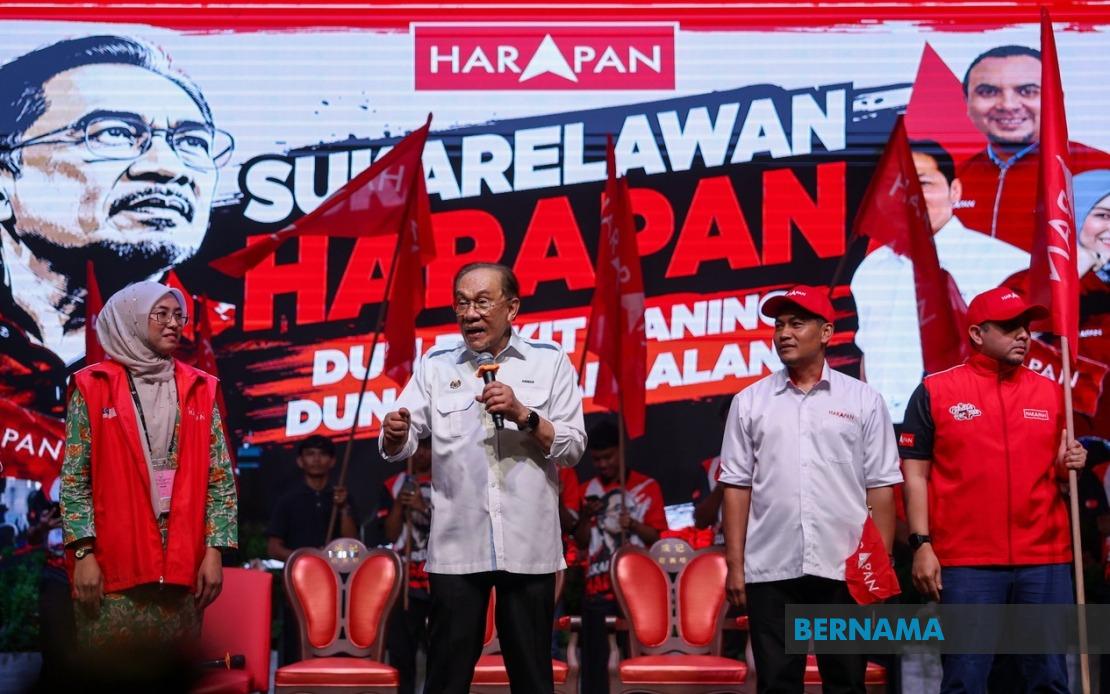
Prime Minister Datuk Seri Anwar Ibrahim has mounted an appeal to young voters in the forthcoming Johor state election, urging them to move beyond the sectarian appeals that have long dominated Malaysian electoral discourse and instead place their faith in candidates with genuine plans to secure their generation's prosperity. Speaking at campaign events in Muar on July 5, the Pakatan Harapan chairman painted a stark contrast between leaders genuinely invested in tackling bread-and-butter concerns and those who profit from fostering interethnic tension while ordinary citizens remain divided.
The Prime Minister's intervention underscores a critical strategic calculation within the ruling coalition: capturing the youth vote has become essential to competing in states like Johor, where demographic shifts and political realignment have created openings for parties willing to articulate alternative visions to the identity politics that dominated previous election cycles. Anwar specifically addressed young Malays, Chinese, and Indian voters, framing electoral participation not merely as a civic duty but as an act of generational self-determination. His message echoed a broader argument that the contemporary Malaysian electorate, particularly younger voters, increasingly recognises that competition on issues of communal identity leaves substantive policy questions unaddressed, perpetuating stagnation in areas where young people face genuine hardship.
The Prime Minister levelled sharp criticism at what he characterised as poisonous political narratives designed to fragment Malaysia's multicultural fabric. He described attempts to cultivate fear of specific communities and to weaponise ethnic divisions as relics of an earlier era, incompatible with the reality of an independent nation built on the principle of unity in diversity. This rhetorical strategy attempts to reposition opposition to ethnic-based appeals not as anti-Malay or anti-Muslim but as a modernising agenda that transcends outdated thinking. By framing divisive politics as the legacy of what he termed the "old guard," Anwar seeks to align his coalition with progress and the younger generation's aspirations, whilst implicitly casting alternative approaches as backward-looking.
The substance of Anwar's appeal focused on concrete governance issues that resonate particularly acutely with young people navigating a challenging economic landscape. Education policy, employment creation, and state-level development initiatives represent areas where voters can assess comparative performance and where parties must articulate specific commitments rather than relying on appeal to communal loyalty. This pivot towards material concerns reflects broader electoral trends across Southeast Asia, where younger cohorts frequently prove more responsive to competence-based arguments than their predecessors, particularly when confronted with housing costs, job scarcity, and educational expenses that strain household finances.
Anwar drew attention to the substantial youth presence at his campaign events, interpreting their turnout as evidence of generational awakening and a hunger for political change. The Pakatan Harapan machinery clearly invested in mobilising younger volunteers, recognising that enthusiasm and grassroots energy among this demographic could prove decisive in a competitive election. The Prime Minister explicitly called upon these young activists to translate their engagement into community-level organising, visiting villages and neighbourhoods to articulate the case for coalition governance with directness and authenticity that might prove more persuasive than top-down messaging.
The Johor state election represents a significant test of whether the messaging strategy Anwar outlined can effectively reshape electoral competition in a crucial state. With 172 candidates contesting 56 seats and voting scheduled for July 11, the contest will determine whether Pakatan Harapan can consolidate support across the multi-ethnic coalitions that propelled it to federal power in 2018 and, more recently, to continued government through shifting parliamentary arithmetic. Early voting on July 7 would allow assessment of whether the youthful energy Anwar highlighted translates into proportional voting strength.
The Prime Minister's broader argument carries implications extending well beyond Johor's boundaries. Southeast Asia faces a generational inflection point where younger voters must determine whether existing political templates—many of which crystallised around identity and ethnic representation—remain serviceable or whether electoral competition will increasingly organise around alternative cleavages. Malaysia's experience will inform regional trajectories. Should Anwar's coalition succeed in attracting substantial youth support by emphasising development and competence over communal mobilisation, this outcome could reshape electoral competition across the region. Conversely, should voters continue prioritising identity-based appeals, this would suggest that generational change operates more slowly than contemporary demographic analysis might suggest.
Anwar's invocation of Malaysia's religious and ethnic pluralism carried deliberate spiritual and philosophical weight, invoking gratitude that the nation has maintained peace despite its diversity whilst implying that continued harmony depends upon rejecting rhetorical approaches that corrode the foundation of mutual respect underlying that stability. This argument attempts to reframe support for his coalition not primarily as partisan choice but as civic commitment to preserving the social cohesion upon which Malaysia's stability depends. By positioning opposition to divisive politics as synonymous with national interest, Anwar seeks to occupy higher ground and render support for his opponents as implicitly dangerous to collective wellbeing.
The Prime Minister also extended an implicit rebuke to those political actors he accused of enriching themselves whilst populations remained distracted by manufactured grievances. This anti-corruption framing aims to capitalise on longstanding public scepticism regarding political elites and their fidelity to public interest, matters that have become increasingly salient following financial scandals and questions regarding the transparency of previous state administrations. For voters wrestling with stagnant incomes and rising costs, the suggestion that competing political elites simply rotate access to spoils rather than meaningfully altering governance can prove persuasive, particularly if coalition campaigners offer credible evidence of changed practices and accountability measures.
The campaign dynamics outlined in Anwar's statements reflect broader tensions within contemporary Malaysian politics. Opposition forces, whilst less directly quoted in available reporting, presumably articulate counter-narratives emphasising Bumiputera interests, Islamic governance priorities, or communal security concerns that resonate with significant portions of the electorate. The competitive terrain has shifted, however, with younger voters proving more sceptical of appeals framed purely in identity terms and more responsive to arguments centred on governance capacity and development outcomes. This generational divergence creates strategic challenges for all political actors attempting to construct coalitions spanning age cohorts with substantially different political consciousness.
The July 11 voting will reveal whether Anwar's framing of the election as a moment of youth empowerment and generational responsibility gains traction with actual voters or whether structural factors—incumbency advantages, administrative resources, communal networks—prove decisive regardless of rhetorical appeals. Johor's significance within Malaysian politics, combined with its demographic composition and recent political history, renders this contest consequential for assessing whether electoral politics can indeed transcend identity-based competition or whether such optimism reflects the aspirations of particular leadership rather than transformative shifts in voter behaviour.

