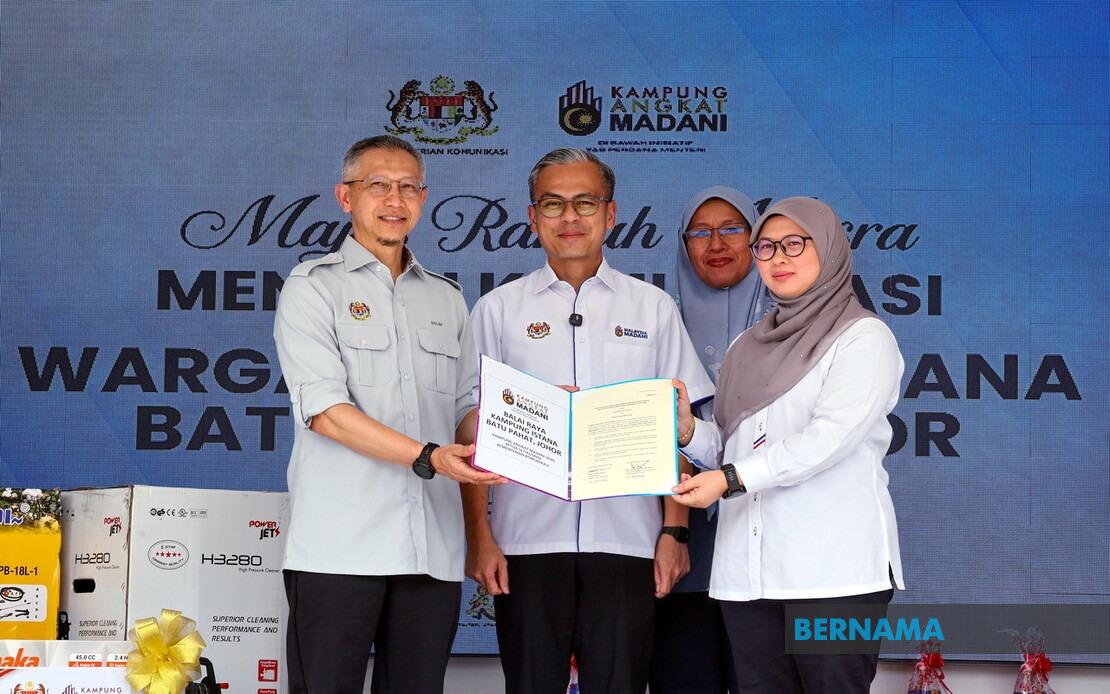
The Johor state election should be understood as a contest fundamentally about governance and development, not as a vehicle for advancing individual political interests, according to Pakatan Harapan Communications Director Datuk Fahmi Fadzil. Speaking in Batu Pahat on July 4, he challenged what he characterized as misleading narratives that attempt to tie electoral outcomes to personal political rehabilitation or vindication.
Fahmi's remarks directly addressed claims made by Datuk Nazifuddin Mohd Najib, who had suggested a Barisan Nasional victory would signal public endorsement for his father, former Prime Minister Datuk Seri Najib Razak, to receive a presidential pardon. Such framing, Fahmi argued, fundamentally misrepresents what is truly at stake in electoral contests and potentially distracts voters from substantive policy and governance questions that should dominate campaign discourse.
The Communications Minister stressed that Malaysian voters are sophisticated enough to distinguish between personal political considerations and the broader imperative of selecting capable leadership. His position reflects a broader PH strategy of repositioning the election around bread-and-butter issues affecting ordinary Johoreans rather than allowing it to become a vehicle for elite factional politics. This approach recognizes a documented trend in Malaysian politics where voters increasingly resent attempts to instrumentalize electoral contests for purposes unrelated to their immediate welfare.
A significant theme in Fahmi's intervention concerns the erosion of what political analysts once termed fixed deposits—voting blocs assumed to deliver reliable support to particular parties. He explicitly rejected the notion that any political party should regard public support as automatically guaranteed or permanent, arguing instead that political backing must be continually earned through demonstrated competence and responsiveness to constituent needs. This observation carries particular weight given DAP's historical reliance on substantial support from non-Malay urban voters, a demographic increasingly willing to hold the party accountable for governance performance.
The Coalition's messaging strategy has pivoted to emphasize that voter agency and electoral choice represent far more than individual decisions—they constitute collective determinations about state and national direction. Fahmi contended that when voters hear concerning rhetoric, including statements that reduce elections to personal vindication, it serves as a catalyst prompting more reflective electoral behaviour. This framing implicitly encourages Johor voters to recognize their ballots as instruments for shaping broader institutional trajectories rather than endorsing specific individuals or their personal agendas.
Fahmi highlighted what PH characterizes as expanding cross-party support for Coalition candidates, citing the public endorsement from former Rengit assemblyman Datuk Dr Mohd Puad Zarkashi for the PH candidate contesting that seat. Zarkashi's position carries symbolic weight given his longstanding association with UMNO and Barisan Nasional, suggesting that traditional party loyalties face unprecedented fluidity. The Communications Minister interpreted such endorsements as evidence that UMNO's historical dominance in Johor cannot be taken for granted, even among established political figures with deep roots in the party apparatus.
Beyond Rengit, PH cited additional cross-party backing, including Bersatu members supporting the Coalition's candidate in the Sri Medan state seat. These developments, whether individually modest or collectively significant, represent part of a narrative strategy designed to portray PH as the beneficiary of broader political realignment. The messaging suggests that support for Prime Minister Anwar Ibrahim's government extends beyond traditional PH constituencies, encompassing figures previously assumed loyal to opposition parties or alternative coalition formations.
Fahmi explicitly connected PH's electoral prospects to macroeconomic performance, particularly highlighting the government's economic recovery efforts and their regional manifestations in Johor. This linkage between campaign messaging and tangible governance outcomes attempts to ground electoral politics in material performance rather than abstract ideological or personal considerations. For Johor voters, whose state economy depends substantially on cross-border trade with Singapore and manufacturing sectors, demonstrable economic management becomes a consequential electoral calculus.
The Communications Ministry secretary-general's attendance at the Batu Pahat campaign event alongside PH candidate Felicia Poh Rui Ling for the Penggaram seat underscored the government's commitment to the election campaign. Such high-level participation signals institutional weight behind the Coalition's electoral push, though it also raises questions about the appropriate boundaries between government apparatus and partisan campaign activity—a persistent tension in Malaysian electoral politics.
With 172 candidates contesting 56 state seats, the July 11 polling will constitute the first comprehensive electoral test of voter sentiment since Anwar Ibrahim became Prime Minister. Early voting has been scheduled for July 7, potentially allowing a subset of voters—likely civil servants and election workers—to cast ballots before the main election day. The electoral mechanics and campaign intensity reflect Johor's political significance as historically Malaysia's most pivotal state in determining federal political balance and national government composition.
The rhetorical battle over how voters should conceptualize the election—whether as a referendum on individuals or as a choice between competing visions for Johor's future—will likely intensify as polling approaches. Fahmi's framing represents one discursive strategy designed to redirect voter attention toward institutional governance and away from elite personal considerations. Whether this messaging resonates depends substantially on whether Johor voters ultimately agree with the Communications Minister's assertion about what truly matters in determining how they cast their votes.

