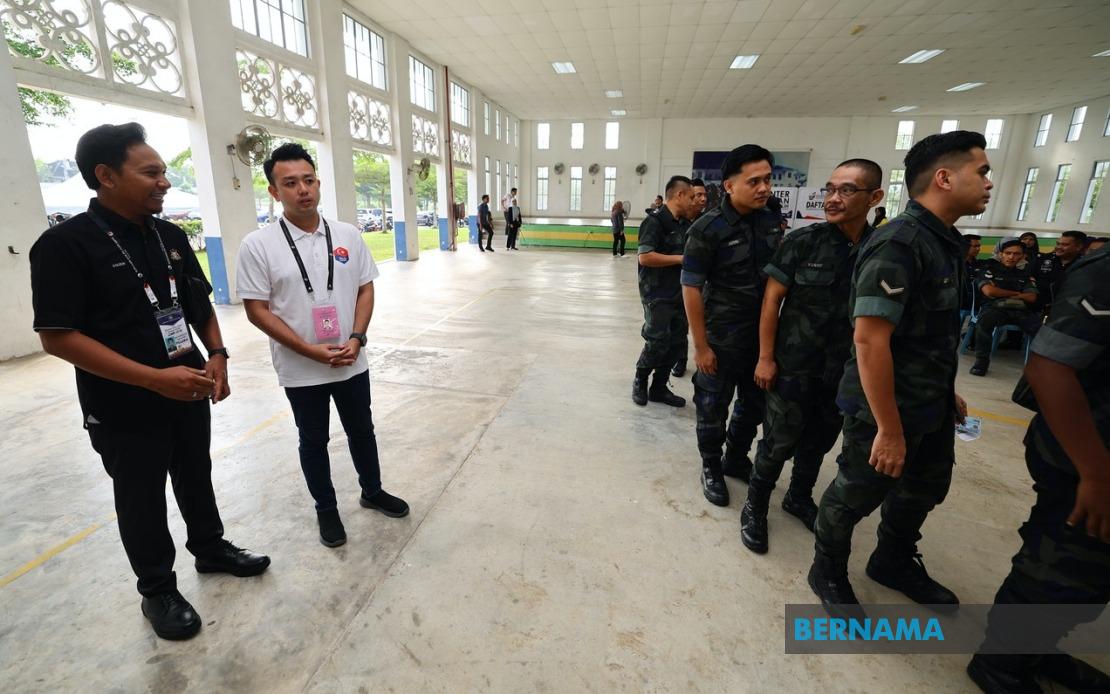
Candidates contesting the Johor state election made time during their campaigning activities to witness the early voting process for military and police personnel on Thursday, demonstrating the cross-party commitment to electoral transparency just days before polling day. The exercise, conducted across 64 designated centres, allowed representatives from competing coalitions to ensure the integrity of voting procedures for a specially designated voter segment, reinforcing public confidence in the electoral process ahead of Saturday's poll.
Representatives from the three major political blocs turned out at various polling venues to observe proceedings. In the contest for Layang-Layang, all three contenders—Guna Balakrishnan representing Pakatan Harapan, Chua Jian Boon from Barisan Nasional, and Abd Mutalip Abd Rahim of Perikatan Nasional—gathered at the 5th Battalion General Operations Force Camp in Simpang Renggam to monitor voting operations. This coordinated observation approach reflects growing awareness among competing parties that maintaining electoral credibility serves the broader political system.
The Tenggaroh constituency similarly saw all three candidates participate in early voting supervision. Muhamad Amerul Muhamad, Mohd Youzaimi Yusof, and Md Yusof Dawam convened at Iskandar Camp's early voting centre in Mersing to observe the process. Such visible scrutiny by candidates themselves sends a message to voters that multiple political interests are invested in fair administration, a consideration of particular significance in Malaysia's competitive multi-party landscape.
Other prominent candidates utilised the opportunity to monitor proceedings at their respective designated locations. Lim Chin Eng, identified as the oldest candidate in the election, attended the Johor Contingent Police Headquarters to observe voting. Muhammad Faezuddin Mohd Puad, Pakatan Harapan's candidate for Kempas, was present at Kempas Police Station, while Datuk Jafni Md Shukor, Barisan Nasional's contender for Bukit Permai, visited Kulai District Police Headquarters. The widespread candidate participation underscores the competitive dynamics at play across multiple constituencies.
Military and security leadership also made their presence felt at early voting centres, reflecting the institutional importance attached to ensuring security force voting rights. Army Chief General Tan Sri Azhan Md Othman, accompanied by 21st Special Service Group commander Major General Datuk Ahmad Shuhaimi Mat Wajab, visited Iskandar Camp in Mersing to observe proceedings. Additionally, Johor's police chief Datuk Ab Rahaman Arsad cast his own ballot at Dewan Dato Onn at Johor police headquarters, demonstrating leadership commitment to the voting exercise.
The scale of early voting reflects Malaysia's constitutional provisions ensuring security personnel the right to vote before general polling. A total of 20,607 voters comprising military personnel and their spouses alongside police officers and their families were registered to participate in the early voting process. The Election Commission accommodated this significant voter segment through 64 early voting centres operating from 8 am, closing in stages between noon and 6 pm depending on venue capacity and registered voter numbers. This logistical arrangement highlights the complexity of administering elections while ensuring all eligible citizens can participate regardless of security duties.
Despite weather challenges, early voting proceeded smoothly throughout Thursday. Brief rainfall at several locations failed to disrupt the arrival of security personnel, who came in scheduled phases to exercise their voting rights. Election Commission officers reported that voters adhered to established procedures, with the entire process unfolding in an orderly and organised manner from opening time. This smooth administration bodes well for Saturday's main polling day, suggesting the commission's preparedness to handle larger voter volumes.
The 16th Johor State Election presents significant political stakes with 172 candidates contesting 56 state legislative assembly seats. The early voting observation by candidates reflects broader campaign intensity and the importance parties attach to demonstrating electoral credibility. In Malaysia's political context, where accusations of election irregularities can significantly impact legitimacy and public trust, visible candidate participation in monitoring procedures serves important public relations and governance functions.
For the wider Malaysian electorate, particularly in Johor, these early voting procedures establish baseline expectations for Saturday's polling day. The presence of candidates and security officials reassures voters that electoral administrators, political contestants, and institutions are jointly invested in conducting a credible exercise. Such visibility helps counter scepticism and encourages voter participation, essential for democratic legitimacy. The coordination among competing political forces, while maintaining their distinct interests, demonstrates how electoral institutions can function effectively even within competitive multi-party systems.
Saturday's poll will determine Johor's state direction across 56 constituencies, with results potentially carrying implications for federal politics given the state's significance within Malaysia's political geography. The extensive candidate participation in observing early voting suggests campaigns remain energised and competitive, with no presumption of easy outcomes for any bloc. The smooth administration demonstrated on Thursday provides a template for how Saturday's main voting exercise should unfold, provided Election Commission operations remain consistent and voter turnout reaches expected levels among the general electorate.

