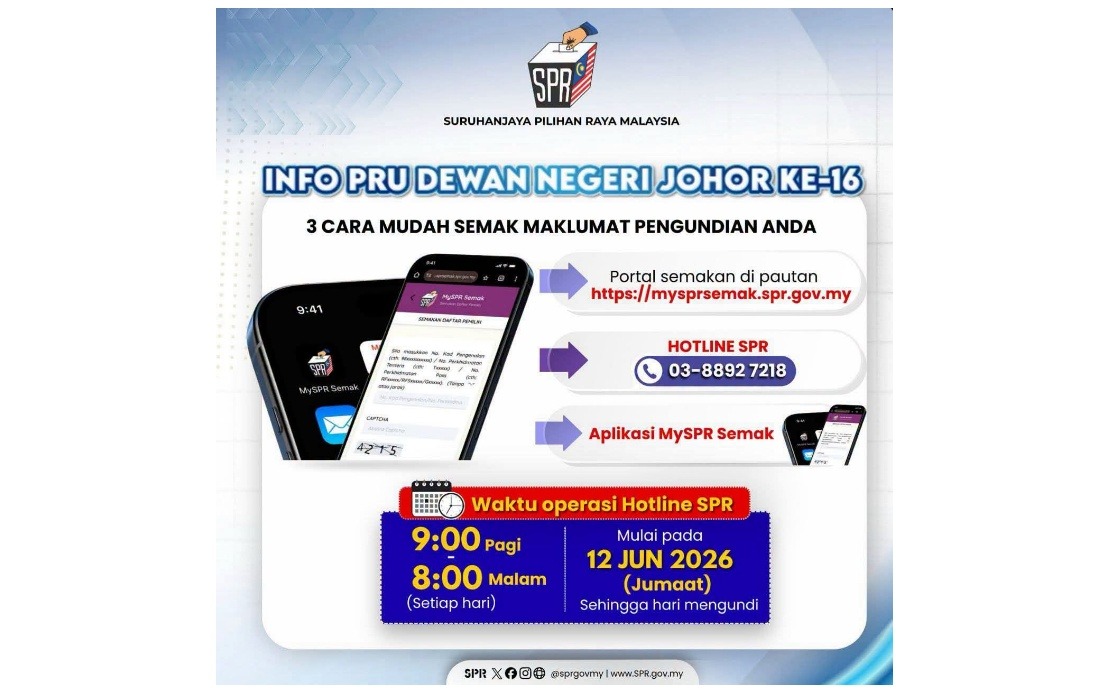
With the 16th Johor state election scheduled for Saturday, July 11, the Election Commission has issued a timely reminder urging all registered voters to verify their assigned polling centres and voting streams ahead of polling day. The advisory comes as the nation's electoral authority seeks to ensure smooth conduct of the election across the state, and citizens can easily access this critical information through two readily available digital platforms: the MySPR Semak online portal or the MySPR Semak mobile application. The Election Commission's call to action underscores the importance of voter preparedness in fulfilling civic duties during this significant electoral exercise.
An estimated 2.7 million eligible ordinary voters are anticipated to participate in Saturday's polling, with their ballots determining which 56 state assembly representatives will form the next legislative session in Johor. This voter turnout expectation reflects the substantial engagement the state's electorate has shown towards the democratic process, and the advance verification step is designed to eliminate last-minute confusion or logistical hurdles that might otherwise impede voting participation. The scale of voter mobilization required for such an election necessitates precise coordination between electoral officials and the voting public.
Early voting has already commenced, demonstrating the Election Commission's efforts to accommodate voters who face scheduling constraints or work commitments during the standard polling period. Between early voting sessions that concluded on Tuesday, a total of 19,471 personnel cast their ballots, comprising 7,960 military personnel and their spouses alongside 11,511 police officers from various units including the General Operations Force and their respective families. This substantial early voter participation reveals how security and uniformed services personnel have been allocated separate polling arrangements, reflecting the Election Commission's logistical planning to manage voting across different voter categories.
The competitive landscape of the Johor election reflects the diverse political representation seeking office. A total of 172 candidates are contesting the 56 state assembly seats, representing a wide spectrum of political formations and individual aspirants. The two major coalitions—Pakatan Harapan and Barisan Nasional—have each fielded 56 candidates, effectively contesting every available seat and positioning the election as a direct two-coalition competition. Beyond these heavyweight contenders, Perikatan Nasional has nominated 33 candidates, while Parti Bersama Malaysia fields 15 and MUDA contributes four candidates to the electoral contest.
Independent candidates and representatives from smaller political entities also feature in the race, adding further complexity to the electoral dynamics. The Parti Orang Asli Malaysia and Parti Sosialis Malaysia have placed candidates in the contest, alongside six independent candidates who are running without formal party affiliation. This breadth of political choice reflects Malaysia's electoral environment where voters in Johor will have genuine options spanning the political spectrum, from established national coalitions to newer political movements and independent voices seeking to represent constituency interests.
The practical mechanics of verifying polling information represent a critical step in ensuring efficient electoral administration. By directing voters to the MySPR Semak platform—a digitalized solution reflecting Malaysia's modernization of electoral processes—the Election Commission enables citizens to quickly ascertain which polling centre they should attend and their assigned voting stream. This advance knowledge prevents unnecessary delays at polling stations and allows voters to plan their Saturday schedules with clarity, ultimately supporting higher participation rates and smoother voting operations. The availability of both web and mobile application access acknowledges the varying technological comfort levels across the voter population.
For Malaysian voters, particularly those in Johor, this election carries implications extending beyond state-level politics. Johor's electoral outcome influences the broader political balance within Malaysia's federal structure, and state government policies directly affect residents' daily lives through education, infrastructure, healthcare, and local economic development decisions. The diversity of candidates contesting reflects how electoral competition has evolved in Malaysia, with established coalitions facing challenges from newer political movements and independent candidates. Understanding this electoral landscape helps citizens make informed voting decisions aligned with their preferences and local priorities.
Regional observers view the Johor election as an important indicator of electoral trends within Southeast Asia's established democracies. Malaysia's managed approach to electoral administration, balancing traditional voting methods with digital voter information systems, demonstrates how developing nations can modernize democratic participation without sacrificing accessibility or security. The advance notice regarding polling centre verification exemplifies how electoral commissions can leverage technology to enhance voter experience and electoral efficiency, lessons potentially applicable across the broader Southeast Asian region where election management remains a critical governance function.
The Election Commission's reminder also reflects broader efforts to combat voter apathy and encourage participation in democratic processes. By simplifying the information-gathering process and removing potential barriers to voting, electoral authorities demonstrate institutional commitment to facilitating rather than hindering voter participation. This approach contrasts with historical periods when voting obstacles were sometimes deliberately constructed, and reflects modern democratic practice's emphasis on enabling rather than restricting electoral engagement. For Johor residents, taking the suggested step to verify polling details represents both practical election day preparation and symbolic participation in Malaysia's democratic framework.

