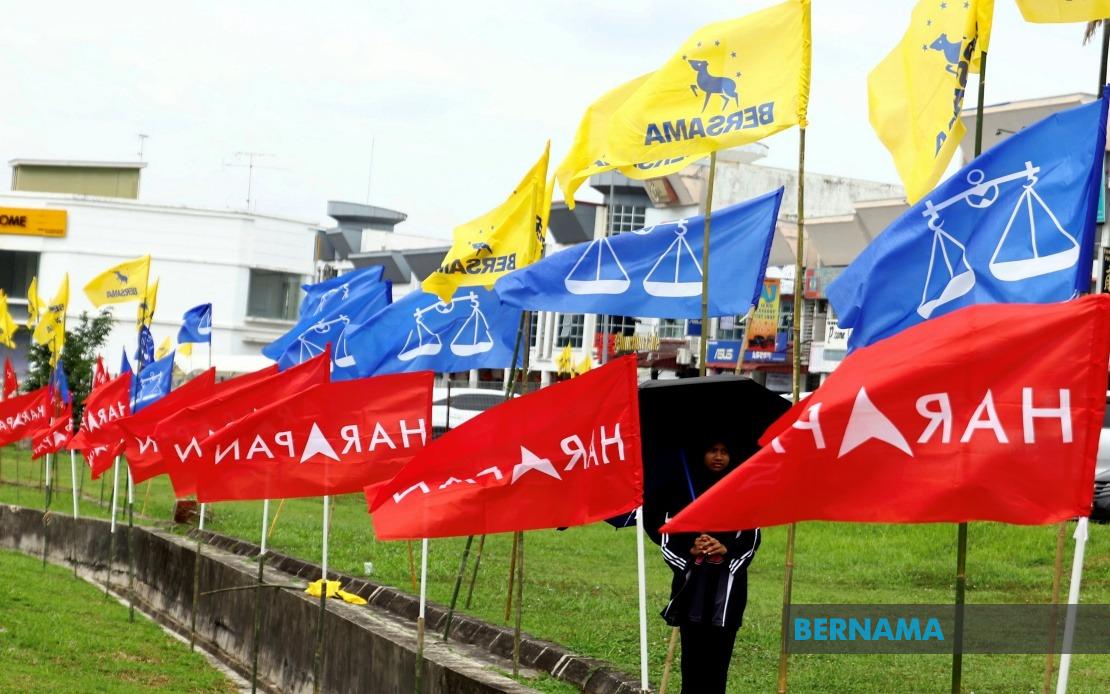
The campaign machinery for Johor's 16th state election shifts into neutral tonight at 11.59 pm, concluding two weeks of concentrated political activity that has consumed the state's political landscape. From early morning tomorrow at 1,076 polling centres across Johor, some 2.7 million registered voters will exercise their franchise to determine which of 172 candidates secure the 56 state assembly seats. The election marks a significant moment for the strategic southern state, whose political composition will shape governance priorities and policy direction through 2029.
The electoral contest itself has drawn substantially fewer candidates than its predecessor. The 172 contenders standing tomorrow contrast sharply with the 239 who contested the 2022 election, suggesting a more consolidated candidature among major political actors. The six established competing coalitions and independent candidates represent a fractionalised political landscape, though two coalitions dominate: Barisan Nasional fielded 56 candidates alongside Pakatan Harapan's identical quota, while Perikatan Nasional committed 33 hopefuls and smaller parties contributed the remainder. This configuration reflects the broader national political terrain, where the federal Unity Government framework involving BN and PH coexists with persistent competition from other political forces.
Voter participation emerges as the central variable that political analysts and observers are monitoring. Dr Nazreena Mohammed Yasin from Universiti Tun Hussein Onn Malaysia cautioned against treating turnout as a universal predictor, emphasising that its effects vary substantially by constituency type and demographic composition. In some localities, elevated participation may disproportionately advantage particular contenders, whilst in others the relationship proves negligible. The 2022 election registered 54.92 per cent turnout, establishing a baseline for comparison. Nazreena's analysis highlights the distinction between aggregate turnout figures and their granular electoral consequences: what matters fundamentally is how mobilisation patterns translate across marginal constituencies where victory margins remain razor-thin.
The machinery of political parties and their ground operations emerge as another critical success factor. Beyond headline turnout statistics, how effectively each camp organises supporter mobilisation and manages polling day logistics determines whether organisational strength converts into parliamentary seats. This operational dimension proves especially consequential in closely contested divisions, where administrative efficiency and volunteer coordination can tip outcomes. The analyst underscored that such marginal seats—where previous election victories proved narrow—represent battlegrounds where disciplined party machinery delivers measurable advantages.
Another layer of electoral unpredictability stems from the substantial constituency of undecided voters. These fence-sitters, whose preferences crystallise only in the campaign's final days or even at the polling booth itself, possess disproportionate influence in closely contested races. Their last-minute choices in marginal seats could reshape the parliamentary composition independent of broader trend lines that pre-election analysis identified. This element of voter volatility complicates forecasting and underscores why final campaign moments retain significance.
Political analysts also point toward comparative trends in victory margins as a metric for evaluating electoral momentum. Did coalitions that performed strongly in 2022 expand their support, or have they experienced erosion? Did opposing forces gain ground in constituencies they previously lost? Such margin shifts provide insight into whether voter allegiances have consolidated around incumbent players or whether realignment is underway. These patterns reflect underlying shifts in public confidence that raw seat counts alone cannot capture.
Assoc Prof Dr Mazlan Ali from Universiti Teknologi Malaysia identified political stability as the dominant campaign narrative, with both major coalitions emphasising their governance track record and their roles within the federal Unity Government framework. This messaging choice signals that major competitors view governmental credibility and institutional stability as persuasive themes with voters. Mazlan notes that whilst various manifestos and pledges circulated throughout the campaign, voters increasingly evaluate parties through performance lenses rather than aspirational promises alone. The historical ability to deliver on stated objectives, demonstrated across federal and state governance, shapes electoral judgement more powerfully than campaign rhetoric.
The campaign itself commenced on June 27, providing two weeks during which political parties articulated visions centred on economic concerns. Cost of living pressures, employment generation, economic recuperation, and public welfare schemes dominated party messaging, reflecting voter preoccupations in an inflationary environment. These kitchen-table issues transcend partisan divisions and touch everyday household calculations, making them powerful electoral variables. How convincingly each coalition addresses such concerns influences their electoral prospects.
Early voting procedures completed last Tuesday allowed Malaysian Armed Forces personnel, police officers, General Operations Force members, and their spouses—20,607 individuals collectively—to cast ballots in advance. This military and security sector constituency, though numerically modest relative to total eligible voters, represents a strategically important demographic whose voting patterns merit monitoring as results emerge.
The state's previous composition provides context for tomorrow's outcome. Before dissolution on June 1, Barisan Nasional controlled 40 of 56 seats, complemented by Pakatan Harapan's 12 seats, Perikatan Nasional's three seats, and MUDA's single representative. This configuration reflected the previous election's verdict. Tomorrow's ballot determines whether BN consolidates its majority, whether PH advances into opposition leadership, or whether fragmentation produces more complex parliamentary arithmetic requiring post-election coalition engineering.
The Election Commission anticipates full results by 10 pm tomorrow, allowing Malaysians and regional observers to assess how this significant state election shapes the country's political trajectory. Johor, as the federation's economic engine and strategically located southern anchor, carries implications extending beyond state governance into national political dynamics. The outcome will signal whether voter support patterns evident in 2022 persist or whether electorate preferences are shifting as Malaysia navigates post-pandemic recovery and cost-of-living challenges that have intensified since the previous election.
As polling centres open tomorrow and voters file through, the months of campaign activity, competing manifestos, and political mobilisation crystallise into concrete parliamentary outcomes. The range of possible results reflects genuine electoral uncertainty, with no coalition possessing absolute guarantees despite incumbent advantages or organisational resources. This unpredictability, combined with Johor's political and economic significance, ensures that tomorrow's election constitutes a pivotal moment for Malaysian political development.

