The Johor government has unveiled an ambitious RM50 million initiative to refresh the appearance of residential buildings across the state, signalling a commitment to upgrading infrastructure in communities that have historically faced maintenance challenges. The large-scale repainting programme will encompass 170 housing blocks spread across 26 locations throughout Johor, addressing the visible deterioration that often marks low-cost housing estates in Malaysia's rapid urbanisation landscape.
Heading the initiative is the State Housing and Local Government Committee, with Datuk Mohd Jafni Md Shukor emphasising that the scope extends beyond cosmetic improvements. The undertaking will directly touch the lives of approximately 46,772 residents while simultaneously serving broader purposes of community revitalisation and environmental restoration. By targeting both privately owned low-medium-cost flats and government-allocated public housing, the programme demonstrates an understanding of Johor's diverse residential landscape where mixed-tenure housing complexes have become commonplace in major urban centres.
The strategic rollout involves a coordination framework that draws together multiple state and local authorities. Implementation responsibilities fall to the Johor State Housing Development Corporation and the Local Government Division under the Johor State Secretary's Office, with direct operational support from four city and municipal councils: Johor Bahru City Council, Iskandar Puteri City Council, Pasir Gudang City Council, and Kulai Municipal Council. This multi-agency approach reflects the administrative complexity of managing housing estates that often span multiple jurisdictional boundaries, a challenge facing many Malaysian states grappling with fragmented urban governance.
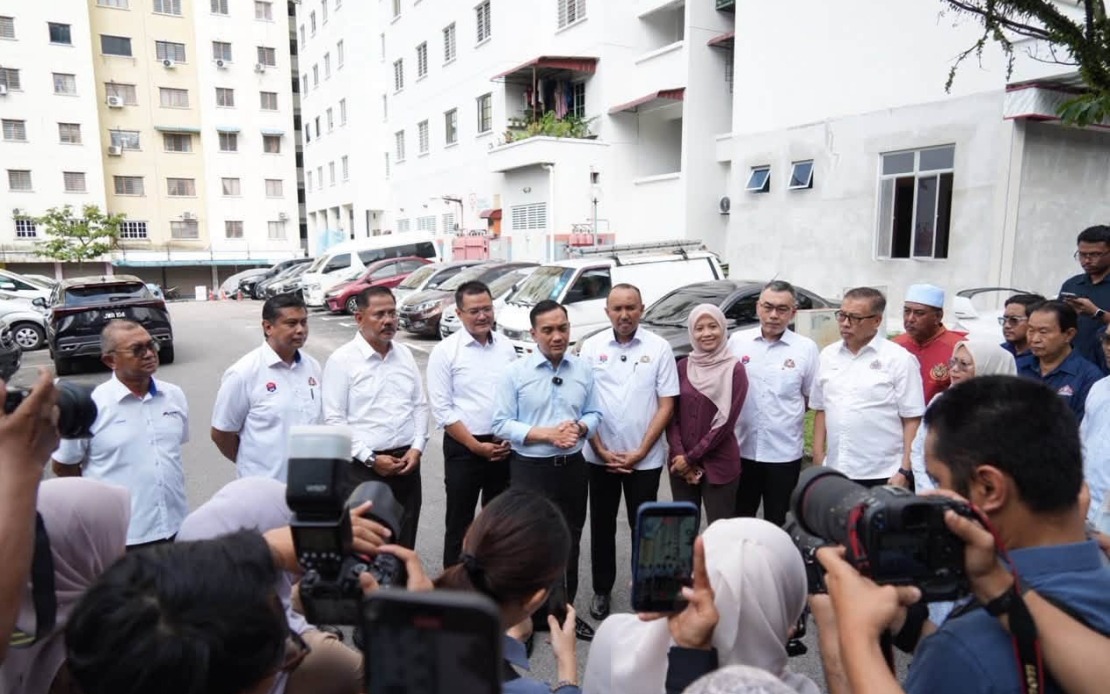
Datuk Mohd Jafni and Johor Menteri Besar Datuk Onn Hafiz Ghazi conducted an inspection at Desa Muafakat Apartments, where repainting works have commenced. Beyond the paint application itself, officials identified and assessed secondary infrastructure concerns affecting resident wellbeing, including slope subsidence near parking areas and internal road deterioration. This holistic site assessment suggests that the repainting initiative may catalyse broader remedial work, though funding limitations for such ancillary repairs remain unclear.
The committee chairman articulated a philosophy recognising that housing aesthetics carry psychological and social implications often overlooked in policy discussions. He noted that well-maintained, visually appealing residential environments foster community cohesion, instil resident confidence in government responsiveness, and create environments conducive to informal social interaction. For lower-income communities frequently stereotyped through media narratives, such environmental improvements can contribute meaningfully to dignity and social perception, though sceptics rightly question whether paint alone addresses root concerns around maintenance culture and accountability systems.
Quality assurance mechanisms form a crucial component of the programme's architecture. All implementing agencies and contractors have received explicit reminders regarding workmanship standards, safety protocols, and cleanliness requirements throughout execution. This emphasis reflects previous disappointing experiences with government projects that appear visually satisfactory upon handover but deteriorate rapidly through poor material selection, inadequate surface preparation, or insufficient protective coatings. Datuk Mohd Jafni's concern that projects must not create new problems for residents acknowledges this pattern while signalling heightened oversight.
The financial commitment of RM50 million represents a considerable allocation for a single state programme, particularly when evaluated against competing priorities in infrastructure, education, and healthcare. For Malaysian states observing Johor's approach, the initiative presents both inspiration and cautionary lessons regarding resource deployment priorities. Whether such investment generates proportional returns depends partly on underlying maintenance systems that prevent future deterioration and engage residents in environmental stewardship.
The programme's timing coincides with broader discussions about housing quality in Southeast Asian cities, where rapid development has sometimes outpaced effective asset management systems. Johor's initiative acknowledges that quality of life encompasses environmental aesthetics, a factor particularly significant for communities where housing represents the most substantial family asset. By framing the project explicitly as community benefit rather than purely fiscal expenditure, state officials attempt to demonstrate responsiveness to resident concerns.
Implementation timelines remain unstated in official announcements, though the scope suggests multi-year execution across multiple sites. Coordination complexities inherent in managing projects across four separate local authorities may challenge efficient delivery. Malaysian readers familiar with state-level housing initiatives will recognise the administrative hurdles typical of such undertakings, from seasonal weather delays to contractor availability challenges.
The broader significance extends beyond physical improvement to encompassing questions about state responsibility for residential environment quality. By undertaking this large-scale repainting initiative, Johor establishes an expectation framework that other states may find difficult to decline, potentially creating political pressure for comparable programmes elsewhere. For residents in comparable housing complexes throughout Malaysia, this intervention raises standards for what constitutes acceptable government engagement with lower-income communities.

