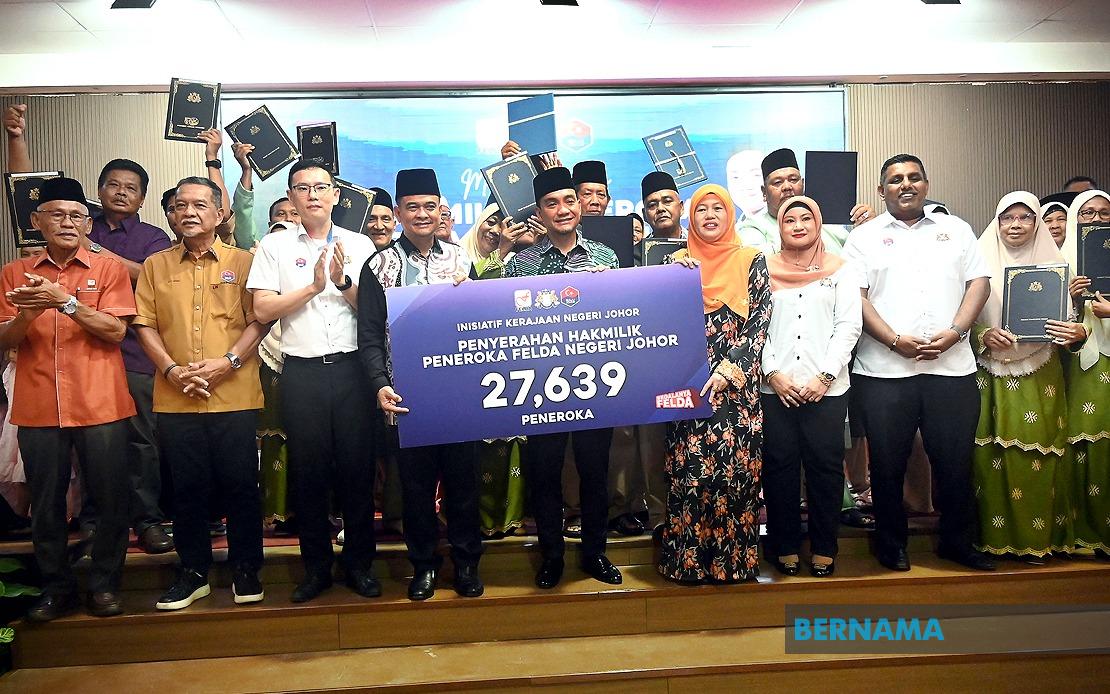
The Johor state government has effectively resolved a decades-old administrative bottleneck that had left thousands of Federal Land Development Authority settlers in limbo over property ownership, bringing closure to what had become one of the most pressing rural welfare concerns in the state. At a land title presentation ceremony held in Kluang on June 23, Menteri Besar Datuk Onn Hafiz Ghazi announced that 27,639 applications out of 27,642 had been processed and approved, achieving a resolution rate of 99.99 per cent. The remaining three cases represent an insignificant proportion of the total caseload, effectively marking the completion of an initiative that had stalled for years under previous administrations.
The practical significance of this achievement cannot be overstated for the affected communities. FELDA settlers, particularly those engaged in plantation agriculture across Johor's three major scheme zones—Kluang, Kota Tinggi and Mersing—have historically faced uncertainty regarding formal ownership documentation. This uncertainty undermined their ability to obtain credit, sell property, secure insurance, or plan long-term investments with confidence. The absence of clear land titles created a precarious situation where settlers operated their holdings without the legal protections afforded to other property owners, effectively rendering their primary assets less valuable and more vulnerable to disputes.
On June 23, the state government distributed land titles to 210 settlers across the three district schemes, providing them with official documentation that finally codified their ownership rights. This batch distribution represented the culmination of sustained bureaucratic effort and reflects a deliberate policy shift toward prioritising rural grievance resolution. For recipients, the presentation ceremony itself carried symbolic weight—public acknowledgement of their claims and formal validation of their status as legitimate landowners. The ceremony's prominence, attended by senior state officials including Johor Agriculture, Agro-based Industry and Rural Development Committee chairman Datuk Zahari Sarip, signalled that the government regarded this matter as administratively important and politically significant.
Menteri Besar Onn Hafiz's public commitment at the ceremony to maintain this momentum suggests that land title resolution has become embedded within the Johor government's broader rural development strategy. His statement that FELDA settlements would continue to receive priority attention and that emerging issues would be addressed proactively indicates a philosophical shift in how the state apparatus engages with agricultural communities. This represents a departure from previous administrative approaches that had permitted title applications to accumulate unresolved in government offices, effectively deprioritising settler welfare despite the fundamental importance of property rights to rural economic security.
The resolution of this issue carries implications beyond the immediate beneficiaries. Legitimate property documentation strengthens rural land markets, enabling settlers to participate more fully in agricultural commerce and facilitating inheritance transfers within families. When land titles are formalized, collateral availability increases, allowing farmers to access credit for equipment purchases, land improvements, and operational expansion. Financial institutions become more willing to lend against documented property, thereby unlocking investment capital that had previously remained inaccessible to settlers operating under informal arrangements. This structural improvement in financial inclusivity contributes to broader rural development objectives by enabling agricultural intensification and diversification.
From a governance perspective, the near-complete resolution of this backlog demonstrates that systematic administrative problems, even long-standing ones, can be addressed through focused institutional commitment and adequate resource allocation. The 99.99 per cent clearance rate indicates that the Johor government successfully mobilized land registry personnel, legal experts, and administrative staff to process applications efficiently while maintaining accuracy. The minimal number of unresolved cases—just three applications—likely reflects edge cases involving complex ownership disputes or incomplete documentation rather than systemic institutional failure. This distinction is important, as it suggests that the government did not simply rubber-stamp approvals to achieve headline figures, but rather maintained rigorous verification procedures.
The timing of this announcement assumes added significance within Malaysia's broader discourse on rural governance. FELDA schemes represent a distinctive institutional arrangement unique to Malaysian development history, combining land settlement, agricultural production, and social provision functions. These schemes have sometimes struggled with administrative accountability and service delivery, making their governance a touchstone for evaluating state-level effectiveness in rural management. Johor's progress on land title resolution therefore carries demonstration value, suggesting that well-resourced state administrations can successfully navigate the intersection of land law, settler interests, and bureaucratic procedure.
For neighbouring Malaysian states facing similar FELDA-related grievances, the Johor experience offers both a benchmark and a policy template. Several other states operate FELDA schemes or comparable rural settlement programmes where land title issues persist. The clear identification of specific targets—27,642 applications—and the systematic working through this inventory to 99.99 per cent resolution provides a replicable model that other governments might adopt. The public documentation of progress also creates accountability mechanisms, as future administrations would face difficulty reversing gains or allowing backlogs to reaccumulate without political cost.
The broader rural development agenda that Menteri Besar Onn Hafiz invoked warrants attention. Land title resolution forms only one component of comprehensive rural development strategy, which typically encompasses infrastructure improvement, market access enhancement, agricultural training, and commodity price support. By anchoring land title work within this wider framework, the Johor government positioned property rights formalization not as a charitable gesture or administrative housekeeping, but as a foundational element enabling subsequent development initiatives. Settlers with secured property documentation can participate more effectively in cooperative arrangements, cooperative borrowing schemes, and state-sponsored agricultural modernization programmes.
The outstanding three unresolved applications merit careful handling by the state government. These remaining cases warrant individual attention and transparent communication to the affected settlers regarding the specific obstacles preventing title issuance. Premature announcement of 100 per cent completion without resolving these three cases would undermine the credibility of the achievement and signal to beneficiaries that some residents had been effectively abandoned. Conversely, demonstrating government determination to address even these difficult outlying cases would reinforce the message that rural settler concerns receive sustained institutional attention.
Looking forward, the sustainability of this achievement depends on whether the Johor government maintains the administrative infrastructure and political commitment that made 99.99 per cent resolution possible. Future applications from new settlers or from existing settlers encountering title transfer situations must be processed expeditiously to prevent new backlogs from forming. Regular public reporting on land title processing timelines would maintain transparency and enable early identification of emerging bottlenecks. The precedent set by this initiative creates public expectations that FELDA matters will receive priority treatment, making it essential that subsequent administrations sustain the institutional capacity and political will that drove this achievement.
The resolution of 27,639 land title applications represents tangible improvement in rural property rights security and demonstrates capacity within state-level governance structures to address longstanding structural problems affecting agricultural communities. For the 210 settlers who received land titles at the Kluang ceremony and the thousands who have received documentation through this process, the implications extend far beyond symbolic recognition—they encompass genuine economic empowerment and enhanced security for their families' primary assets. The near-universal resolution rate signals that systematic rural administrative challenges, when addressed with appropriate resources and political commitment, can be largely overcome.

