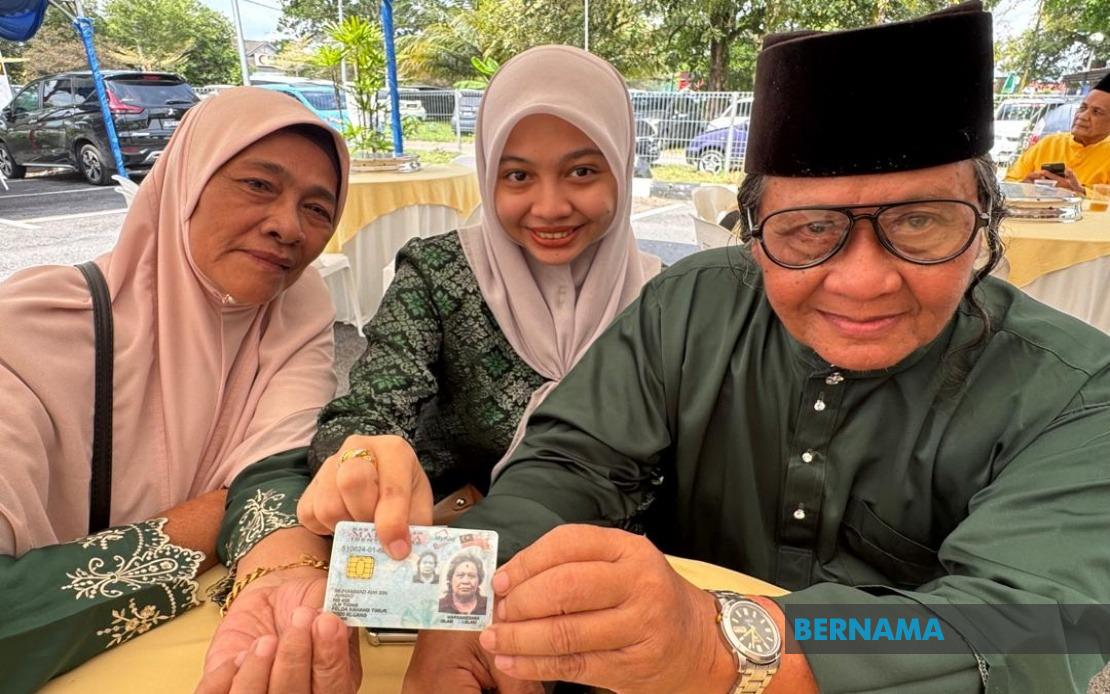
A milestone was reached yesterday in Kluang as 210 Felda settlers from three districts received formal ownership titles to their plantations and residential land, marking the culmination of a bureaucratic struggle that has constrained settlement communities across Johor for generations. The handover ceremony, presided over by Menteri Besar Datuk Onn Hafiz Ghazi at Dewan Dato' Onn in Rumah Komuniti Parlimen Sembrong, underscores a significant shift in how the state government is tackling one of the most persistent grievances within the Felda framework—the absence of formal land ownership documentation despite settlers having cultivated and maintained their plots for decades.
The emotional resonance of the occasion was captured perfectly in Muhammad Awi Ahmad's story. At 75 years old, receiving an ownership title to his 4.2-hectare property in Felda Kahang Timur constituted far more than a routine administrative transaction; it represented vindication of his labours since 1986 and the closure of a chapter marked by repeated disappointment. His earlier applications in 1990 and 2000 had been rejected, leaving him in legal limbo for much of his working life. Under the current administration, however, his third application was processed and approved within approximately twelve months—a dramatic acceleration compared to the glacial pace of previous decades. For someone who had invested nearly four decades in cultivating land without possessing formal proof of ownership, the timing could scarcely have been more poignant.
The experiences of other recipients reveal the scale of the problem that persisted across Johor's Felda communities. Mohd Farhan Mohamad, now 43, had initiated the process in 2006 when his father Mohamad Masek, who began farming in the 1980s, wished to secure his family's tenure. Nearly two decades elapsed before the latest application was finally approved. Such prolonged uncertainty creates compounding effects that ripple through generations, leaving families unable to leverage their assets for credit, unable to plan long-term improvements, and vulnerable to disputes over succession and inheritance. The emotional toll of such limbo extended well beyond the first generation of settlers themselves.
The generational dimension came into sharp focus through testimony from Norliyani, Muhammad Awi's 25-year-old daughter, who articulated the stakes for younger Felda families with particular clarity. While her father's generation maintained connections to ancestral villages and could theoretically retreat to those original homes, Norliyani and her peers have no such safety net. For them, the Felda settlement is not a transitional arrangement or a developmental stepping stone—it is home, their only home. The prospect that parents who had cultivated land across four or five decades might lose it to third parties, or that inheritance disputes could dispossess the next generation, was not abstract anxiety but a tangible threat. Her intervention in the ceremony represented not merely family gratification but a statement about the existential concerns facing thousands of young Malaysians whose futures remain tethered to unresolved land questions.
The statistical dimensions of the resolution effort are noteworthy. As of the ceremony date, 27,639 out of 27,642 Felda settlers across Johor who had submitted applications had received their ownership titles, representing 99.9 per cent approval. This near-universal success rate stands in stark contrast to the rejection patterns that persisted through the 1990s and 2000s, suggesting a fundamental reorientation of state policy and administrative capacity. The figure encompasses multiple districts including Kluang, Kota Tinggi, and Mersing, indicating that the initiative extends beyond isolated pockets to encompass the broader Felda landscape across the southern state.
The Felda framework itself, established as a vehicle for rural development and smallholder empowerment, had paradoxically created institutional impediments to full ownership rights. Settlers cultivated land under schemes that positioned them as beneficiaries of state land rather than proprietors. Over time, this ambiguity created legal complications, administrative bottlenecks, and cycles of application and rejection. The persistence of this arrangement into the 2020s represents a policy failure spanning multiple administrations, though the current initiative suggests political will to address the accumulated grievances. For Malaysia's broader rural development narrative, the Johor resolution carries implications about how legacy schemes require periodic modernisation to ensure they genuinely serve settler interests rather than perpetuating dependency or legal uncertainty.
The practical consequences of securing formal title extend into multiple domains. Titled land becomes collateral for agricultural loans, enabling investment in improved farming techniques, equipment, or crop diversification. It becomes inheritable property that can be formally transferred to heirs, eliminating disputes and ensuring family continuity. It becomes saleable, allowing settlers to exit agriculture if desired or to consolidate holdings. It also confers dignity and recognition—the psychological weight of possessing formal state acknowledgement of one's claim cannot be understated, particularly for individuals whose labour has literally transformed landscape into productive holdings.
For the broader Southeast Asian context, the Johor initiative illuminates persistent challenges within historical land settlement schemes. Many countries across the region—Indonesia, Thailand, and others—maintain variants of settler frameworks that similarly leave beneficiaries in ambiguous legal positions. Malaysia's experience suggests that such ambiguities do not resolve themselves but accumulate into problems affecting multiple generations. The political cost of indefinitely withholding full ownership rights eventually becomes untenable, particularly as settled communities mature and younger generations demand clarity about their prospects.
The role of political leadership in accelerating the process deserves emphasis. The shift from decades of rejections to near-universal approval within a year suggests that institutional resistance was not insuperable but rather reflected priority allocation at the executive level. When Menteri Besar Onn Hafiz Ghazi's administration made settler land titles a focus, bureaucratic and logistical obstacles that had seemed permanent suddenly yielded. This pattern underscores how historical policy gridlock often reflects political neglect rather than genuine legal or administrative impossibilities.
Looking forward, the resolution of the Johor Felda land title question may catalyse similar initiatives in other states with comparable settler populations. Kedah, Pahang, and other states maintain substantial Felda communities whose land ownership status requires similar clarification. The Johor precedent demonstrates that comprehensive resolution is administratively feasible and politically beneficial, providing a template that other state governments might adopt. For settlers in those jurisdictions, the success in Johor offers evidence that decades-long waits need not be permanent.
The emotional triumphalism evident in yesterday's ceremony masks deeper questions about why such fundamental rights required so prolonged a struggle. Yet the practical reality remains: nearly 28,000 families across Johor can now plan their futures with legal certainty. For Muhammad Awi Ahmad, marking his 75th birthday with formal ownership of the land he has tended since his fifties, the resolution came not too early but perhaps just in time. For thousands of younger Malaysians like Norliyani, the securing of parental assets provides foundation for planning their own lives within communities they now know will remain theirs.

