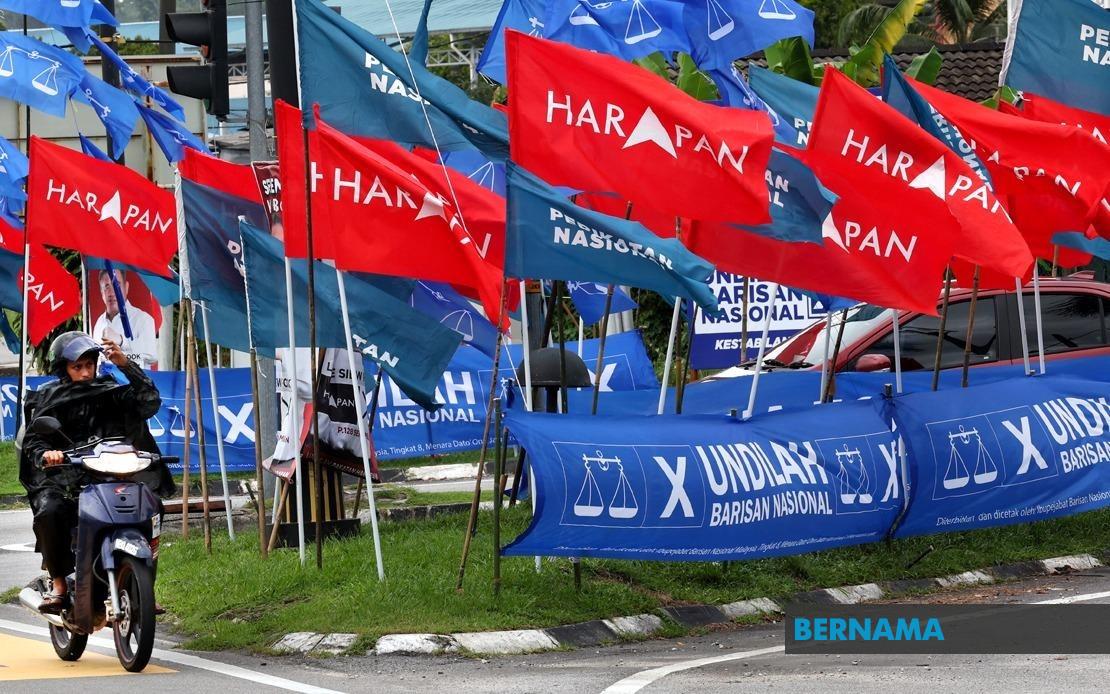
The 16th Johor state election campaign has entered a critical final phase, with less than two days remaining before the midnight deadline on July 10. Across the state, 172 candidates representing multiple political coalitions are intensifying their ground efforts to capture voter support ahead of Saturday's polling day, signalling that the contest remains fiercely competitive down to its closing hours.
Packatan Harapan maintains a visible advantage in terms of high-level political presence, with Prime Minister Anwar Ibrahim scheduled to lead campaign rallies at three key locations tonight, signalling the coalition's confidence in specific marginal battlegrounds. The decision to deploy the nation's top political leader reflects PH's strategic assessment of where victory margins may be tightest, with particular focus on the Puteri Wangsa constituency, widely considered a bellwether seat that could signal broader voting trends across the state. Such targeted deployment of national figures at the campaign's tail end typically indicates coalitions are attempting to consolidate support in constituencies where initial polling or internal party assessments suggest the race remains unsettled.
Maszlee Malik, the PH candidate for Puteri Wangsa, leveraged social media to generate attendance at the coalition's "Grand Finale Harapan Johor Selatan" rally, employing informal messaging designed to resonate with younger voters through references to fear of missing out. This strategic choice underscores how modern Malaysian election campaigns blend traditional mass rallies with digital-age engagement tactics. The emphasis on final momentum-building events reflects a deeper campaign reality: the last 48 hours often determine whether a candidate can shift uncommitted voters or consolidate support among those already leaning toward their coalition.
Personal resilience narratives have also emerged as campaign elements, with Dr A. Ruban, the PH candidate for Paloh, publicly announcing his return to active campaigning after taking time for medical treatment. Such messaging serves dual purposes—demonstrating commitment through physical presence despite health challenges, while implicitly reassuring supporters that candidate viability remains uncompromised. These human-interest dimensions of campaigns often resonate strongly in local Malaysian politics, where personal qualities and perceived dedication are valued alongside policy positions.
Packatan Harapan's party machinery has similarly mobilised extensively, with Johor PKR chairperson Datuk Seri Dr Zaliha Mustafa participating in grassroots convoys designed to reach dispersed voter populations. The deployment of 120 motorcyclists in a motorised convoy targeting Felda Redong for the Kemelah candidate represents both a spectacle designed to generate local media attention and a pragmatic approach to reaching rural voters who may be less accessible through conventional campaigning methods. Such initiatives highlight how different constituencies demand tailored engagement approaches based on geography and demographics.
Barisan Nasional, as the incumbent coalition governing Johor through Menteri Besar Onn Hafiz Ghazi, has pursued a mixed strategy combining executive visibility with grassroots outreach. BN coalition chairman Ahmad Zahid Hamidi's final campaign push across Endau and Kempas represents an attempt to stabilise support in constituencies that may feel competitive pressure from opposition challenges. The sitting Menteri Besar's continued active campaigning for his own Machap seat suggests internal party assessments indicate the race requires sustained effort even in what might conventionally be considered safe seats. Such precautions indicate that no BN stronghold should be assumed secure given the broader state-level political dynamics.
Perikatan Nasional, positioned as the third major competing force in Johor politics, is mounting a counter-offensive through its mega rally in Endau featuring party leadership including chairman Ahmad Samsuri Mokhtar and PAS president Abdul Hadi Awang. The mobilisation of top-tier PN figures demonstrates that this coalition views the state election as consequential for its national political positioning, particularly given Perikatan's stated ambitions to expand beyond its current geographic strongholds. The selection of Endau for a leadership rally suggests internal polling or strategic assessment indicates this constituency represents an achievable target for PN advancement.
Smaller parties and independent candidates have also maintained campaign momentum through unconventional means, with Parti Bersama Malaysia deploying a mobile campaign truck to reach voters across multiple locations, while individual candidates continue community dialogue programmes. These grassroots-focused approaches reflect how Malaysian elections operate across multiple campaign scales simultaneously—from prime ministerial rallies commanding media attention to intimate community conversations driving voter decisions in specific neighbourhoods. Both dimensions contribute meaningfully to overall campaign outcomes.
The geographic spread of campaign activities across all 56 state seats indicates that no corner of Johor remains uncontested, though candidate quality, resource availability, and party machinery strength vary considerably between constituencies. The fact that candidates are sustaining intensive ground campaigns until the final permitted moment suggests Malaysian voters in Johor may remain genuinely undecided in substantial numbers, creating real competitive space for all three major coalitions heading into Saturday's voting.
The election itself carries implications extending beyond state-level governance, potentially influencing national political dynamics and coalition stability. Johor, as Malaysia's second-largest state by population and a historically important political territory, traditionally serves as a barometer for broader electoral trends. The outcome on Saturday could provide valuable signals regarding voter sentiment toward Anwar Ibrahim's federal administration, BN's recovery trajectory, and Perikatan Nasional's capacity to expand electoral influence beyond its northern and eastern strongholds. For Malaysian political observers and regional analysts tracking Southeast Asian electoral developments, Johor's results will offer insight into how religious-based parties, establishment coalitions, and reform movements are currently faring at the state level.

