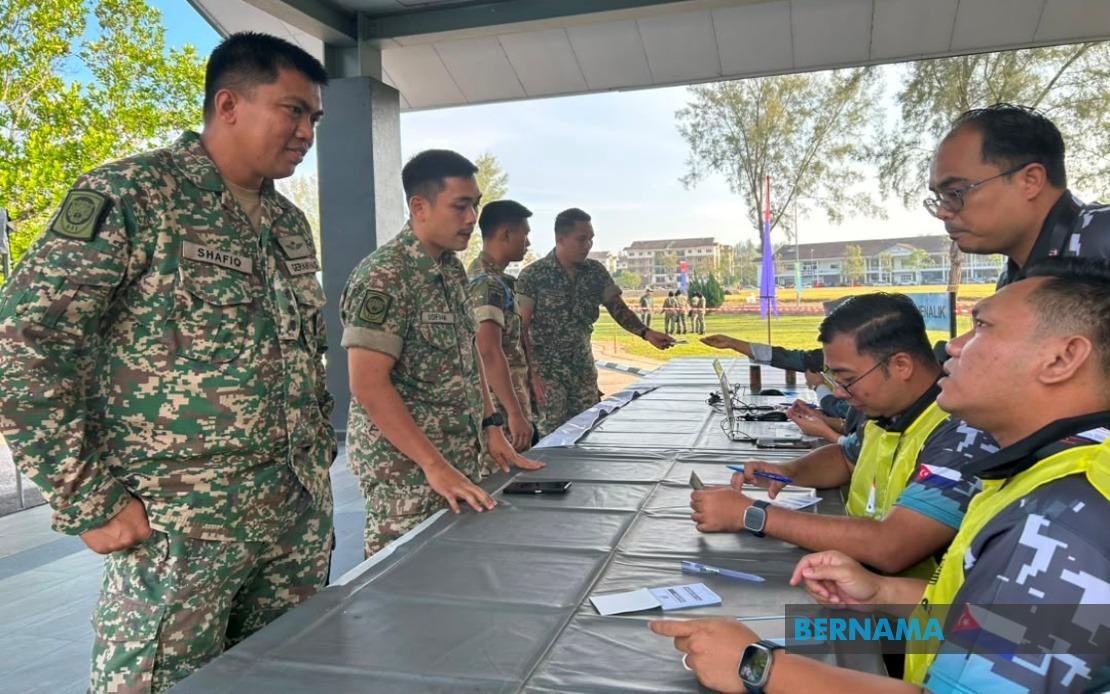
Early voting in Johor's 16th state election crossed the halfway mark by mid-morning on July 7, reflecting strong participation among security personnel and military staff eligible to vote ahead of Saturday's main polling day. The Election Commission reported that 56.32 per cent of registered early voters—equivalent to 11,605 individuals out of a total 20,607—had already cast their ballots by 11 am, indicating healthy engagement with the advance voting process.
The advance voting system, restricted to security and defence personnel together with their spouses, represents a standard feature of Malaysian electoral procedure designed to accommodate those with scheduling constraints due to their professional duties. Across 64 designated polling centres that opened at 8 am, the turnout demonstrated consistent movement throughout the morning, suggesting organised and efficient voting operations. The staggered closure schedule, with different centres closing between noon and 6 pm depending on local circumstances and voter density, was designed to accommodate the geographic spread of voting locations throughout the state.
Breaking down the early voter composition reveals the dominant role of police and paramilitary forces in the advance ballot count. Of the 12,063 Royal Malaysia Police and General Operations Force personnel registered for early voting, along with their eligible spouses, 6,852 had cast votes by the 11 am checkpoint. This figure represents approximately 56.8 per cent participation among this security cohort. Meanwhile, Malaysian Armed Forces members and their families showed comparable engagement, with 4,753 of the 8,544 eligible military voters having already submitted their ballots, translating to roughly 55.7 per cent participation among defence personnel.
The Johor state election itself represents a significant political moment for Malaysia's southern peninsula, with 172 candidates competing for 56 state assembly seats. This contested field indicates vigorous electoral competition across the state's constituencies, with candidates from various parties seeking to secure these legislative positions. The upcoming Saturday polling day is expected to draw approximately 2.7 million registered voters to the ballot box, making this one of the larger electoral exercises in recent Malaysian political history.
For Malaysian observers tracking electoral engagement patterns, the early voting performance offers preliminary indicators of voter enthusiasm and organisational effectiveness. The rapid achievement of the 50 per cent threshold suggests that the advance voting machinery is functioning smoothly, with security force participation—historically among the most organised voting blocs—proceeding without significant logistical impediments. The comparable participation rates between police and military voters indicate fairly uniform engagement across different security branches.
From a broader perspective, early voting performance in Malaysian elections often correlates with overall polling day turnout, though security and defence personnel typically exhibit higher participation rates than the general population. The strong showing in Johor's advance voting could portend substantial overall engagement when regular voters go to the polls on Saturday, though various other factors—including weather, local political dynamics, and campaign momentum—will ultimately influence final turnout figures.
The administration of the election across multiple polling centres demonstrates the institutional capacity of the Election Commission to manage simultaneous voting operations across dispersed geographic locations. The fact that 64 centres operated simultaneously without apparent disruption reflects considerable logistical planning and coordination. Managing staggered closure times based on voter numbers and location represents a practical approach to accommodating variable population densities and ensuring orderly, unhurried voting procedures.
The composition of early voters—overwhelmingly security and defence personnel—reflects a specific policy decision regarding electoral access and scheduling. These professional groups maintain operational responsibilities that may conflict with standard weekend voting schedules, necessitating advance voting provisions. However, this also means that Saturday's general polling will involve a substantially larger cross-section of the electorate, including voters without such scheduling constraints, potentially offering a more demographically representative sample of electoral preferences across Johor.
As Johor moves toward Saturday's main election day, the early voting phase has established baseline participation metrics and tested electoral infrastructure. Election officials will likely analyse these early voting patterns to identify any procedural refinements needed before the larger influx of voters on Saturday. The smooth progression of advance voting operations suggests that technical and organisational preparations are proceeding as planned, providing some assurance regarding the capacity to manage the expected 2.7 million voters throughout the following day.
The timing and scale of this election carries implications beyond Johor itself, as state-level contests often serve as political barometers for national sentiment and party performance. The competitive field of 172 candidates across 56 seats indicates genuine electoral contestation, with multiple parties evidently believing they can secure meaningful representation. How voters ultimately distribute their preferences across this diverse candidate pool will shape Johor's political direction and may offer insights into broader electoral trends affecting Malaysia as a whole.

