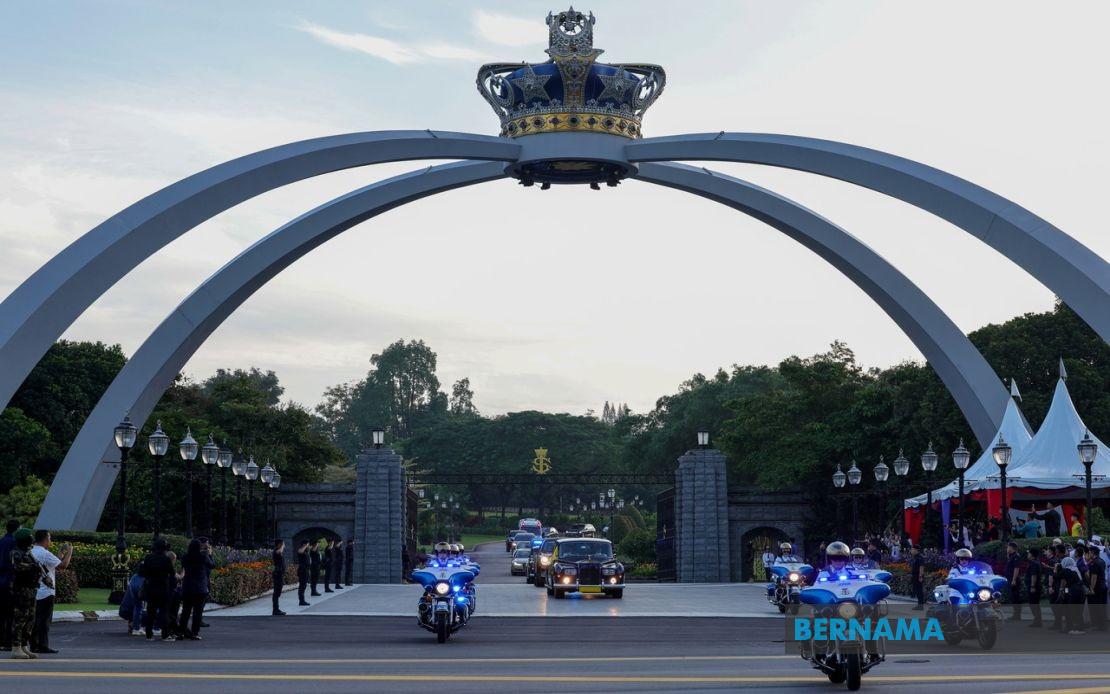
The formal swearing-in of Johor's newly constituted State Executive Council has been delayed by twenty-four hours, moving from Friday to Saturday at Istana Bukit Serene in Johor Bahru. The postponement was announced to the media on the morning the ceremony was originally scheduled to proceed, though authorities declined to provide any explanation for the reschedule.
The revised ceremony is now set to take place before Tunku Mahkota Ismail, the Regent of Johor, with the attendance of Menteri Besar Datuk Onn Hafiz Ghazi, State Secretary Datuk Mohammed Ridha Abd Kadir, and Johor Royal Council president Datuk Dr Rahim Ramli. The gathering represents a significant administrative milestone following the recent restructuring of Johor's political leadership at the state level.
This swearing-in follows the confirmation of Datuk Onn Hafiz Ghazi, who represents the Machap state assembly constituency, as Menteri Besar for a second consecutive term. His reappointment came last Sunday, just days after the conclusion of Johor's sixteenth state election, which delivered a commanding endorsement of the Barisan Nasional coalition's stewardship of the state.
The electoral outcome proved particularly emphatic, with Barisan Nasional capturing forty-eight of the fifty-six seats available in the Johor State Legislative Assembly. This commanding majority represents a strong mandate from voters and provides Datuk Onn Hafiz with substantial parliamentary support to advance his government's agenda across the full length of his second term. The scale of the victory underscores the coalition's consolidation of electoral dominance in Malaysia's southernmost peninsula state.
The composition of the State Executive Council holds significance not merely as a ceremonial matter but as a practical mechanism through which state-level policy priorities are formulated and implemented. The council serves as the principal decision-making body for key portfolios including economic development, infrastructure, social welfare, and inter-agency coordination. With Barisan Nasional's large legislative majority, the incoming cabinet is expected to operate with minimal internal friction and face limited parliamentary obstruction to its legislative agenda.
For Johor specifically, the swearing-in represents continuity at the helm at a time when the state faces ongoing challenges related to economic diversification, infrastructure investment, and demographic management. The capital region around Johor Bahru continues to serve as a crucial economic nexus linking the Malaysian market to Singapore and the broader region, making state-level governance decisions consequential for investors and residents alike.
The postponement itself, while procedurally minor, may reflect logistical considerations or royal scheduling adjustments that required brief rescheduling. Ceremonies of this nature involve multiple government departments, media coordination, and protocol considerations that occasionally necessitate adjustment. The transparency of announcing the change to journalists promptly suggests standard administrative practice rather than any underlying political concern.
Regionally, the Johor outcome carries implications beyond state boundaries, as the coalition's performance in this major state serves as a bellwether for federal-level support for Barisan Nasional's leadership. The state's electoral strength provides important political capital for the federal government and reflects ongoing voter confidence in the coalition's governing capacity, at least in this portion of the peninsula. This manifests in Johor's continued stability and institutional continuity.
Datak Onn Hafiz's second term authorization arrives amid broader discussions about state-level governance reforms and economic planning across Malaysia. The comprehensive electoral mandate provides his administration with an opportunity to pursue medium-term strategic initiatives spanning two to three years, sufficient for meaningful infrastructure and policy development. Infrastructure projects initiated during his first term may be advanced or expanded under his renewed mandate.
The State Executive Council's expanded membership and portfolio assignments will become clearer following the Saturday ceremony. Political observers will monitor the council's composition to assess whether existing power-sharing arrangements among coalition partners are maintained or adjusted, and whether particular constituencies receive enhanced ministerial representation. These internal political dynamics influence state-level resource allocation and development priorities.
Looking forward, the composition and performance of the State Executive Council will shape Johor's policy trajectory across multiple domains including urban planning, education quality, healthcare provision, and business environment development. The council's decisions will ripple across the state's population of over four million people and substantially affect the investment climate in the peninsula's economic heartland.

