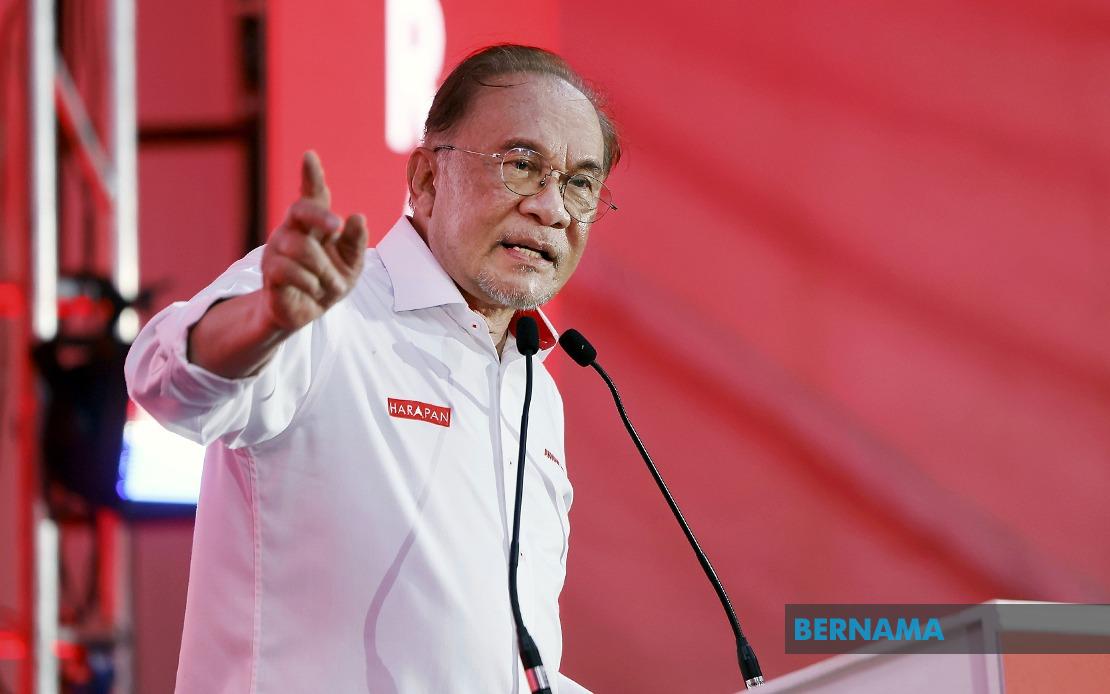
Prime Minister Datuk Seri Anwar Ibrahim has appealed to Johor voters to support elected representatives and leaders who demonstrate wisdom in identifying priorities and the courage to make difficult decisions on behalf of their communities. Speaking during Pakatan Harapan's campaign launch in Johor Bahru on July 4, the PH chairman emphasised the need for representatives who genuinely understand the concerns and aspirations of ordinary Johoreans across all ethnic and social backgrounds.
Anwar's call reflects a strategic repositioning by Pakatan Harapan ahead of the 16th Johor state election, scheduled for July 11, with early voting set for July 7. Rather than focusing solely on party machinery or traditional political messaging, the Prime Minister has framed the election as a choice between different qualities of leadership—specifically, the intellectual capacity and moral fortitude required to navigate the state's development challenges. This rhetorical approach suggests PH's recognition that voter concerns in Johor extend beyond partisan affiliation to encompass fundamental questions about competence and representation.
The coalition's campaign strategy involves extensive grassroots engagement across the state's diverse constituencies. On the opening day of campaigning, Anwar personally attended seven separate programmes in different areas, participating in community meetings, public talks, and localised engagement events. This intensive ground presence is designed to strengthen voter confidence in PH candidates while conveying the message that party leadership prioritises direct dialogue with constituents over top-down announcements.
Packatan Harapan has demonstrated significant confidence in its electoral prospects by fielding candidates in all 56 state constituencies—a complete slate that underscores the coalition's determination to contest every available seat. The candidate distribution reflects the coalition's internal structure: PKR has nominated 20 candidates, Amanah has fielded 19, while DAP is contesting 17 seats. This balanced allocation across the three major PH component parties suggests an effort to maintain internal coalition harmony while presenting voters with a unified front.
The broader electoral context reveals competitive intensity in Johor's political landscape. A total of 172 candidates are contesting the 56 available state seats, indicating that multiple parties beyond Pakatan Harapan are mobilising resources and volunteer bases to compete for representation. This crowded field suggests that Johor remains a politically contested battleground where outcomes remain uncertain, reinforcing the urgency of PH's campaign messaging about leadership quality and voter mobilisation.
Anwar's emphasis on representation that bridges ethnic and communal divides carries particular significance for Johor, which maintains a substantial Chinese and Indian population alongside its Malay-Muslim majority. The Prime Minister's explicit reference to electing leaders who can unite Malays, Chinese, and Indians in joint nation-building addresses a persistent challenge in Malaysian politics: the tension between communal politics and inclusive governance. By highlighting this dimension, Anwar is positioning Pakatan Harapan as the coalition most committed to transcending divisive identity-based politics.
The campaign messaging also reflects PH's broader development agenda for the state. Anwar's promise to drive Johor towards greater prosperity and development suggests the coalition believes voters are responsive to arguments about economic growth, infrastructure investment, and social progress. This emphasis on material advancement and tangible improvements complements the more abstract appeals to leadership wisdom and decisiveness, creating a multi-layered campaign narrative that addresses both values-based and outcome-oriented voter concerns.
For Malaysian observers monitoring state-level politics, the Johor election represents a significant test of Pakatan Harapan's performance in one of Malaysia's most populous and strategically important states. Johor has historically served as a political bellwether, and outcomes here may influence voter sentiment in other states and shape the trajectory toward the next federal general election. The coalition's emphasis on leadership quality over purely partisan messaging may reflect lessons learned from recent electoral contests where voters have demonstrated willingness to reject parties perceived as insufficiently responsive or accountable.
The campaign's focus on decisiveness and priority-setting also implicitly addresses a criticism sometimes levelled at coalition governments: that multiple parties within an alliance may struggle to reach consensus on policy direction. By emphasising the need for leaders with both wisdom and courage, Anwar is tacitly conceding that governance complexity demands more than good intentions. The message suggests that voters should support PH not despite its coalition structure but because its representatives possess the leadership qualities necessary to navigate multi-party politics effectively.
Looking forward, the two-week campaign period before polling on July 11 will determine whether Pakatan Harapan's emphasis on leadership quality resonates with Johor voters or whether other considerations—incumbent performance, local issues, or support for alternative coalitions—prove more decisive. The intensity of PH's early campaign activities, including the Prime Minister's personal engagement across multiple constituencies, suggests the coalition views this election as high-stakes for both its state-level positioning and its broader credibility heading into future national contests.
The election also reflects evolving patterns in Malaysian electoral competition, where single-issue or personality-driven campaigns have increasingly given way to more nuanced discussions about governance competence and representation quality. Anwar's framing of the choice available to Johor voters emphasises these substantive dimensions of political choice, potentially setting a benchmark for how subsequent campaigns will engage with Malaysian electorates.

