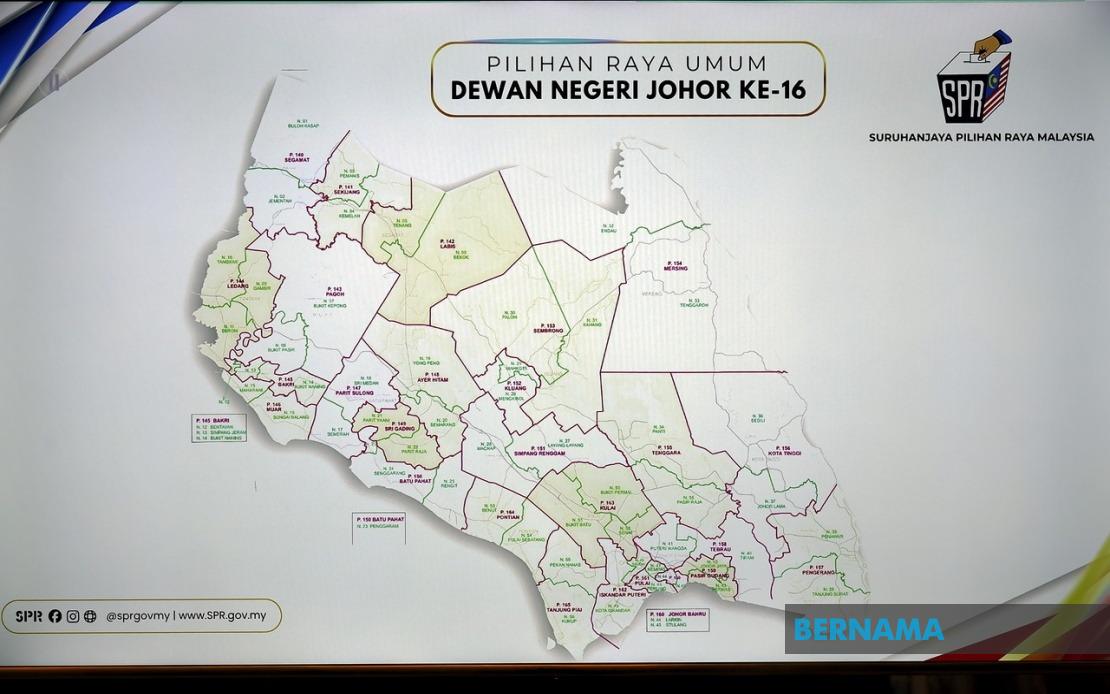
Johor's 16th state election enters its critical phase tomorrow when nomination day transforms the political landscape across all 56 state assembly seats. The formal registration of candidates between 9 am and 10 am at designated nomination centres will crystallise what has been weeks of behind-the-scenes manoeuvring by Malaysia's major political coalitions. Polling day is scheduled for July 11, with early voting available on July 7, giving the state's electoral machinery just over two weeks to process a contest that will reshape the peninsula's political dynamics.
The Election Commission has verified that 2,727,926 voters are registered to participate, a figure encompassing over 2.7 million ordinary voters supplemented by 12,041 military personnel and their spouses alongside 12,710 police officers and theirs. This electorate size underscores Johor's importance within Malaysia's political architecture, given the state's significance as a major economic engine and strategic political prize. The breadth of the voter base reflects both the military presence in border regions and the extensive civil service population that administrative operations throughout the state require.
Pakatan Harapan has committed to contesting every single seat available, deploying 20 candidates from Parti Keadilan Rakyat, 19 from Amanah, and 17 from DAP. This full-court strategy signals the coalition's determination to capitalise on whatever gains it accumulated since the previous election, though the decision to field candidates everywhere also risks spreading organisational and financial resources thinly across a large geographical area. Barisan Nasional has matched this intensity with its own comprehensive slate featuring 36 UMNO candidates, 16 from MCA, and four from MIC, maintaining the coalition's traditional structure while reflecting UMNO's dominant position within the broader alliance.
Perikatan Nasional presents a markedly different configuration through its component parties, with PAS contesting 11 seats, Bersatu fielding 16, and the Malaysian Indian People's Party deploying five candidates. The PN arrangement reveals ongoing tensions within the coalition regarding seat allocations and strategic positioning, particularly given Bersatu's relatively larger candidate roster relative to PAS despite the latter's broader grassroots presence in many areas. This internal distribution may signal either factional preferences within PN leadership or pragmatic assessments about electoral viability in specific constituencies.
Beyond the traditional three-coalition framework, several smaller parties are attempting to carve electoral space for themselves. The Malaysian United Democratic Alliance is pursuing four seats, the Socialist Party of Malaysia one, and Parti Bersama Malaysia is making its electoral debut across 15 seats. The emergence of Bersama as a significant participant represents a notable shift in Johor's political ecosystem, suggesting potential voter appetite for alternatives beyond established options or deepening dissatisfaction with mainstream offerings. These secondary players collectively hold the potential to fragment votes in specific constituencies, potentially reshaping outcomes in tight races.
The Election Commission has implemented procedural safeguards to prevent nomination day complications, explicitly urging prospective candidates to verify their nomination forms in advance at the Returning Officer's Office or State Election Office. Such preventative messaging reflects lessons learned from previous electoral cycles where technical errors in documentation have disqualified otherwise viable candidates or created unnecessary delays. The requirement that candidates settle deposit payments early and retain receipts as proof demonstrates the commission's intent to maintain administrative discipline throughout the nomination process, reducing the scope for last-minute submissions or disputes.
Anticipation of electoral misconduct has prompted the Malaysian Anti-Corruption Commission to issue pointed warnings to all candidates and parties regarding prohibitions under the MACC Act 2009 and the Election Offences Act 1954 (Amendment 2012). The specificity of these legal references suggests the MACC recognises particular vulnerability points in state-level campaigns where oversight might otherwise be limited. To operationalise this enforcement posture, the commission has established five dedicated 24-hour operations rooms positioned across Tampoi, Batu Pahat, Kluang, Segamat and Mersing, strategically distributed to cover both urban and rural regions of the state. This geographical dispersal enables direct public reporting mechanisms and signals serious commitment to investigation throughout the election period.
The Johor State Legislative Assembly dissolution on June 1 initiated this electoral process, terminating the previous legislature's formal existence and triggering the constitutional requirement for fresh elections within a specified timeframe. Understanding the 2022 election results provides essential context for interpreting tomorrow's nominations and the broader contest that follows. That election delivered Barisan Nasional a commanding 40 seats, Pakatan Harapan 12, Perikatan Nasional three, and Malaysian United Democratic Alliance one seat, establishing the incumbent BN government's substantial majority and defining the opposition's fragmented challenge.
The 2022 outcome incentivises different strategies for each major player. Barisan Nasional will seek to consolidate and expand its position, defending its 40 seats while attempting to prise away vulnerable opposition constituencies. Pakatan Harapan will pursue gains from both BN and PN territory, requiring a significantly improved performance to dramatically alter power dynamics. Perikatan Nasional faces pressure to demonstrate organisational competence and voter relevance beyond its minimal representation, knowing that poor performance could undermine its credibility as a serious federal alternative. For Malaysian United Democratic Alliance, building on its single seat into a meaningful presence represents a considerable challenge but remains within theoretical reach if urban-based mobilisation proves effective.
The nomination process will reveal not merely how many candidates each party is fielding but equally importantly which specific constituencies receive competition versus uncontested seats. Strategic decisions about candidate allocation frequently indicate where parties perceive genuine opportunities versus where they merely maintain nominal presence. Examining the geographic distribution of contested seats across Johor's diverse landscape will illuminate whether this election is primarily driven by urban or rural concerns and whether particular demographic or geographic communities will dominate the political conversation.
For Malaysian observers more broadly, Johor's election functions as a bellwether signalling broader electoral trends and coalition dynamics at a crucial moment in the nation's political calendar. The state's size and strategic importance mean its results carry implications extending well beyond Johor itself, potentially influencing calculations regarding federal politics and coalition stability. The performance of Perikatan Nasional is particularly significant given ongoing questions about its viability as a serious federal governing option, while Pakatan Harapan's result will indicate whether its recent federal experience has strengthened or weakened its state-level appeal.
As nomination day approaches, the intensity of campaigns will increase markedly, with parties mobilising volunteers and resources across constituencies. The next two weeks leading to polling day will determine whether familiar political patterns persist or whether voter sentiment has shifted substantially. The breadth of candidate choices available, from established parties commanding state and federal apparatus through smaller challengers offering alternative visions, suggests voters will face genuine portfolio options rather than mere theatre. Tomorrow's formal commencement of the nomination process begins the decisive countdown.

