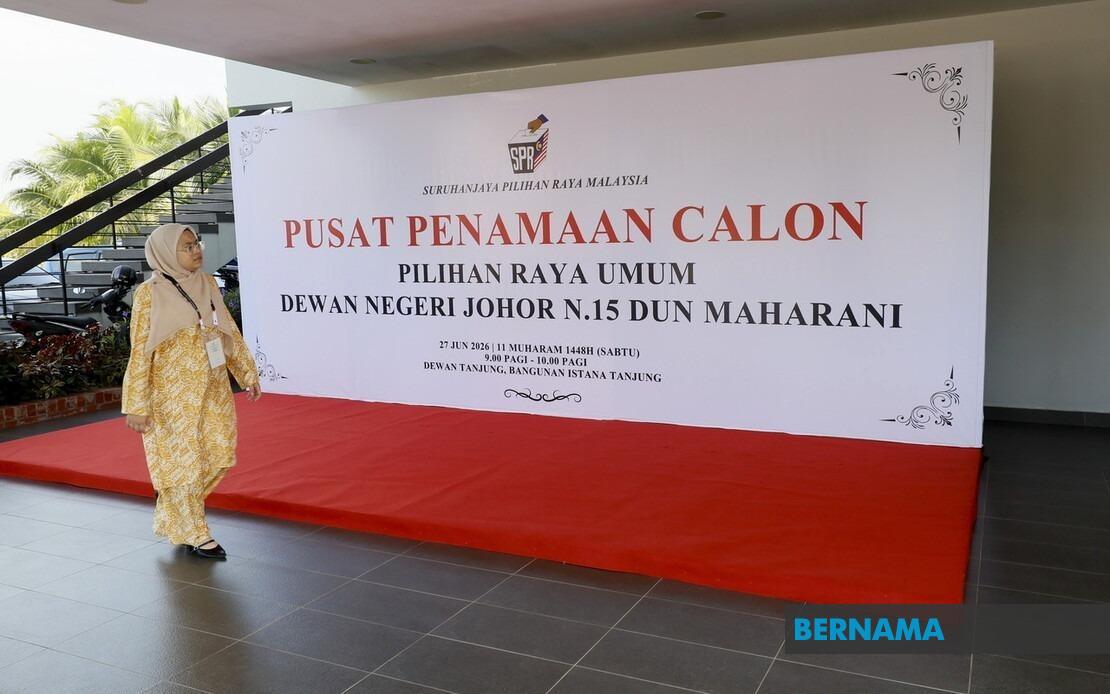
The 16th Johor State Election formally commenced today with the opening of 56 nomination centres across the state, marking the beginning of what promises to be a closely watched electoral battle in Malaysia's second-largest state by population. From 9 am, prospective candidates began submitting their nomination papers, with a one-hour submission window closing at 10 am, after which the Election Commission will formally declare eligible contenders. This sets in motion a tightly scheduled electoral calendar that will culminate in polling on July 11, preceded by early voting opportunities on July 7.
The decision to hold the election follows the dissolution of the Johor State Legislative Assembly on June 1, triggered by political shifts within the state that have reshaped the competitive landscape. The 14-day campaign period, running through July 10 at 11.59 pm, will be the canvas on which all participating parties present their visions and platforms to more than 2.7 million registered voters. This compressed timeframe means campaigns will need to move with considerable pace and intensity to reach constituencies across this geographically large and economically significant state.
The voter roll reflects a diverse electorate comprising 2,703,175 ordinary voters, along with 12,041 military personnel and their spouses, and 12,710 police personnel and their spouses. These specific constituencies within the broader electorate have traditionally warranted particular attention from political parties seeking to mobilise support. The size and composition of this electoral base underscores the complexity of conducting a modern state election in Johor, which encompasses significant urban centres, industrial zones, and rural areas with varying demographic profiles and political preferences.
As nomination day progressed, 133 prospective candidates had already paid their election deposits, signalling serious intent to contest, while 593 nomination forms had been distributed. The competition appears set to be robust, with multiple political blocs fielding candidates across the state's 56 seats. The incumbent Barisan Nasional government, which held 40 seats before dissolution, is mounting a comprehensive campaign through UMNO's 36 candidates, complemented by MCA's 16 and MIC's four representatives. This traditional coalition represents the continuity option for voters dissatisfied with change or seeking to maintain established governance structures.
Pakatan Harapan, the federal ruling coalition, is contesting all 56 seats through a tripartite arrangement combining PKR's 20 candidates, Amanah's 19, and DAP's 17. This comprehensive fielding across the entire state assembly reflects the coalition's ambition to consolidate its federal electoral momentum at the state level and reverse previous setbacks in Johor. The opposition bloc's strategy emphasises completeness of coverage, ensuring that no seat is left unopposed and that voters across all constituencies have a direct choice between the ruling coalition and alternatives.
Perikatan Nasional, the third-force coalition that previously held three seats, is returning to contest through a four-party framework that includes PAS (11 seats), Bersatu (16), the Malaysian Indian People's Party (5), and Parti Pejuang Tanah Air (1). This expanded footprint suggests the coalition is positioning itself as a genuine contender capable of forming government should electoral mathematics align favourably. The diversification of its fielding across multiple parties beyond PAS reflects broader coalition-building efforts to appeal to diverse voter demographics and ethnic communities.
New and emerging parties are also staking claims in this election. MUDA, which made its electoral debut in recent federal elections, is contesting four seats, representing the growing appetite among younger voters for political alternatives beyond established blocs. Parti Sosialis Malaysia has fielded a single candidate, maintaining its presence despite limited resources. Most significantly, Parti Bersama Malaysia is making its debut in state elections with 15 candidates, suggesting that new political formations continue to emerge in Malaysia's evolving democratic landscape. This fragmentation beyond the traditional three-bloc structure adds unpredictability to the outcome and reflects ongoing political realignment at the state level.
The logistics of conducting the election across Johor's sprawling territory have required substantial security and administrative preparations. The Election Commission has deployed 4,832 police personnel to ensure order and manage traffic, with 19 major roads near nomination centres being subject to closures and diversions. These measures underscore the potential for disruption and the need for careful crowd management when large numbers of party supporters converge on nomination centres to demonstrate support for their candidates. Weather has also been factored into planning, with the Malaysian Meteorological Department forecasting rain in several parts of Johor during the morning and thunderstorms in the afternoon, potentially affecting turnout and campaign logistics.
Nomination day festivities traditionally generate considerable atmosphere and energy as party supporters gather in demonstration of solidarity. The Election Commission has issued reminders that the Election Offences Act 1954 and local authority by-laws remain fully in force, with particular attention to restrictions on musical instruments and vehicle-mounted loudspeakers during campaign activities. These regulations seek to balance the right of parties to campaign energetically against the need to maintain public order and prevent intimidation of voters or candidates from opposing parties. Such restrictions remain contentious, with supporters sometimes viewing them as overly restrictive of legitimate political expression.
The current political composition of the Johor assembly before today's dissolution reflected the fractured state of Malaysian politics at the state level. Barisan Nasional's 40 seats represented traditional dominance but also reflected an erosion of the supermajority margins that once characterised its tenure in Johor. Pakatan Harapan's 12 seats represented significant advances compared to earlier periods but remained insufficient to threaten the incumbent. Perikatan Nasional's three seats and MUDA's single seat exemplified the fragmentation of the anti-BN vote across multiple competing blocs, a dynamic that may shift significantly depending on which political forces succeed in consolidating voter support over the coming campaign period.
For Malaysia and Southeast Asia, the Johor election carries implications beyond the state itself. As the nation's second-most economically productive state and home to critical manufacturing, petrochemical, and port infrastructure, political instability or governance changes in Johor can ripple through regional supply chains and investor confidence. The election also serves as a significant test of the federal coalition's ability to translate national-level support into state-level success, and of whether Perikatan Nasional can establish itself as a genuine nationwide alternative rather than a regional protest movement. The level of voter participation and the patterns of support across different demographic groups will provide valuable indicators of how Malaysian politics may evolve toward the next general election.
The coming fortnight will test the campaign capabilities and ground organisation of all participating parties as they compete for voters' support across Johor's 56 constituencies. The compressed timeline means that early campaign momentum may prove decisive, and the effectiveness of each party's messaging will be tested in real time through voter responses. Early voting on July 11 will provide initial indicators of which way the electoral winds are blowing, though the decisive results will only arrive when main polling day voting concludes on July 11.

