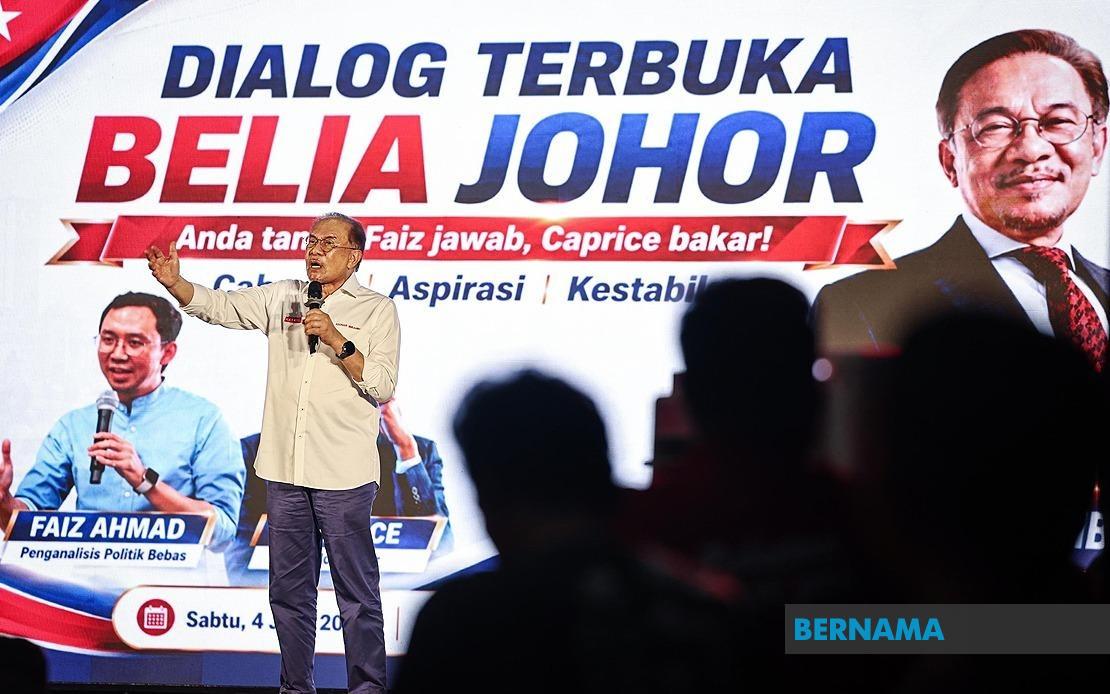
Prime Minister Datuk Seri Anwar Ibrahim has signalled that Johor's future prosperity depends on spreading development benefits more equitably across the state, rather than concentrating investment in high-visibility mega-projects that dominate city skylines. Speaking at a youth engagement event in Johor Bahru, Anwar articulated a vision where growth reaches underserved rural districts and struggling urban populations simultaneously, a message that reflects broader tensions within Malaysia's development model.
The Prime Minister's intervention highlights a critical imbalance that characterises many Malaysian states. Johor, despite being economically significant and home to major industrial zones, exhibits stark contrasts in living standards. In affluent parts of Johor Bahru, modern amenities abound, yet venture into outlying areas like Ulu Tebrau—a mere 30 minutes away—and infrastructure provision drops markedly. This spatial inequality, Anwar suggested, demands urgent correction through a fundamental shift in policy priorities.
Anwar's emphasis on basic amenities over architectural prestige carries particular weight. His explicit rejection of unnecessary high-rise development in rural pockets signals frustration with a development paradigm that equates progress with visible, trophy projects. Instead, he advocated channelling resources toward affordable housing that working-class families can actually access, educational facilities that prepare students for opportunity, and community infrastructure that strengthens social cohesion. Markets stalls, prayer halls, and gathering spaces may lack the glamour of shopping malls, yet they form the sinews of functional communities.
The spatial divide within Johor mirrors patterns across Malaysia and Southeast Asia broadly. Metropolitan areas attract disproportionate investment because they generate immediate returns and international prestige. Rural municipalities, conversely, struggle to justify expenditure to investors and stakeholders fixated on headline growth metrics. This creates a vicious cycle where underdeveloped regions fall further behind, driving rural-to-urban migration and straining city infrastructure. Anwar's call for rebalancing directly challenges this entrenched logic.
Contextualising these remarks within Malaysia's political landscape adds nuance. Johor remains strategically crucial for Pakatan Harapan's electoral fortunes, particularly in constituencies like Kempas, where the party fielded candidate Faezuddin Puad. Youth disengagement from development processes that ignore their immediate needs—employment, housing, social spaces—has emerged as a significant political vulnerability. By emphasising ordinary infrastructure rather than grandiose schemes, Anwar positioned his coalition as responsive to grassroots aspirations.
The timing of these comments also reflects evolving thinking within Malaysia's federal leadership. Post-pandemic, there is growing recognition that resilient development must be inclusive and geographically dispersed. Concentrating wealth and infrastructure in a few nodes creates fragility; distributing opportunity more broadly builds sustainable prosperity. For Johor specifically, this means leveraging its economic strengths—petrochemicals, port activities, manufacturing—to create employment and revenue throughout the state, not merely in premium zones.
Implementing such a vision requires administrative and financial mechanisms currently underdeveloped in Malaysian governance. Johor's state government must align budgetary allocation with equity objectives, resist lobbying from developers interested primarily in high-margin urban projects, and invest in project planning that genuinely reflects community needs rather than bureaucratic convenience. Anwar's rhetoric must translate into concrete budget lines and measurable outcomes, or risk being dismissed as political theatre.
The Prime Minister's framing also raises questions about the relationship between state and federal governments. Johor has its own executive and assembly; federal exhortations toward balanced development carry weight only if backed by fiscal transfers or regulatory leverage. Whether Putrajaya will genuinely prioritise equity funding over flagship projects remains unclear. Sceptics may note that grand announcements often precede modest follow-through in Malaysian politics.
Neighbouring states and the broader Southeast Asian region watch Johor's trajectory closely. As a cornerstone of Malaysia's economy and a gateway to the region, development patterns established here influence investor confidence, governance standards, and prosperity distribution across Malaysia and beyond. If Johor successfully implements inclusive development, it becomes a template; if it maintains traditional inequities while paying lip service to equity, it reinforces pervasive regional disparities.
For ordinary Johoreans in rural areas and struggling urban neighbourhoods, Anwar's remarks offer hope—but only if matched by resource allocation and political will. The construction of schools and community halls may lack the symbolic appeal of gleaming towers, yet they address tangible quality-of-life concerns that shape voter sentiment and social stability. The next phase of Johor's development will reveal whether federal and state leadership genuinely prioritise spreading prosperity or whether such rhetoric masks business as usual.

