The Ministry of Human Resources has committed to addressing job displacement triggered by ongoing global supply chain disruptions through a comprehensive upskilling initiative. Speaking in Johor Bahru, Human Resources Minister Datuk Seri R. Ramanan outlined plans to deploy Technical and Vocational Education and Training programmes targeting workers who have lost employment due to the international logistics crisis. The announcement signals the government's recognition that structural economic shocks require targeted human capital interventions rather than passive benefit schemes.
Workers across three critical economic sectors—services, manufacturing, and construction—stand to benefit from the initiative. Malaysia's exposure to global supply chain volatility has been particularly acute in semiconductor manufacturing and automotive component production, both cornerstone industries for employment in states like Johor, Selangor, and Penang. By concentrating support on these sectors, the ministry aims to minimise long-term skill erosion and prevent permanent workforce detachment. The selection reflects an understanding that each sector faces distinct retraining needs, from digital skills in manufacturing to customer engagement capabilities in services.
Central to the support framework is the integration of job placement services through PERKESO's MYFutureJobs platform. Rather than limiting assistance to passive income support, the programme emphasises active labour market participation through structured job matching. This approach acknowledges that successful reskilling requires more than training provision; workers need meaningful pathways into suitable employment. By ensuring placement suitability, the ministry aims to prevent mismatches that leave workers overqualified or underqualified for new roles, a common challenge in rapid workforce transitions.
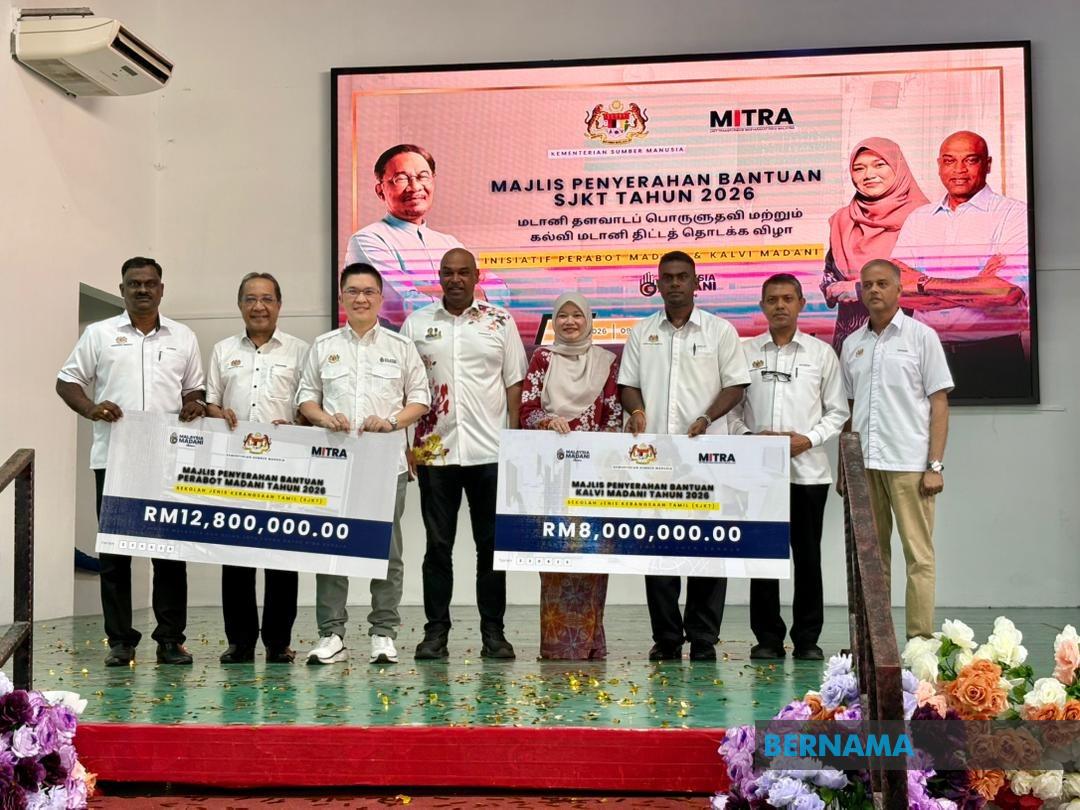
The announcement occurred during the launch of two complementary education initiatives targeting disadvantaged communities. The MADANI Furniture Initiative will supply 14 categories of high-quality furniture and equipment to Tamil vernacular schools, benefiting approximately 39,692 pupils and 5,290 educators across 361 government-aided institutions. The distribution, proceeding in phases from June through August, addresses long-standing infrastructure disparities in vernacular education settings. Educational equity remains essential for Malaysia's inclusive development trajectory, particularly as economic transitions demand increasingly sophisticated skill foundations from younger generations.
Paralleling the furniture initiative, the RM8 million KALVI MADANI Programme extends multifaceted support to Indian pupils in selected Tamil schools. The programme combines free tuition, nutritional assistance, learning resources, and digital devices alongside teacher welfare enhancements. Nearly 10,410 pupils across 315 schools will gain access to these services, creating foundational advantages that reduce educational inequality driven by household income disparities. Nutritional support proves especially significant given evidence linking student nutrition to cognitive development and academic achievement, factors that constrain long-term earnings potential and social mobility.
The simultaneous announcements reflect a broader policy philosophy integrating immediate crisis response with longer-term human development. Supply chain disruptions create immediate employment shocks requiring urgent reskilling, while educational infrastructure investments build absorptive capacity for future workforce transitions. This dual approach recognises that economic resilience depends on both adult workers retaining relevance and younger generations acquiring competitive skills. Malaysia's demographic structure, with a substantial young population, makes educational investment particularly consequential for demographic dividend realisation.
Regional context shapes the urgency of these interventions. Southeast Asia's manufacturing sector faces intensifying competition from lower-cost producers and automation-driven displacement. Thailand, Vietnam, and Indonesia have pursued aggressive TVET expansion programmes, positioning themselves advantageously for manufacturing investments. Malaysia's reskilling initiative responds to competitive pressures while addressing domestic employment concerns. The choice to emphasise TVET rather than solely higher education reflects realistic labour market dynamics; manufacturing and services sectors require skilled technicians and mid-level professionals more than additional university graduates.
Implementation quality will determine programme effectiveness. TVET systems require significant institutional capacity, from qualified instructors to modern equipment and industry linkages. Past Malaysian vocational programmes have sometimes suffered from weak employer engagement, creating graduates whose skills diverge from actual labour market demand. Success depends on genuine industry participation in curriculum design and training delivery. The coordination between KESUMA, PERKESO, and educational institutions must function seamlessly to translate policy into tangible employment improvements.
The programme's scale suggests moderate ambition relative to potential supply chain disruption magnitudes. While the initiatives target genuine needs, their capacity limitations mean many displaced workers will lack access to formal support. Private sector participation and international cooperation through frameworks like ASEAN could amplify impact. Additionally, the focus on manufacturing and services overlooks agricultural workers and informal economy participants, both substantial Malaysian employment categories experiencing their own disruption pressures.
Monitoring displacement patterns and programme outcomes will prove essential for evidence-based policy refinement. Understanding whether reskilled workers achieve comparable earnings, whether placement success varies by region or demographic group, and whether particular industrial transitions prove especially challenging would inform future interventions. Malaysian policymakers should establish robust evaluation mechanisms to capture these dynamics.
The initiative represents pragmatic acknowledgment that globalisation's distributional consequences require deliberate government action. Rather than assuming market forces will automatically reabsorb displaced workers, the strategy intervenes through education, skills transfer, and employment services. For Malaysian workers facing uncertain tenure in global supply chains, these supports provide tangible buffers against economic displacement, though universal coverage and outcome quality remain aspirational targets rather than guaranteed achievements.

