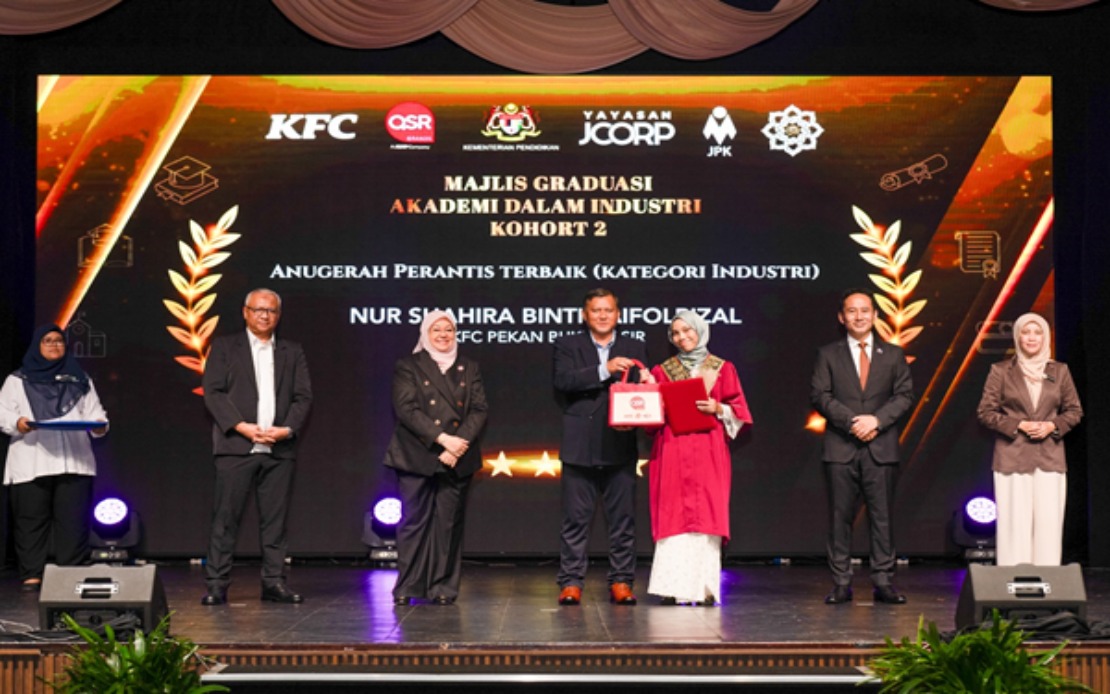
A collaboration between QSR Brands, operating KFC Malaysia, and Yayasan JCorp has successfully produced another cohort of 37 vocational graduates through the Apprenticeship Development Initiative (ADI), signalling growing momentum in Malaysia's push to align skills training with industry needs. The second intake represents a doubling of the inaugural batch that completed the programme in March 2025, with total graduates now standing at 60 as the partnership deepens its commitment to workforce development in the quick-service restaurant sector.
The ADI programme represents a deliberate effort to bridge the persistent gap between formal education and workplace readiness that has long challenged Malaysia's labour market. By embedding vocational training within actual restaurant operations rather than purely classroom settings, the initiative enables young workers to develop practical competencies in food preparation, customer service, and operational management while simultaneously pursuing recognised qualifications. This dual-track approach addresses a critical weakness in traditional vocational education: the disconnect between theoretical knowledge and the demands of real working environments.
Zulkernai Fauzi, the Ministry of Education's technical and vocational education and training director, has publicly endorsed the ADI model as a benchmark for how Malaysia's education and industry sectors should collaborate. His comments reflect official recognition that fragmented approaches to skills development have underperformed. The integration demonstrated by KFC Malaysia and Yayasan JCorp offers a replicable framework that other major employers could adopt to systematically develop their own talent pipelines while contributing to national workforce objectives.
The second cohort's academic performance merits attention as a measure of programme effectiveness. All 37 graduates achieved perfect pass rates in Vocational Stream Subjects (MPAK) and obtained both Malaysian Skills Certificate qualifications at Levels 2 and 3, with 95 per cent successfully completing the SPM examination. These outcomes suggest that the combination of workplace immersion and structured vocational education creates conditions conducive to learning, contradicting assumptions that apprenticeship models inherently compromise academic rigour. Each graduate accumulated five separate qualifications, providing layered credentials that enhance employment prospects across different sectors and advancement opportunities.
Training delivery occurred exclusively at KFC outlets in Johor Bahru, utilising standardised curricula for Fast Food Preparation and Service. This geographic concentration and sectoral focus enable quality control and consistent standard-setting across cohorts. Participants gained exposure to the full spectrum of quick-service restaurant operations: from food handling protocols and safety compliance through to customer interaction and service delivery. The structured exposure to compliance requirements proves particularly valuable, as regulatory adherence represents a significant liability area in food service and a source of competitive disadvantage for unprepared workers.
Rozaini Mohd Sani, chairman of Yayasan JCorp, framed the initiative as an opportunity vehicle for disadvantaged youth to build confidence and acquire market-ready skills. This characterisation highlights the programme's potential social dimension: beyond meeting employer recruitment needs, the ADI model creates pathways for individuals who might otherwise remain outside formal employment or higher education opportunities. For Johor specifically, which has experienced industrial restructuring and shifting labour demands, such programmes offer partial mitigation against skills mismatches and youth underemployment.
Dr Sharifah Musainah Syed Alwi, QSR Brands' chief human resources officer, positioned the programme's success not merely as credential production but as evidence of practical skill acquisition in authentic working conditions. Her distinction matters significantly: certificates carry legitimacy only when employers trust that holders possess demonstrated competencies. By training workers in operational environments they will later inhabit professionally, the ADI model generates trustworthy signals of job-readiness that benefit all parties—graduates possess confidence grounded in experience, employers receive pre-screened candidates, and the broader economy gains workers with reduced initial training costs and faster productivity ramps.
The programme's genesis in June 2023 through collaboration between KFC Malaysia, the Department of Skills Development under the Ministry of Human Resources, and the Ministry of Education represented uncommon coordination across typically siloed government portfolios. This inter-ministerial alignment, though limited in scale, demonstrates receptiveness to private-sector partnership models that might be expanded to other industries facing talent shortages. The quick-service restaurant sector's choice as the initial testing ground reflects both the sector's accessibility for rapid iteration and its employment significance across Malaysia's urban and semi-urban regions.
The achievement awards presented during the second cohort's graduation ceremony—recognising best apprentices, strongest SPM performance, and exemplary documentation—serve purposes beyond ceremonial recognition. These distinctions create aspirational benchmarks for future cohorts and generate incentive structures that encourage engagement and excellence throughout the training period. For employers, such differentiation provides hiring guidance regarding high-performing graduates worth prioritising for advancement track placements.
For Malaysian policymakers observing skill-development outcomes, the ADI programme's expansion trajectory offers encouraging evidence that employer-education partnerships can function at meaningful scale. The progression from 23 initial participants to 60 total graduates within approximately 18 months suggests operational sustainability and organisational capacity to expand further. Should QSR Brands and Yayasan JCorp commit to sustained scaling and should competing restaurant operators launch parallel initiatives, the cumulative effect could materially reshape talent availability in a labour-intensive sector chronically challenged by turnover and retention.
The programme's particular relevance to Malaysia extends beyond workforce development metrics into broader economic transformation objectives. As the country pursues higher-value manufacturing and service sectors, reducing dependency on low-skilled migrant labour, initiatives that systematically develop domestic talent in service occupations become strategically important. Quick-service restaurants, while labour-intensive, increasingly incorporate technology and complex operations requiring workers with foundational competencies and learning capacity—precisely the characteristics the ADI model appears to develop.
Looking forward, the programme's sustainability depends on maintaining employer commitment, ensuring genuine employment pathways for graduates, and demonstrating competitive advantages that justify continued investment compared to alternative recruitment strategies. Early indications suggest these conditions exist: QSR Brands' decision to expand from one to two cohorts indicates internal satisfaction with programme outcomes, while the willingness of Yayasan JCorp to partner suggests social objectives alignment. The next phase will reveal whether this partnership model attracts replication across Malaysia's hospitality and food service sectors or remains a commendable but isolated initiative.

