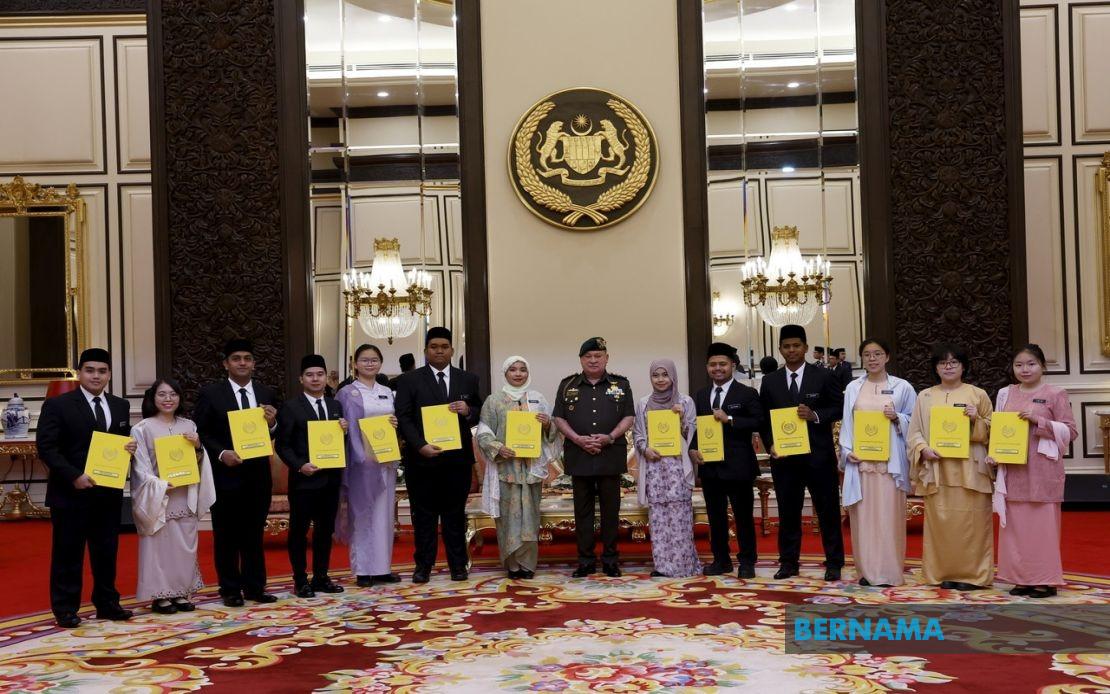
His Majesty Sultan Ibrahim, King of Malaysia, conferred the 2026 Yang di-Pertuan Agong Scholarships (BYDPA) upon 14 outstanding scholars during a formal investiture ceremony at Istana Negara in Kuala Lumpur on June 24. The recipients represent a cross-section of Malaysia's most promising academic talent, selected through a rigorous national assessment process that recognises excellence across multiple disciplines and research areas. The ceremony, attended by senior government officials including Director-General of the Public Service Tan Sri Wan Ahmad Dahlan Abdul Aziz and Comptroller of the Royal Household Tan Sri Dr Azmi Rohani, underscored the significance attached by the monarchy to advancing scholarship and research capability within the nation.
The 2026 cohort splits evenly between two levels of advanced study. Seven of the recipients will pursue doctoral degrees, positioning them to emerge as research leaders and subject matter experts capable of contributing substantially to Malaysia's knowledge economy. The remaining seven have been selected for Master's (Research) programmes, which serve as a critical stepping stone for those intending to advance further into doctoral work or apply their specialised knowledge directly within academic and professional sectors. This balanced composition reflects deliberate policy emphasis on developing researchers at multiple career stages, ensuring a steady pipeline of skilled academics and innovators for the coming decade.
Geographically, the scholarship distribution reveals an interesting tension between domestic and international education priorities. Four scholars will undertake their studies at prestigious universities located abroad, benefiting from exposure to world-class research environments, international peer networks, and academic systems that rank among the globe's most advanced. However, the substantial majority—comprising ten recipients—will conduct their research at Malaysia's leading research universities. This weighting toward domestic institutions reflects the government's commitment to strengthening local research infrastructure and demonstrating confidence in the capabilities of home-grown universities to provide world-standard postgraduate education without requiring scholars to emigrate.
During remarks following the presentation, Tan Sri Wan Ahmad Dahlan emphasised that the BYDPA stands as the most prestigious scholarship programme available within Malaysia's government scholarship ecosystem. Beyond its prestige, he highlighted that the scheme offers the highest level of financial support among all government-sponsored scholarships, a crucial distinction in a landscape where postgraduate study often demands substantial personal investment. This superior funding structure acknowledges that doctoral and Master's research programmes typically require extended periods of full-time commitment, laboratory access, international conference attendance, and other costs that undergraduate scholarships traditionally do not cover.
The BYDPA scheme carries particular significance within Malaysia's broader human capital development strategy. As the nation positions itself to transition toward a high-income, knowledge-intensive economy, the advancement of homegrown researchers becomes increasingly vital. Scholars of this calibre typically contribute not only through their dissertations and published research but also by entering the academic workforce, where they mentor the next generation and establish research programmes that address local and regional challenges. The international exposure granted to the four scholars studying overseas simultaneously cultivates networks and brings diverse methodologies and perspectives back into Malaysian academia upon their return.
The decision to distribute scholarships across multiple research universities rather than concentrating them in a single institution reflects policy recognition that research excellence in Malaysia has become geographically diffused. While certain universities maintain particular strengths in specific fields, the ecosystem now supports quality postgraduate work across multiple campuses, a development that enhances competition and encourages improvement across the higher education sector. For the broader university system, the presence of BYDPA scholars serves as a mark of institutional standing, attracting further investment and attention from both government and private sectors interested in supporting world-class research.
For the 14 recipients themselves, this honour represents validation of years of undergraduate achievement and represents a substantial investment in their future trajectories. The financial security and prestige associated with the BYDPA allows scholars to focus entirely on their research without the distraction of external employment, accelerating the pace at which they can complete their studies and transition into productive research roles. Many recipients will go on to hold influential positions within academia, government research agencies, or private sector innovation departments, where their advanced training becomes instrumental in driving institutional performance and competitive advantage.
The timing of these awards in the middle of 2026 provides recipients with advance notice to make comprehensive preparations for their studies, whether securing international visas, arranging accommodation in new cities, or coordinating with supervising institutions regarding research direction and resource requirements. The formal presentation by the King elevates the significance of these scholarships beyond mere financial support, imbuing them with national importance and connecting individual scholarly achievement to the Crown's commitment to national development and intellectual advancement. This ceremonial dimension, unique to the BYDPA, distinguishes it culturally within Malaysia's scholarship landscape and reinforces broader narratives about education as a national priority worthy of royal patronage and attention.

