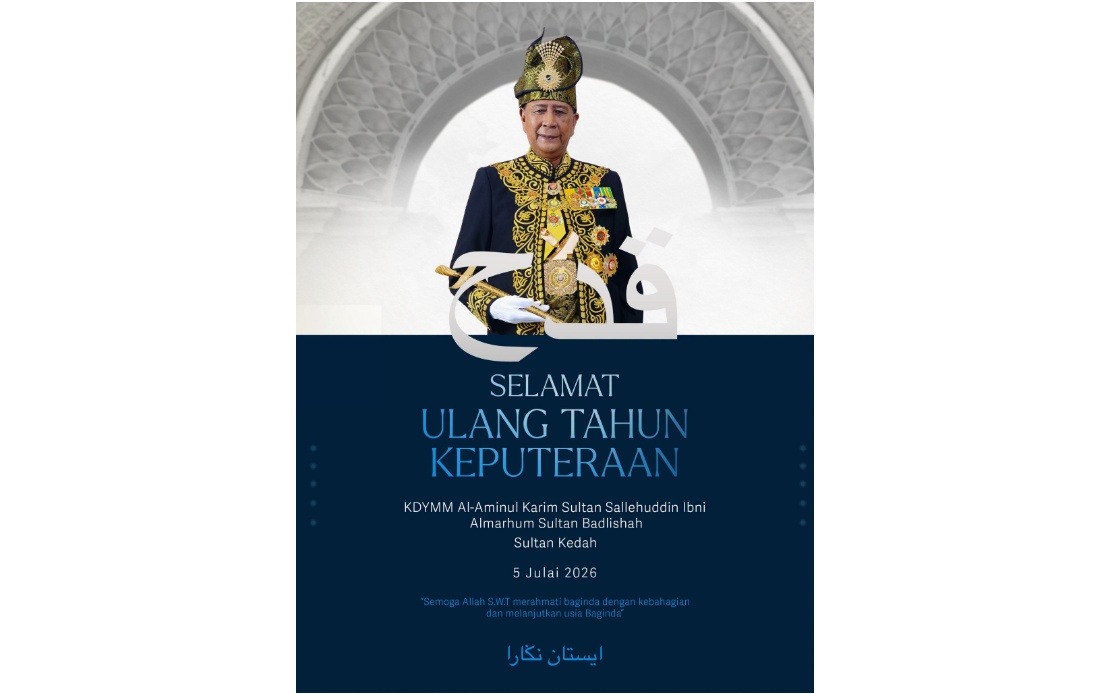
His Majesty Sultan Ibrahim, King of Malaysia, has conveyed warm birthday greetings to Al-Aminul Karim Sultan Sallehuddin Sultan Badlishah, the Sultan of Kedah, as the royal leader celebrates his 84th birthday. The monarch's message, shared through the official Facebook platform of Sultan Ibrahim Sultan Iskandar, expressed His Majesty's heartfelt prayers for the Kedah ruler's continued wellbeing and longevity.
In his message, the King invoked divine blessings upon the Kedah Sultan, requesting that Allah SWT grant him lasting happiness and a lengthy lifespan. The gesture reflects the traditional protocols observed among Malaysia's constitutional monarchy, where the reigning monarch customarily acknowledges significant milestones in the lives of fellow state rulers. Such exchanges of goodwill are integral to maintaining the cooperative framework that underpins the Conference of Rulers and the broader system of constitutional governance across the country's thirteen states.
Beyond the palace, Prime Minister Datuk Seri Anwar Ibrahim also extended his congratulations to Sultan Sallehuddin, demonstrating the multifaceted respect shown by Malaysia's highest political leadership toward the state rulers. The Prime Minister's salutation, likewise disseminated via social media, encompassed not only the Sultan but also acknowledged the Sultanah of Kedah, Sultanah Maliha Tengku Ariff, and the entire royal household of the northern state.
The Prime Minister's message carried deeper significance through its explicit invocation of divine guidance and mercy for the royal family. By referencing Allah SWT's blessings and the perpetuation of sovereignty, Anwar Ibrahim's statement underscored the interconnected relationship between the federal administration and state-level monarchy. This balanced acknowledgment of both spiritual and constitutional dimensions reflects Malaysia's unique political architecture, wherein the King serves as the supreme head of Islam and guardian of the Federal Territories, while state sultans hold parallel authority within their respective jurisdictions.
Sultan Sallehuddin's tenure as Sultan of Kedah represents considerable longevity in his role, making his 84th birthday a significant occasion in Malaysian royal circles. Kedah, one of the federation's historically important states, maintains prominent representation in the Conference of Rulers, the consultative body through which state rulers engage with the federal government on matters of national importance. The ruler's prominence ensures that any acknowledgment from the highest levels of government carries weight beyond ceremonial convention.
The exchange of birthday wishes also serves a broader diplomatic function within Malaysia's constitutional framework. These public gestures, shared across digital platforms with immediate reach to millions of citizens, reinforce the narrative of unity and mutual respect among the nation's leadership structures. For Malaysians, witnessing their constitutional heads demonstrate deference and goodwill toward one another provides reassurance regarding the stability and cohesiveness of the country's governance systems.
For regional observers, such courtesies underscore the orderly succession of authority and the respect for established institutions that characterize Malaysia's political system. In an era when stability is increasingly valued across Southeast Asia, these demonstrations of institutional respect and inter-governmental harmony constitute soft indicators of national health and continuity. The celebration of a senior statesman's milestone further emphasizes the value placed upon experience and institutional memory within Malaysia's leadership circles.
The inclusion of the Sultanah of Kedah and the broader royal family in the Prime Minister's wishes demonstrates contemporary awareness of the expanding role of royal consorts and family members in modern governance and ceremonial functions. The Sultanah of Kedah represents not merely a ceremonial position but an active participant in state-level charitable, cultural, and social initiatives that reinforce the monarchy's connection to ordinary citizens and institutional networks throughout the state.
Such birthday acknowledgments, while appearing routine on the surface, occupy an important place in Malaysia's constitutional order. They affirm the legitimacy of state rulers and their institutions at a moment when federal and state governments occasionally experience tensions over resource allocation, legal jurisdiction, and administrative authority. When the King and Prime Minister jointly celebrate a state ruler's birthday, they collectively signal that notwithstanding such disagreements, the underlying respect for federalism and the sanctity of the monarchical institution remains robust and unshaken.

