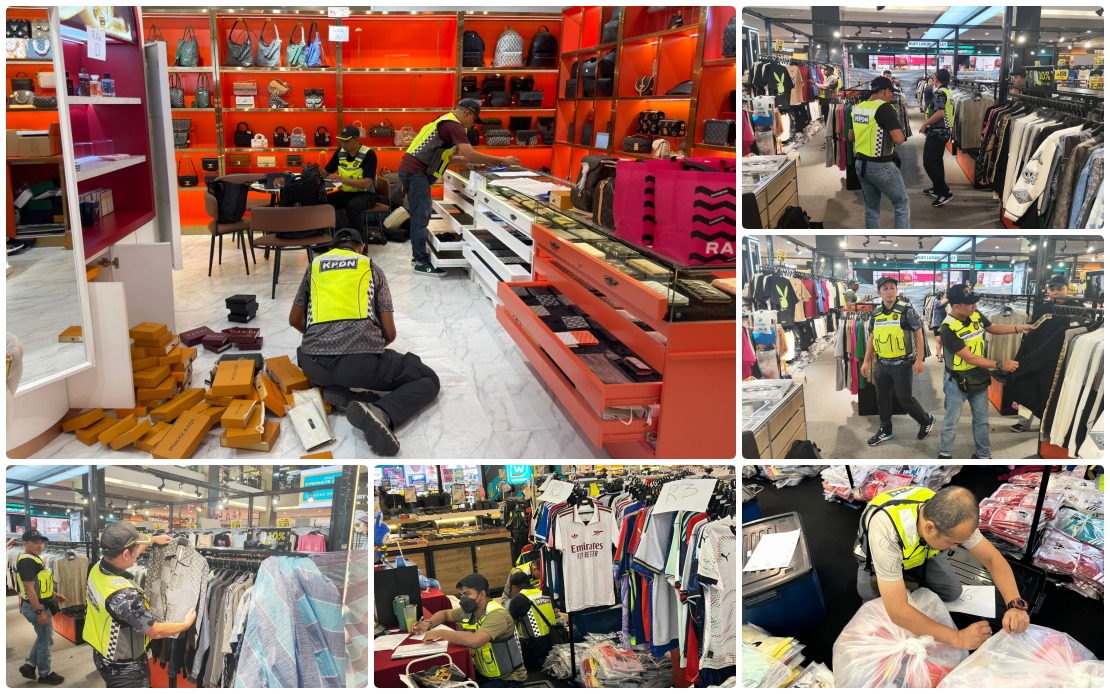
The Ministry of Domestic Trade and Cost of Living (KPDN) has delivered a significant blow to counterfeit traders operating in Johor, confiscating suspect branded merchandise estimated at RM600,000 from three separate business locations in Johor Bahru during a coordinated enforcement drive on June 15. The operation, announced through KPDN's Putrajaya Enforcement Division, represents an escalation in the government's ongoing campaign against trademark infringement and the distribution of fake luxury goods that undermine consumer protection and damage the reputation of legitimate brand owners.
Director-General Datuk Azman Adam outlined the scope of the investigation that preceded the raids, emphasizing that KPDN's intelligence division had spent approximately one month tracking the suspected traders' activities. The investigation revealed a sophisticated distribution network where the operators were not merely retailing counterfeit items through major supermarket chains but were actively functioning as wholesalers supplying further downstream traders, suggesting the counterfeiting operation had considerable reach within the state's retail ecosystem.
The enforcement teams recovered an extensive array of counterfeit merchandise bearing fraudulently applied trademarks of established international brands. The seized items encompassed multiple product categories including clothing, handbags, wallets, belts, and perfumes, alongside relevant business documentation. This diversity of product types indicates that the counterfeiters operated a well-organized operation capable of sourcing or manufacturing multiple categories of fake goods, rather than engaging in opportunistic small-scale violations.
The investigation uncovered clear evidence satisfying the legal threshold for prosecution. Preliminary inspections and verification conducted by representatives designated by the complainants established sufficient grounds to believe that offences had occurred under Section 102(1)(c) of the Trademark Act 2019, specifically the possession, custody, or control of goods bearing wrongfully applied trademarks for commercial trading purposes. This legal finding is critical, as it establishes the intentional nature of the infringement rather than inadvertent misuse.
Four local individuals, including the premises owners and caretakers, were taken into custody to facilitate the investigation and to provide statements regarding their involvement in operating the counterfeit distribution business. The detention of management-level personnel suggests KPDN is pursuing a comprehensive investigation aimed at determining the full extent of the operation and identifying any upstream suppliers or downstream distribution networks connected to these locations.
The penalties available under the Trademark Act 2019 provide substantial deterrents against trademark infringement. For individual offenders committing a first violation, the law permits courts to impose fines reaching RM10,000 per counterfeit item or custodial sentences of up to three years, or both. The penalties increase substantially for repeat offenders, with maximum fines of RM20,000 per item or imprisonment extending to five years, or both. For corporate entities and business organizations, the first-offence fine threshold stands at RM15,000 per item, escalating to RM30,000 per item for subsequent convictions.
The severity of these potential penalties underscores the government's determination to protect intellectual property rights and safeguard consumers from deceptive merchandise. For the four detainees, if convicted on the current evidence, they face considerable financial and personal consequences depending on the number of counterfeit items deemed to be under their control and the extent of their culpability in the operation. The per-item calculation methodology means that operations involving thousands of counterfeit goods, such as the current case, could result in aggregate penalties running into millions of ringgit.
Counterfeit goods operations inflict multifaceted damage extending well beyond individual brand owners. For Malaysian consumers, fake products pose health and safety risks, particularly when counterfeit cosmetics, perfumes, and personal care items are involved, as these may contain harmful or undisclosed chemical substances. The proliferation of counterfeit merchandise also distorts market competition, allowing unscrupulous traders to undercut legitimate retailers who maintain genuine stock and incur proper business expenses.
From a regulatory perspective, KPDN's enforcement action reflects heightened vigilance against intellectual property violations. The month-long preliminary investigation demonstrates that the ministry has transitioned beyond reactive enforcement to proactive intelligence gathering, allowing officials to identify and target organized counterfeit networks rather than responding solely to consumer complaints. This intelligence-driven approach is particularly significant in cross-border trade contexts, where Malaysian territory serves as a conduit for counterfeit goods destined for regional markets.
The operation carries implications for legitimate e-commerce and retail sectors in Malaysia. As online shopping expands and informal trading channels proliferate, the risk of counterfeit goods infiltrating supply chains increases substantially. Retailers and marketplaces must implement robust verification procedures for suppliers to avoid inadvertently stocking counterfeit merchandise, which could expose them to liability under the same trademark statutes.
Datuk Azman's statement that KPDN would intensify enforcement and refuse compromise with counterfeiters signals an organizational commitment to sustained action rather than episodic crackdowns. The statement explicitly connects trademark protection to consumer welfare, framing intellectual property enforcement as an essential consumer protection mechanism. This framing is particularly resonant in Malaysia, where consumers increasingly demand product authenticity and where branded goods represent substantial household expenditures.
The regional context is also noteworthy. Johor Bahru's geographic position as a major entry and distribution point makes it a critical node in counterfeiting networks serving not only Malaysia but also Singapore and other Southeast Asian markets. Effective enforcement in Johor therefore has spillover benefits for regional intellectual property protection and consumer safety.
Moving forward, the outcomes of this investigation and any subsequent prosecution will influence trader behavior and organizational practices within Malaysia's retail sector. Convictions would further establish KPDN's enforcement credibility and potentially encourage brand owners to report suspected infringements more actively, creating a virtuous cycle of improved intellectual property protection.

