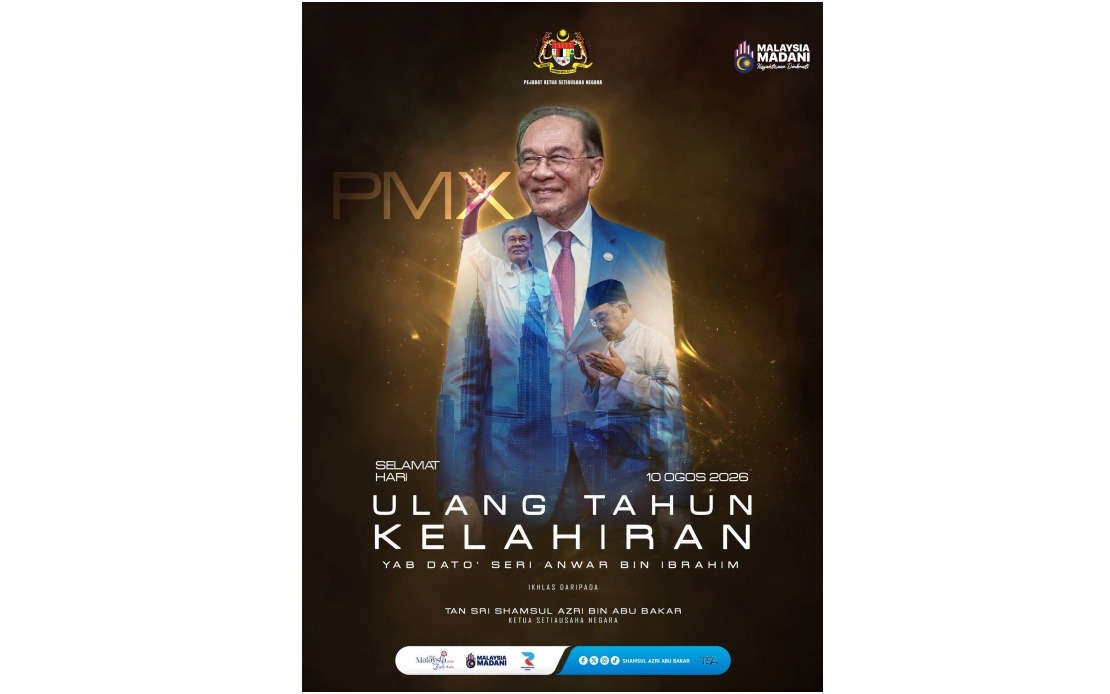
The Chief Secretary to the Government, Tan Sri Shamsul Azri Abu Bakar, has publicly celebrated Prime Minister Datuk Seri Anwar Ibrahim's 79th birthday, conveying warm wishes through an official Facebook post that acknowledged the milestone and expressed hope for the leader's continued wellbeing. Beyond the ceremonial nature of such occasions, Shamsul Azri's message carried a substantive commitment to the administration's broader vision, emphasising that the civil service remains steadfastly aligned with both the Prime Minister's strategic direction and the ongoing reform programme within the public sector that aims to serve the Malaysian people more effectively.
In his statement, Shamsul Azri invoked both spiritual blessing and institutional resolve, requesting divine favour for Anwar Ibrahim's health, vitality and wisdom as he navigates the complex demands of leading the nation through a period of significant institutional and policy change. The choice to emphasise wisdom reflects the civil service's recognition that Malaysia's governance challenges extend beyond administrative routine, requiring the Prime Minister to balance competing interests and articulate a coherent national vision that resonates across diverse constituencies. The CSG's prayer for strength, meanwhile, acknowledges the considerable physical and mental demands placed on a leader managing an economically vulnerable nation amid regional and global uncertainties.
The formal machinery of government reinforced these sentiments through the Prime Minister's Office, which released a separate birthday tribute via video on Facebook. The message struck a notably different tone from typical ceremonial wishes, emphasising the continuation of work and the fulfilment of public trust rather than dwelling on the personal milestone itself. The phrase "Efforts continue, the trust is fulfilled, and to Allah SWT we place our trust" encapsulates a governing philosophy that subordinates individual celebration to collective purpose, positioning the Prime Minister's birthday as a moment for reaffirming institutional commitment rather than marking a personal achievement. This framing suggests the administration views its mandate not as secure but as contingent upon sustained performance and the maintenance of popular confidence.
The Malaysia MADANI Facebook page, representing the government's signature policy initiative, similarly extended birthday wishes that carried implicit policy messaging. MADANI, which roughly translates to "civilisational" or encompasses a civilisational-development framework, used the occasion to pray for the Prime Minister's continued strength and capacity to serve the nation. By invoking MADANI alongside birthday greetings, the government subtly reinforced its central policy brand and the notion that the Prime Minister's continued wellbeing directly correlates with the policy agenda's prospects for successful implementation. This conflation of personal and institutional renewal reflects broader political communication strategies employed by Southeast Asian governments seeking to personalise policy frameworks around individual leadership figures.
At 79 years old, Anwar Ibrahim represents a generation of Malaysian politicians who have witnessed multiple constitutional and electoral cycles. His longevity in public life, spanning decades of activism, imprisonment, political comeback and eventual ascension to the premiership, has made his health and fitness for office a matter of sustained public and political attention. The carefully worded wishes from government institutions implicitly address concerns about succession and continuity that inevitably surface when any leader enters their ninth decade, even as Malaysian political convention discourages explicit discussion of such matters. The emphasis placed on Anwar Ibrahim's strength and wisdom by multiple government voices signals confidence in his capacity to continue performing effectively, a message intended for both domestic and international audiences evaluating Malaysia's political stability.
The coordination between different government entities in extending birthday wishes, while ostensibly routine, reflects the hierarchical and ceremonial dimensions of Malaysian governance. The Chief Secretary's message carries particular weight because the CSG serves as the apex of the civil service hierarchy and the key administrative interface between political leadership and bureaucratic implementation. That Shamsul Azri publicly affirmed the civil service's commitment to supporting the Prime Minister's reform agenda suggests that administrative cooperation with the government's policy programme cannot be assumed, and requires periodic renewal through direct statements of alignment. This dynamic becomes particularly relevant in Malaysia's fractious political environment, where past administrations have occasionally experienced friction between political and bureaucratic leadership over policy direction and pace of implementation.
The religious and spiritual language employed across these messages—invoking Allah's protection, blessing and wisdom—reflects Malaysia's Islamic constitutional framework and the Prime Minister's own background as a prominent figure in the Islamic modernisation movement. This rhetorical choice grounds the Prime Minister's leadership in a transcendent framework that transcends ordinary political competition, positioning him as a custodian of national interests rather than merely a partisan leader. For a government that has positioned itself as committed to institutional reform and anti-corruption efforts, appeals to divine guidance serve to legitimise these initiatives as morally grounded rather than merely politically expedient.
Anwar Ibrahim's premiership, which commenced in 2022 following the November 2022 elections that produced a hung parliament, has proven substantially more stable than many analysts anticipated. The coordination evident in these birthday messages suggests a government apparatus that has achieved functional coherence despite the precariousness of its political coalition. The civil service's explicit commitment to supporting the Prime Minister's reform agenda indicates that bureaucratic cooperation, often a challenge in transitional governments, has been secured. This institutional stability, however, remains dependent upon the continued health and political viability of the Prime Minister himself, making the careful monitoring of his wellbeing a matter that extends beyond personal concern into questions of national governance and continuity.
Looking forward, Anwar Ibrahim's advanced age inevitably raises questions about succession planning and the long-term direction of Malaysian politics, even as his government focuses on immediate policy challenges including economic management, institutional reform and political consolidation. The birthday messages, while celebratory in form, also constitute implicit acknowledgments that the Prime Minister's tenure, whenever it concludes, will represent a generational transition in Malaysian politics. For now, however, the chorus of official wishes reflects confidence that his leadership remains vital to the government's reformist agenda and to Malaysia's continued navigation of the complex challenges confronting the nation.

