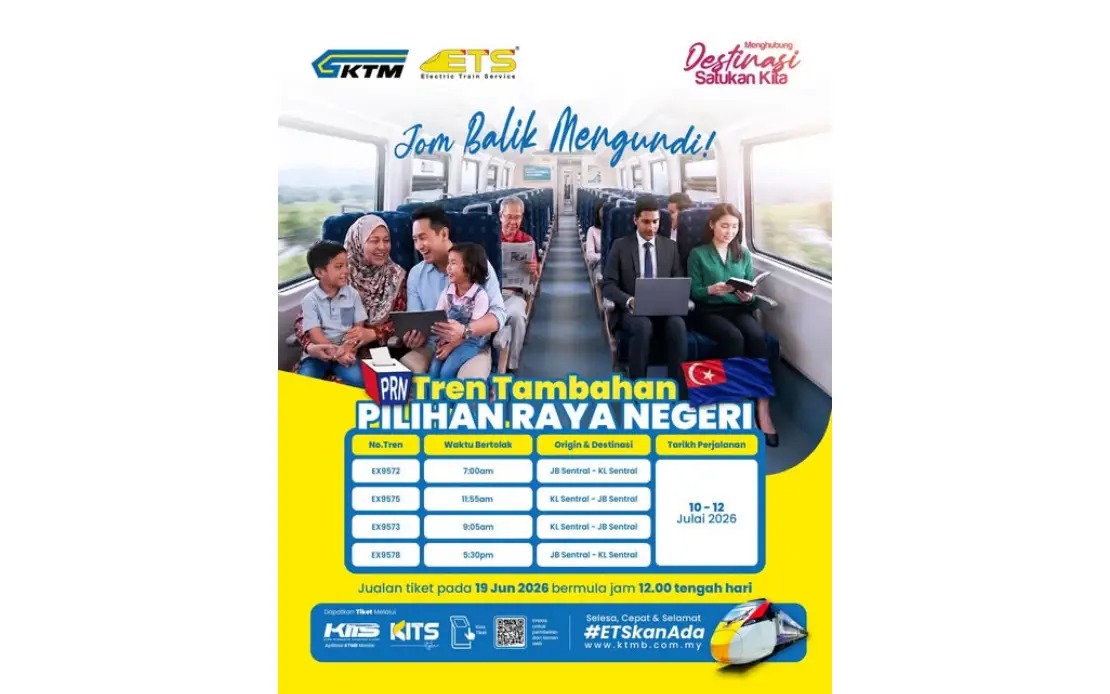
Keretapi Tanah Melayu Berhad (KTMB) is expanding capacity on its East Coast Main Line to handle the anticipated surge in passenger traffic as Johor residents return to cast votes in their state election. The move reflects longstanding logistical challenges during major electoral events, when significant portions of Malaysia's working-age population relocate temporarily to participate in democratic processes. Such coordinated transport initiatives have become routine during national and state polls across the country, reflecting both the geographic dispersal of Malaysian voters and the importance placed on facilitating participation.
The additional train services will operate throughout a three-day travel window spanning July 10 to 12, bracketing the election day of July 11 set by the Election Commission following the dissolution of the Johor State Legislative Assembly on June 1. This scheduling gives voters flexibility to depart either the day before balloting or immediately after, accommodating those who work in other states or who may prefer not to rush back after voting concludes. The timing also reflects practical experience: previous elections have shown that bundling extra capacity into a short window prevents service strain from cascading into regular scheduling disruptions.
Ticket sales commenced at noon on June 19, with KTMB offering multiple booking avenues designed to suit diverse passenger preferences and digital literacy levels. The KTMB Mobile app and KITS Style app represent the state operator's push toward digital-first distribution, reducing queues and providing real-time seat availability information. For those preferring traditional methods, the official website at online.ktmb.com.my offers a straightforward booking interface, while walk-up purchases remain available at KTMB ticket kiosks across the country. This multi-channel approach has become standard practice in Malaysian transport operations, ensuring that rural voters without smartphone access or internet reliability can still secure seats without travelling to city terminals.
The railway operator's proactive announcement carries broader implications for how Malaysian infrastructure handles democratic participation. The ETS network, which connects major urban centres along Peninsular Malaysia's western and central corridors, serves as a critical artery for internal migration during elections. Johor, as the southern anchor of this network and home to significant populations working in Kuala Lumpur and other centres, typically witnesses substantial bidirectional passenger flows during state and federal elections. By adding capacity rather than allowing market forces to drive up fares, KTMB signals commitment to ensuring economic status does not create barriers to voting.
From a regional perspective, Malaysia's approach contrasts with some Southeast Asian neighbours where rural voters face significant travel costs and logistical barriers to participating in elections. The availability of affordable train transport, supplemented with extra services during electoral periods, reinforces the accessibility of voting rights across economic classes. This institutional responsiveness also sets expectations: failing to provide adequate transport capacity would generate political criticism, as voters and opposition parties alike could credibly argue that the government was making voting inconvenient.
The Johor election itself carries weight beyond the state level, given the southern state's economic importance and its traditional role as a bellwether for federal politics. The July 11 polling represents a test of voter sentiment following recent political volatility and shifting coalitions at the national level. Ensuring smooth logistics—including transport—becomes a matter of democratic legitimacy and operational efficiency. Disruptions or passenger complaints about overbooked trains could generate negative headlines that extend beyond KTMB's responsibility into broader perceptions of government competence.
For workers based in Klang Valley and other northern employment hubs, the announcement provides concrete reassurance that they can fulfil civic obligations without sacrificing income or workplace stability. The three-day window allows staggered travel rather than creating a single bottleneck, and the emphasis on advance booking through digital platforms provides data that helps KTMB calibrate consist composition—the number and type of train cars deployed. This data-driven approach to infrastructure management represents a maturing of Malaysia's transport administration, moving beyond reactive crisis management toward predictive capacity planning.
The promotion also encapsulates a broader pattern in Malaysian governance: during elections, multiple state institutions coordinate to facilitate participation. Beyond railways, returning officers manage expanded polling stations, postal voting systems accommodate those unable to travel, and security forces ensure orderly access to voting premises. These systems have evolved over decades of electoral practice and periodic refinement. The ETS service expansion fits within this institutional ecosystem, reflecting recognition that modern electoral participation depends on reliable physical infrastructure as much as on legal frameworks.
For KTMB specifically, managing election travel demand represents both an operational challenge and a public relations opportunity. Successfully moving large numbers of voters without service failures builds institutional credibility and public goodwill. Conversely, overcrowded trains or missed connections during elections generate the kind of persistent political criticism that haunts public agencies for years. The operator's early announcement and multiple booking channels suggest awareness of these stakes and commitment to getting logistics right.
The announcement also underscores continuing demand for southern-corridor connectivity, validating earlier investments in the ETS network that some critics had questioned. Sustained electoral travel demand validates the infrastructure's role in binding geographically dispersed Malaysian communities together, allowing citizens to maintain roots in home states while pursuing economic opportunities elsewhere. In that sense, the extra July trains are not merely a short-term response to one election but a demonstration of enduring demand patterns that justify ongoing investment and maintenance of the ETS system.

