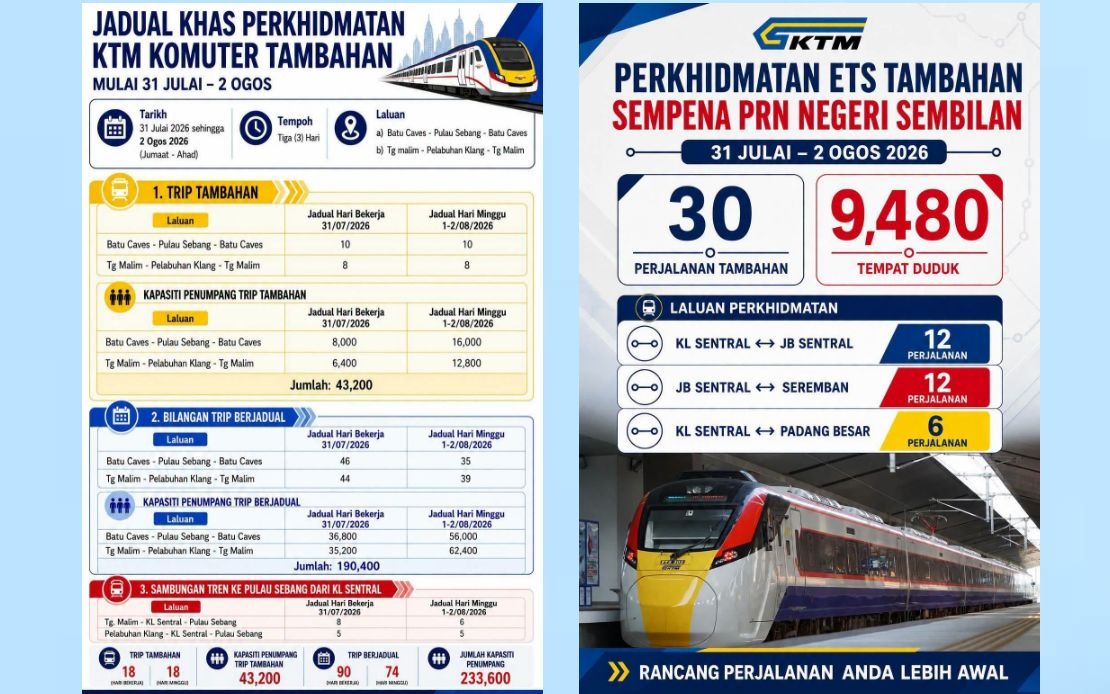
Keretapi Tanah Melayu Berhad (KTMB) has announced a significant expansion of rail capacity for the upcoming Negeri Sembilan state election, recognising that voter mobility will be critical on polling day. The national rail operator will operate 48 additional train trips across its Komuter and Electric Train Services (ETS) networks over a three-day window beginning July 31 and concluding August 2, with August 1 serving as the actual voting date. This deployment represents a strategic effort to prevent congestion on Malaysia's busiest commuter corridors and ensure that citizens from the Negeri Sembilan heartland can exercise their democratic rights without facing transport bottlenecks.
The Komuter expansion will see 18 extra trips added on both Friday, July 31 and the weekend period spanning Saturday and Sunday, August 1 to 2. These additional services will run according to weekday scheduling patterns, indicating that KTMB anticipates sustained demand throughout the period rather than a single-day surge. The enhancements target two main routes: the Batu Caves–Pulau Sebang corridor will absorb 10 of these trips, while the Tanjung Malim–Port Klang line will handle the remaining eight. Collectively, these 36 Komuter additions will inject 43,200 new passenger seats into the system alongside the railway's regular scheduled services, which are expected to carry 190,400 passengers during the same period. The total weekend capacity across both regular and additional Komuter services thus reaches 233,600 seats.
The ETS services receive even more intensive reinforcement, with KTMB committing 30 supplementary intercity train movements across three strategic corridors. The Johor Bahru Sentral to Seremban route—the most direct pathway from the south into the Negeri Sembilan state capital—will receive 12 additional departures in both directions. Similarly, the KL Sentral to Johor Bahru Sentral corridor will accommodate 12 extra ETS trips, recognising that many voters may travel via the federal capital. The northern route from KL Sentral to Padang Besar will support six additional services. Together, these 30 ETS movements will furnish 9,480 seats for longer-distance travellers, particularly those coming from or transiting through major urban centres.
Specific scheduling details reveal KTMB's efforts to distribute demand across multiple departure times. On the Johor Bahru to Seremban route, train EP9636 departs the southern terminus at 2.10 pm and reaches Seremban at 5.15 pm, with the return service EP9637 leaving Seremban at 5.45 pm and arriving back in Johor Bahru at 8.50 pm. Early morning options are also available, with EP9630 providing a 6.15 am departure that reaches Seremban by 9.20 am, and EP9633 running a late-morning service departing Seremban at 9.50 am. For the Johor Bahru to Kuala Lumpur corridor, morning and evening options bookend the day: EX9572 departs Johor Bahru at 7.00 am, arriving at KL Sentral at 11.10 am, while EX9578 provides an evening departure at 5.30 pm with arrival at 9.40 pm. Northbound services via EX9575 and EX9573 offer midday flexibility for travellers planning return journeys.
The Padang Besar route receives less intensive augmentation but reflects KTMB's attempt to maintain connectivity across the entire peninsular network. Train EP9273 operates a morning-to-afternoon service departing Padang Besar at 11.05 am and reaching KL Sentral at 4.30 pm, while EP9276 provides the return service from KL Sentral at 5.00 pm with arrival in Padang Besar at 10.20 pm. These timings suggest that KTMB is accommodating voters from the northern states who may need to reach Negeri Sembilan, though the lower frequency on this route compared to the Johor Bahru services indicates that northbound demand is expected to be more modest.
Operational logistics have also been recalibrated to support this election-period initiative. KTMB has arranged a temporary suspension of the Klang Valley Electric Double Track Infrastructure Facilities Upgrading Project Phase 2 (KVDT2) works on affected routes for the three-day period. This decision underscores the rail operator's commitment to prioritising service reliability and safety during this crucial window. However, passengers on the Tanjung Malim–Port Klang Komuter line will need to adjust their plans by changing trains at KL Sentral Station to continue onward to Seremban or Pulau Sebang stations, introducing a minor inconvenience that could be mitigated through advance journey planning.
For Malaysian and Southeast Asian observers, this deployment illustrates how infrastructure institutions adapt to democratic imperatives. Negeri Sembilan, while not Malaysia's most populous state, occupies strategic geographic position between Kuala Lumpur and Johor Bahru, the nation's second-largest urban agglomeration. Voters from within the state who have migrated to these major economic centres frequently return for state elections, creating predictable but concentrated demand patterns that occur only once per electoral cycle. By pre-emptively expanding capacity rather than merely hoping for capacity management, KTMB demonstrates institutional learning from previous electoral events and a recognition that voter participation ought not be hindered by transport logistics.
The scale of this operation—48 additional train trips providing over 52,000 combined seats—represents a substantial mobilisation of rolling stock and personnel. For context, this single three-day election initiative roughly equals the weekly scheduled service increment that KTMB might typically introduce during holiday season. Yet unlike peak-period travel demand, which is diffuse and extends over weeks, election-related demand is highly concentrated and predictable. This creates a planning advantage: KTMB can activate pre-positioned trains and crews with precision, knowing that the surge will dissipate immediately after polling day.
Passenger behaviour during this period will also test KTMB's operational resilience. Election crowds tend to cluster around specific times—early morning departures for those wanting to vote and return the same day, and late afternoon or evening services for voters planning overnight stays. The additional schedule offerings suggest KTMB has anticipated these patterns, though real-time management capacity and station handling procedures at crowded hubs like Seremban will face stress testing. Weekend operation during August 1 and 2 adds complexity, as KTMB must substitute its typical Saturday-Sunday service patterns with election-demand patterns instead.
From a broader transportation policy perspective, this initiative raises questions about permanent service expansion on the Komuter network, which remains chronically capacity-constrained during peak periods. If KTMB can sustainably operate 36 additional Komuter trips across these routes without major incidents, and if utilisation rates confirm strong demand, the case for permanent service increases strengthens considerably. The Klang Valley metropolitan area, which includes the Batu Caves–Pulau Sebang and Tanjung Malim–Port Klang corridors being reinforced, faces persistent congestion, and additional train capacity could offer a tangible alternative to car-dependent travel.
Public communication surrounding these arrangements remains paramount. KTMB has advised travellers to plan journeys in advance and consult official timetable channels, a reasonable precaution given the schedule complexity. However, the railway operator faces inherent challenges: information dissemination during an election period competes with political messaging, and voters with time-sensitive travel needs may not routinely monitor KTMB announcements. Clear, repeated messaging via multiple channels—KTMB's website, mobile application, partnership with news media, and station signage—will be critical to translating these extra trains into realised journeys rather than empty or underutilised capacity.
Ultimately, KTMB's Negeri Sembilan initiative exemplifies how state infrastructure must flex to serve democratic processes. Whether this election deployment becomes a permanent upgrade or remains a temporary surge—and whether it successfully prevents transport-related voter suppression—will bear watching closely. For Malaysia's broader transportation ambitions, particularly the ongoing development of higher-capacity rail networks across the Klang Valley and beyond, this real-world test case provides valuable operational and demand-pattern data that should inform future infrastructure investment.

