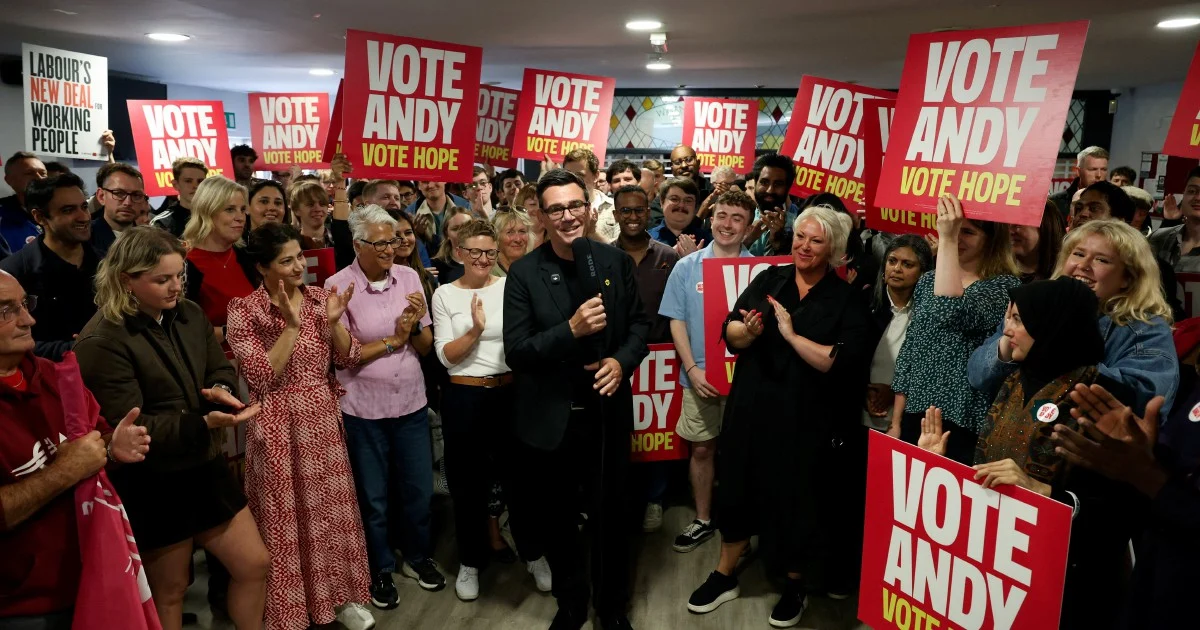
Andy Burnham's emergence as a serious contender to lead Britain could be substantially aided by the fractured state of right-wing politics, with the Makerfield by-election on Thursday serving as a crucial test of both his personal standing and the broader realignment shaping Westminster. The Labour candidate, who currently serves as Mayor of Greater Manchester, is positioned to challenge Prime Minister Keir Starmer for the top job, yet his pathway to victory in this key seat appears increasingly facilitated by competition between the Conservative Party and the populist Reform UK movement, which together risk cannibalising each other's support base in constituencies across England.
The Makerfield contest represents a microcosm of the deeper structural shifts occurring within British electoral politics following the recent general election. The constituency, located in the North West, has become a bellwether for understanding how traditional voting coalitions are fragmenting and reorganising. For Burnham, the timing could hardly be more fortuitous, as the divided opposition provides a clearer pathway to a comfortable victory than might otherwise exist if right-wing voters consolidated behind a single candidate. This dynamic underscores a broader pattern now visible across the country, where the two-party system that once dominated British politics faces unprecedented pressure from new entrants and internal party divisions.
The strategic implications for Burnham's longer-term ambitions are substantial. Winning Makerfield would provide him with a parliamentary seat while he retains his mayoral responsibilities, positioning him uniquely within Labour's upper echelon as both a regional power broker and a Westminster MP. This combination of local and national influence mirrors the path taken by previous party leaders who used regional prominence to establish their credentials. More importantly, a decisive victory built on divided opposition would send a powerful signal about Labour's ability to dominate electoral contests even when the government faces significant headwinds, a critical metric for any potential party successor.
The Reform UK challenge to Conservative dominance represents perhaps the most significant rupture in British right-wing politics in decades. Under Nigel Farage's leadership, the party has attracted voters disillusioned with traditional Conservatism, siphoning away support that previous UKIP campaigns struggled to mobilise with comparable consistency. In constituencies like Makerfield, where working-class voters have historically oscillated between Labour and Conservatives, Reform UK's populist messaging appears to resonate strongly. The party positions itself as fundamentally opposed to the establishment consensus on immigration, economic management, and cultural issues, creating a direct competitive dynamic with an already weakened Conservative Party struggling to recapture its coalition after electoral defeat.
For Malaysian and Southeast Asian readers observing British politics, this fragmentation offers instructive lessons about electoral volatility and the limitations of long-established political structures. Malaysia's own experience with BN-PAS competition in the Malay-Muslim electorate presents parallels to the Conservative-Reform UK split, though the Malaysian context involves more complex coalition dynamics and constitutional frameworks. The Makerfield result will likely influence international assessments of whether established conservative parties can recover dominance or whether populist challengers have permanently altered electoral mathematics in ageing democracies.
Burnham's personal profile carries considerable weight in assessing whether he represents genuine alternative leadership or merely a beneficiary of temporary opposition weakness. The 57-year-old politician built his reputation through a combination of grassroots activism in Manchester, institutional competence as mayor, and willingness to challenge Westminster orthodoxy on devolution and regional funding. His decade-long tenure managing Greater Manchester during austerity and subsequent recovery gave him practical experience in difficult governance circumstances that many Westminster figures lack. Whether this translates into broad appeal as a potential prime minister, however, remains untested at the national level.
Labour's strategic positioning around Burnham's candidacy reflects broader calculations about the party's electoral durability. Keir Starmer's government entered office with a substantial majority but has faced mounting criticism over living standards, public service management, and economic policy direction. Having a credible internal challenger, rather than suppressing one, potentially strengthens Labour by demonstrating internal democratic renewal and preventing the kind of bitter succession contests that weakened Conservative leadership transitions. Burnham's prominence as a figure willing to articulate regional concerns and challenge London-centric policymaking appeals to Labour MPs in post-industrial constituencies increasingly concerned about voter retention.
The Makerfield by-election itself emerged from circumstances typical of contemporary Westminster—a sitting MP's resignation creating an unexpected vacancy requiring urgent replacement. These contests carry disproportionate significance as they serve as mid-term referendums on government performance and opposition credibility. For Starmer's government, defending the seat is mandatory; a loss would suggest serious erosion of Labour support and would dramatically elevate questions about the party's electoral longevity. For Burnham, victory provides validation of his electoral appeal and demonstrates his capacity to deliver solid results in challenging circumstances.
The mechanics of vote-splitting between Conservatives and Reform UK warrant careful analysis, as they reveal how electoral systems translate voter preferences into parliamentary outcomes. First-past-the-post voting amplifies the impact of opposition fragmentation, allowing a challenger to win with minority support if opponents divide equally. In Makerfield, current polling suggests Conservative and Reform UK combined command roughly equivalent support to Labour in isolation, meaning their division effectively surrenders the seat to Burnham. This pattern, if replicated across the country, could reshape Westminster composition dramatically, potentially delivering Labour additional seats despite any decline in its absolute vote share.
Looking forward, the consequences of a Burnham victory extend well beyond this single constituency. A comfortable win would enhance his credibility as a future party leader while simultaneously highlighting the structural advantages Labour now possesses through right-wing opposition disunity. His victory speech will be scrutinised for signals about whether he intends to position himself explicitly as a future prime minister or maintain his existing dual roles. The tenor and content of his remarks could influence Labour MPs' assessments of succession scenarios, particularly if Starmer faces mounting pressure from backbenchers or public opinion deterioration.
For international observers, the Makerfield result provides one crucial data point in evaluating whether Britain's two-party political system remains fundamentally stable or whether it has entered a transitional period toward more fragmented, coalition-dependent governance. The outcome will inform broader understanding of how established democracies respond to economic disruption, migration pressures, and cultural anxieties that fuel populist movements globally. Burnham's potential ascent to leadership would represent not a rejection of these underlying forces but rather Labour's capacity to accommodate some populist concerns within a traditional social democratic framework.