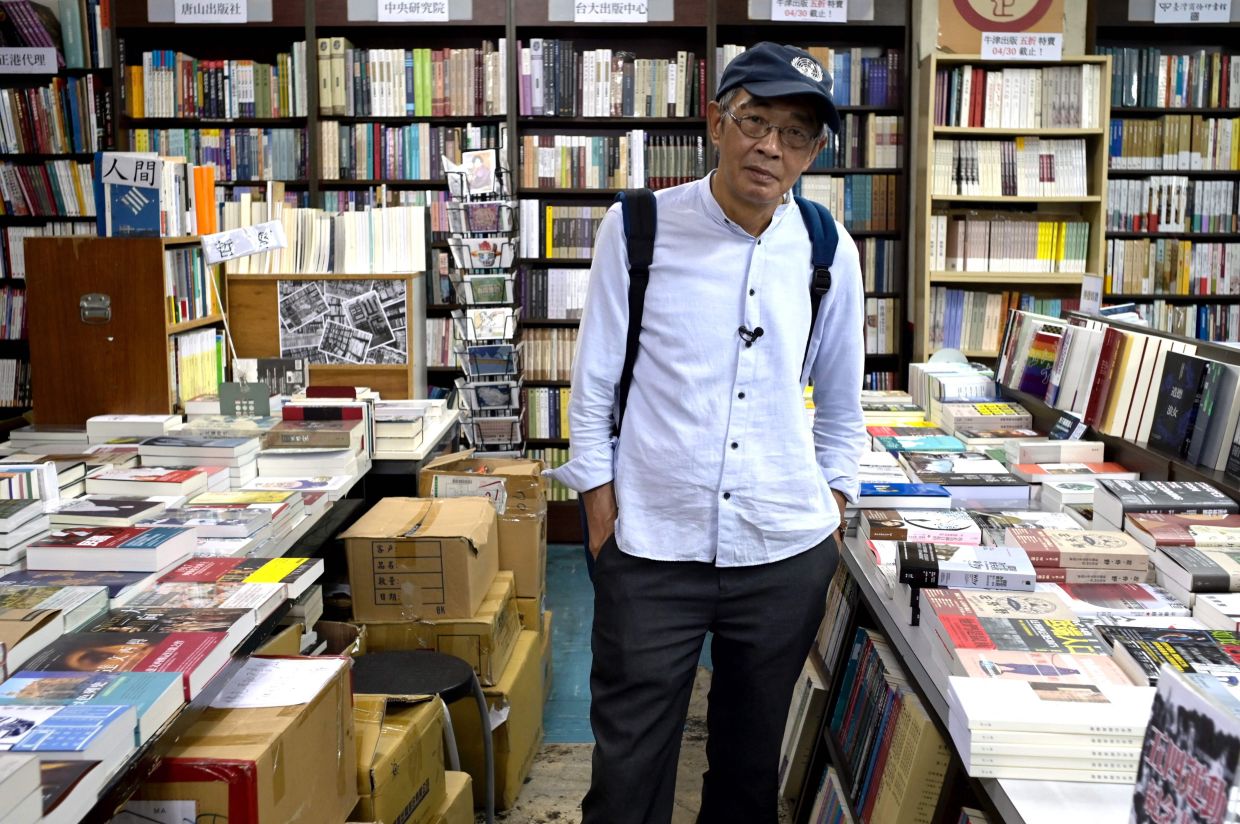
Lam Wing-kee, the Hong Kong bookseller who emerged as a symbol of resistance to Beijing's authoritarian grip on free expression, has died in Taiwan at the age of 70. Taiwan's Central News Agency reported the death without disclosing the specific cause, though sources indicated that Lam suffered a cancer recurrence the previous year. He was hospitalized at MacKay Memorial Hospital in Taipei earlier this week, where he slipped into unconsciousness on Wednesday before passing away Thursday evening.
Lam's death marks the end of a remarkable chapter in Hong Kong's struggle for freedom. As manager of Causeway Bay Books, a Hong Kong bookstore specializing in titles banned on mainland China—including controversial exposés about senior Communist Party leaders—Lam became caught up in one of the most alarming episodes of Beijing's expanding reach into the semi-autonomous territory. His subsequent escape and continued defiance through testimony and his reopened bookstore in Taiwan represented an act of quiet but resolute resistance against authoritarian control.
In late 2015, five people connected to Causeway Bay Books vanished under mysterious circumstances, triggering international alarm about Hong Kong's eroding autonomy. The disappearances sent shockwaves through the publishing world and civil society, raising urgent questions about the city's "one country, two systems" arrangement and Beijing's willingness to circumvent local laws to silence voices critical of the Communist Party. Lam was among those seized, an event that would fundamentally alter the trajectory of his life and transform him into an unwilling symbol of mainland China's suppression of press freedom.
In a dramatic 2016 news conference in Hong Kong, Lam provided a harrowing first-hand account that contradicted official Chinese narratives. He described being captured by Chinese authorities in October 2015 as he crossed from Hong Kong into Shenzhen, then subjected to a 13-hour blindfolded train journey to Ningbo in eastern China. There, he recounted being held in solitary confinement under constant surveillance by rotating two-person teams for five months—a period of psychological torment designed to break his will. The authorities subsequently forced him onto Chinese state television to issue a scripted confession, a common tactic used to delegitimize detainees and manufacture evidence against them.
Gui Minhai, another member of the group and a part-owner of Causeway Bay Books, faced a far grimmer fate. Gui vanished from his vacation home in Thailand and later emerged in Chinese custody, where he was convicted in 2020 of illegally providing intelligence to foreign entities and sentenced to a decade in prison. His case illustrated the lengths to which Beijing would go to pursue and punish those it deemed threats to national security, even across international borders and in defiance of another nation's sovereignty.
Following his release and eventual departure from Hong Kong in 2019, Lam relocated to Taiwan, where he attempted to rebuild his life and continue his mission of providing access to banned literature. He reopened Causeway Bay Books in Taipei in 2020, establishing a foothold for uncensored publishing in a democratic Chinese-speaking society. The bookstore became a beacon for those fleeing mainland repression and a practical manifestation of the freedoms that Hong Kong had begun to lose. However, ill health ultimately curtailed his operations, and last month he revealed to the Central News Agency that he had temporarily shuttered the store without indicating when it might resume business.
Taiwan's President Lai Ching-te released a statement honoring Lam's legacy, acknowledging the profound impact of his courageous testimony. "The passing of Mr Lam Wing-kee is deeply saddening, but the courage he left behind would not fade," Lai wrote on social media. "Taiwan will remember that a Hong Kong bookstore worker once told us in the most ordinary yet most steadfast way how precious freedom is and reminded us that democracy requires the efforts of generation after generation to defend it." The presidential tribute underscores how Lam's experience resonated across the Taiwan Strait, serving as a cautionary tale about the fragility of autonomy under Beijing's expanding authoritarian reach.
The broader context of Lam's death illuminates the accelerating dismantling of Hong Kong's distinctive freedoms. Since the massive pro-democracy protests of 2019, both Chinese and Hong Kong authorities have systematically dismantled virtually all remaining space for dissent. The 2024 national security law has provided a sweeping legal framework for silencing opposition, with Hong Kong police using it to arrest bookstore owners and publishers on charges of sedition and receiving foreign political support. This June, authorities arrested two individuals operating a bookstore suspected of selling seditious materials and accepting funds from abroad—a scenario that would have been unthinkable a decade earlier and one that tragically echoes the circumstances surrounding Lam and his colleagues.
Lam's story carries particular resonance for Southeast Asia, where questions about press freedom, publishing autonomy, and resistance to external pressure remain contested. Malaysia, with its own history of restrictions on certain publications and periodic tensions between authorities and booksellers, can recognize troubling parallels in Lam's experience. His 2015 disappearance from Hong Kong into mainland custody demonstrated how the boundary between the territory and the mainland had become porous and vulnerable, a warning that administrative and legal distinctions offer limited protection against determined authoritarian actors.
The symbolic meaning of Lam's life extends beyond his individual ordeal. He embodied the resistance of ordinary people to extraordinary suppression—a bookstore manager who became, through circumstances beyond his control, a champion of intellectual freedom. His act of publicly recounting his torture and mistreatment took tremendous courage in a region where such testimonies often bring further retaliation against families or associates. That he chose to resettle in Taiwan and attempt to continue his work demonstrated a commitment to his principles that transcended personal safety or comfort.
For Hong Kong residents and the broader diaspora, Lam's passing represents the symbolic closure of an era. The disappearance of the five booksellers in 2015 marked a visible turning point in Beijing's approach to Hong Kong, signaling that the territory's legal system would not protect those deemed threats to Communist Party interests. A decade later, Hong Kong's transformation from a relatively open society into an increasingly controlled authoritarian space is nearly complete. Lam's death in Taiwan, a place where he found refuge and where he could speak freely about his ordeal, underscores the starkness of that contrast and the enduring costs of resistance to Beijing's consolidation of power.

