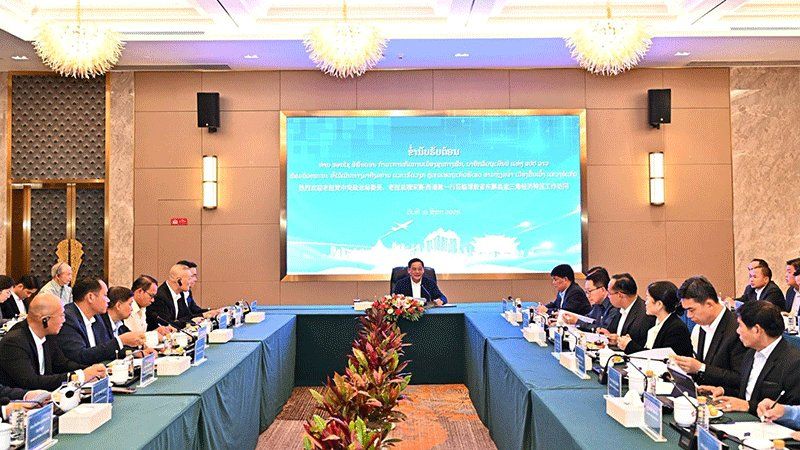
Prime Minister Sonexay Siphandone has directed authorities to implement stricter oversight of the Golden Triangle Special Economic Zone (GTSEZ) in Bokeo province, signalling growing concerns about operational compliance and environmental stewardship at the sprawling development project. During an inspection visit on Tuesday, the Lao leader outlined a comprehensive programme of management improvements intended to accelerate economic returns while ensuring the zone operates within regulatory frameworks and sustainable parameters.
The Golden Triangle SEZ represents one of Southeast Asia's most strategically positioned commercial hubs, straddling the borders of Laos, Myanmar, and Thailand while sitting within proximity of China's Yunnan province. This tri-border location and the zone's position along the Mekong River have positioned it as a gateway for investors seeking access to consumer markets and labour pools across multiple countries. The development occupies 10,000 hectares of Tonpheung district, with 3,000 hectares allocated for commercial operations and 7,000 hectares designated as forested reserves, reflecting an attempt to balance industrial expansion with environmental conservation.
Since its establishment in 2007, the zone has accumulated approximately US$10 billion in cumulative investments across diverse sectors including manufacturing, real estate, hospitality, financial services, and tourism. The zone hosts more than 10,000 registered workers and currently accommodates over 10,000 additional investors, business operators, residents, and visitors. Additionally, more than 400 government officials from various sectors have been stationed at the zone to facilitate administration and investor relations. These figures underscore the zone's significance as both an economic engine and administrative burden for the Lao government.
Yet performance gaps have prompted the Prime Minister's intervention. Data reveals that only 60 per cent of contractually specified business activities have materialised to date, indicating substantial underperformance relative to initial projections and investor commitments. This shortfall suggests that existing management frameworks have failed to ensure accountability or that developmental challenges—whether regulatory, infrastructural, or market-related—have inhibited full implementation of approved projects. The discrepancy between promised and delivered outcomes threatens the zone's credibility with future investors and raises questions about governance capacity.
Prime Minister Sonexay's remedial strategy encompasses multiple dimensions. He instructed the zone's management authority to strengthen one-stop-service systems that streamline investment approvals and reduce bureaucratic friction. Simultaneously, he demanded stricter enforcement of the Law on Enterprises, indicating that non-compliance with national legislation has been an issue. He further stipulated that all financial transactions—encompassing trade, investment, wages, and service payments—must be processed through the formal Lao banking system rather than cash or informal channels, a measure designed to enhance financial transparency and regulatory oversight.
Border security and labour management emerged as additional focal points. The Prime Minister instructed tighter controls over entry and exit procedures within the zone, reflecting concerns about cross-border movement and potentially irregular workforce flows from Myanmar, Thailand, and China. He also called for enhanced mechanisms to effectively manage workers migrating from neighbouring territories, suggesting that informal or undocumented labour arrangements may have been problematic. These directives acknowledge the zone's position as a transnational economic space where labour mobility requires coordinated management.
Sectoral prioritisation represents another element of the policy shift. Prime Minister Sonexay identified tourism, manufacturing, processing, transportation, education, and public health as priority sectors warranting accelerated investment and development. This focus reflects a strategic judgement that the zone should transcend narrow commercial or extractive functions and contribute to regional human development and service provision. Tourism development, in particular, aligns with objectives to maximise the zone's geographic appeal and generate revenue beyond manufacturing-oriented models.
Regional cooperation mechanisms feature prominently in the developmental vision. The Prime Minister called for expanded airline connections linking the zone to neighbouring countries, recognising that improved transport infrastructure enhances investor accessibility and consumer reach. He also advocated strengthening formal cooperation frameworks with Myanmar, Thailand, and China to facilitate cross-border business operations and labour management. These regional dimensions reflect recognition that the zone's viability depends on seamless integration within the broader tri-border ecosystem.
The concession agreement framework itself requires modernisation according to the Prime Minister's assessment. He instructed that existing agreements be revised to align with contemporary legislation and international standards, suggesting that original 2007-era contracts may contain provisions inconsistent with evolving legal requirements or development priorities. This review process could reshape investor rights, obligations, and revenue-sharing arrangements, with implications for both existing operators and prospective entrants.
The Prime Minister's emphasis on sustainability and environmental stewardship reflects international expectations and regional sensitivities regarding Mekong River management. With 7,000 hectares designated as forested areas, environmental compliance represents both a contractual obligation and a reputational consideration. The directive to maintain vibrant economic activity while preserving environmental integrity suggests awareness that reputational damage or ecological degradation could jeopardise the zone's long-term attractiveness to quality investors.
For Malaysian observers and regional stakeholders, the Lao government's intervention demonstrates that even strategically important economic zones require course correction when management gaps emerge. The emphasis on regulatory enforcement, financial transparency, and cross-border coordination offers lessons applicable to other Southeast Asian development projects. The Golden Triangle SEZ's performance trajectory will signal whether enhanced oversight can translate underutilised potential into sustained economic contribution, or whether structural constraints limit the zone's capacity to deliver on its ambitious initial vision.

