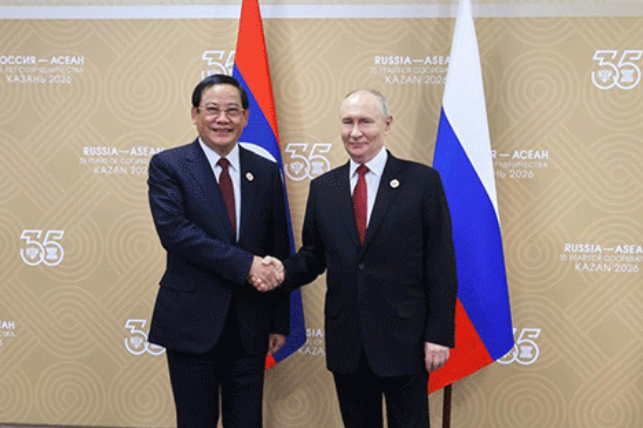
The strategic partnership between Laos and Russia deepened significantly during high-level talks between Prime Minister Sonexay Siphandone and President Vladimir Putin in Kazan, marking a pivotal moment in the two nations' enduring relationship. The engagement took place alongside the Russia-Association of Southeast Asian Nations Summit, providing an opportune setting for the Lao premier to conclude his inaugural official visit to Russia since assuming office in August 2023. The June 14-17 journey, conducted at the express invitation of Russian Prime Minister Mikhail Mishustin, underscores the centrality of Moscow in Vientiane's strategic calculations and reflects how the landlocked Southeast Asian nation continues to balance its diplomatic portfolio amid shifting regional dynamics.
The centerpiece of the bilateral dialogue was Russia's commitment to assist Laos in developing nuclear energy infrastructure, a development with profound implications for the region. President Putin characterised the signing of an intergovernmental agreement on peaceful nuclear energy cooperation as a watershed achievement, emphasising that this accord would establish the essential legal framework for constructing a small nuclear power plant utilising Russian technology within Laotian territory. Such a project would mark a significant expansion of Russia's technological footprint in Southeast Asia and represents a tangible manifestation of Moscow's economic engagement beyond traditional commodity trade. For Laos, which faces mounting energy demands as its economy develops, Russian nuclear expertise offers an alternative to overdependence on hydroelectric resources, though the arrangement will likely attract scrutiny from regional observers concerned about Moscow's expanding influence.
President Putin articulated the Russian perspective on the bilateral relationship with measured warmth, stressing that Moscow has consistently valued its connections with Laos through a prism of mutual respect and consideration of reciprocal interests. He acknowledged Laos's instrumental role in facilitating Russia-ASEAN cooperation, a particularly noteworthy statement given that 2026 will commemorate the thirty-fifth anniversary of formalised relations between Russia and the ten-nation regional bloc. This framing positions Laos as a bridge between Moscow and Southeast Asia more broadly—a role that carries both opportunity and complexity for a nation seeking to maintain equidistant relationships among great powers. Putin's recognition of Laotian President Thongloun Sisoulith's attendance at Russia's Victory Day celebrations in May, and of Lao military personnel's participation in the preceding year's World War II commemoration parade marking eight decades of Soviet victory, demonstrates how Moscow leverages historical narrative and symbolic gestures to reinforce bilateral bonds.
The collaboration agenda outlined during the talks spans multiple sectors critical to Laos's development trajectory. Energy cooperation extends beyond nuclear initiatives to encompass traditional power generation and distribution mechanisms. Industrial partnerships aim to enhance value-added manufacturing capacity within the Lao economy, while agricultural cooperation addresses food security and rural development—sectors where Russian technical knowledge and investment could meaningfully complement Chinese infrastructure projects already underway in Laos. Mining collaboration, given Laos's significant mineral endowments, represents a consequential dimension of the economic relationship. The digital economy and banking sectors feature prominently in contemporary strategic partnerships globally, signalling both nations' recognition that economic integration increasingly occurs in virtual and financial domains rather than solely through physical trade. Transport and tourism cooperation carry direct relevance to Laos's aspirations of becoming a regional transit hub and developing its nascent tourism sector as a sustainable revenue source.
Educational exchange constitutes another cornerstone of the relationship. Prime Minister Sonexay expressed gratitude for Russia's longstanding provision of annual scholarships and training programmes for Lao nationals, with particular emphasis on capacity-building for government officials. Such human capital development, cultivated over decades, creates networks of individuals with personal ties to Russia and familiarity with Russian institutions, thereby embedding institutional relationships at multiple levels. The impending completion of the Laos-Russia Friendship School in Vientiane, a cooperative project between both governments' educational agencies, will provide another venue for cultural and educational exchange. These initiatives represent investments in soft power that yield returns across generations, fostering constituencies within Laos predisposed toward collaborative relationships with Moscow.
The diplomatic pageantry accompanying the visit reflected both nations' commitment to ceremonial validation of their partnership. Prime Minister Sonexay presided over the transfer of two elephants to the Kazan Zoo, a gesture from President Thongloun and the Lao people commemorating the sixty-fifth anniversary of diplomatic relations and Russia Day on June 12. Such symbolic gestures, rooted in cultural tradition and historical significance, serve diplomatic functions beyond their immediate material value. The animals themselves become living representations of bilateral friendship, generating sustained public interest and media coverage that reinforce the political message of sustained partnership. This reflects a diplomatic sophistication in deploying cultural assets to substantiate claims of friendship.
The commercial dimension of the relationship received specific attention through Prime Minister Sonexay's participation in a Laos-Russia business forum designed to catalyse trade and investment flows. Despite the formal architectures of cooperation established through governmental channels, the ultimate utility of bilateral relationships depends significantly on private sector engagement and commercial viability. Such forums create platforms for business representatives from both nations to identify synergies, negotiate terms, and establish the contractual relationships that translate political goodwill into economic activity. The timing of this forum during an official visit by the prime minister signals governmental commitment to creating favourable conditions for commercial expansion.
Prime Minister Sonexay's engagement with Russian Prime Minister Mikhail Mishustin complemented his discussions with President Putin, enabling exploration of practical implementation mechanisms for bilateral agreements. The two premiers characterised their expanding cooperation as rooted in mutual trust and reciprocal support, language emphasising the interpersonal dimensions of state relationships that often prove as durable as formal institutional arrangements. Mishustin's role as head of government positioned him to address the technical and administrative aspects of bilateral cooperation that require sustained governmental attention and resource allocation. The acknowledgment of Russian assistance in human resource development and infrastructure projects like the Friendship School demonstrates the concrete manifestations of partnership in domains directly affecting Laotian citizens' daily lives.
For Malaysian and Southeast Asian observers, the Laos-Russia engagement merits careful attention. It illustrates how smaller nations in the region navigate relationships with external powers, balancing Russian engagement with simultaneous partnerships involving China, Vietnam, and Western nations. Laos's willingness to deepen nuclear cooperation with Russia reflects confidence in Moscow's technological capabilities and willingness to invest in long-term infrastructure partnerships that may not generate immediate commercial returns. The strategic partnership underscores how Russia maintains relevance in Southeast Asian calculations despite facing significant Western sanctions and geopolitical isolation. For Malaysia specifically, the Lao example demonstrates how regional neighbours are pursuing diversified engagement strategies that include Russian economic and technological participation, a reminder that the region's geopolitical landscape encompasses more than Sino-American competition.

