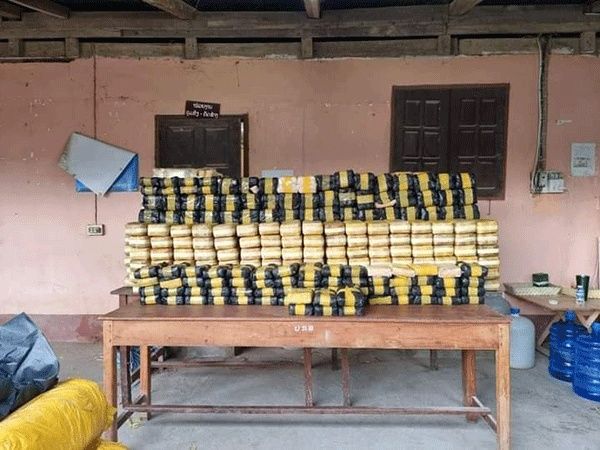
Central Laos is grappling with a narcotics crisis of alarming proportions, with drug-related offences now dominating the criminal landscape in Xaysomboun province. During the first half of 2024, drug crimes accounted for nearly half of all criminal cases processed by local authorities, underscoring how profoundly the drug trade has penetrated the region's security challenges. Police Brigadier General Ouday Insouvanh, commanding the Xaysomboun Provincial Public Security Force, revealed these troubling statistics during an August visit from Police Lieutenant General Vanthong Kongmany, the national Minister of Public Security, signalling that the problem has gained urgent attention at the highest levels of government.
The scale of drug trafficking in Xaysomboun is evident in the raw numbers. Twenty-four of fifty-four criminal cases recorded between January and June involved narcotics offences, with only two cases concluded and forwarded for prosecution while twenty-two remain under investigation. This backlog suggests both the volume of drug activity overwhelming local capacity and the complexity of prosecuting trafficking networks that likely extend beyond provincial borders. The prevalence of unresolved cases indicates that authorities are struggling to move cases through the justice system efficiently, a common challenge in Southeast Asian jurisdictions where organised crime networks operate with sophisticated methods and considerable resources.
Beyond Xaysomboun, Laos faces a nationwide drug emergency that has become embedded in government priorities. According to Prime Minister Sonexay Siphandone's report to the National Assembly last month, authorities nationwide have processed 1,786 drug-related cases during the same six-month period, resulting in 4,025 arrests that included ninety-three foreign nationals. The scope of confiscations—encompassing large drug quantities, paraphernalia, and vehicles used for trafficking—demonstrates that law enforcement is engaging with substantial trafficking operations. Yet the sheer volume of cases relative to arrests suggests that many individuals involved in the drug trade escape prosecution, particularly lower-level operatives or those operating within protected networks.
The national government designated drug suppression as a core policy agenda five years ago, reflecting a long-standing recognition that narcotics trafficking poses an existential threat to social stability and governance in Laos. The Golden Triangle region, where Laos, Thailand, and Myanmar converge, has historically served as a production and transit zone for illicit drugs destined for regional markets and beyond. Xaysomboun's location within this geography makes it particularly vulnerable to trafficking networks, which exploit porous borders, geographic remoteness, and limited enforcement resources. For Malaysian readers and regional observers, Laos's drug problem carries direct implications, as Southeast Asian drug trafficking networks frequently route shipments through multiple countries, and narcotics originating from Laotian production facilities inevitably reach Malaysian streets.
Police Lieutenant General Vanthong's visit yielded explicit instructions for provincial forces to escalate operations across multiple crime categories. Beyond drugs, the minister demanded stronger action against smuggling, human trafficking, theft, burglary, illegal mining, and illegal gambling. This multifaceted approach suggests that authorities recognise drug trafficking does not exist in isolation but operates within an ecosystem of organised crime where criminal networks often diversify their activities to maximise profit and reduce operational risk. The emphasis on human trafficking is particularly significant, as trafficking networks frequently overlap with drug smuggling organisations, with both exploiting similar routes and border vulnerabilities.
Cybercrime has emerged as an unexpected but critical addition to Xaysomboun's security agenda. The minister instructed the provincial command to strengthen oversight of social media usage and combat online crime in accordance with ministry directives. This directive reflects a global trend of criminal organisations migrating portions of their operations online—from drug advertising on social media to money laundering through digital channels. For a province that likely experiences limited digital infrastructure sophistication compared to urban centres, integrating cybercrime prevention into already-stretched security operations presents substantial logistical and training challenges that may strain local resources further.
Road safety emerged as another pressing concern during the ministerial briefing, revealing that public safety extends well beyond organised crime. Xaysomboun recorded sixty traffic accidents in the first six months of 2024, resulting in four deaths, eighty injuries, and an estimated 2.56 billion kip in vehicle damages. While traffic accidents differ fundamentally from drug trafficking, both represent threats to social stability and quality of life. The financial losses alone—exceeding US$200,000 at official exchange rates—burden families and divert economic resources from productive investment, compounding the cumulative impact of security problems on provincial development.
Foreign national management and tourism oversight constitute additional security dimensions that Xaysomboun authorities must balance. During the six-month period, officers inspected 1,698 tourists, of whom 396 were foreign nationals. This tourism surveillance reflects concerns that international visitors may inadvertently enable criminal activity through drug consumption, money laundering, or exploitation of local vulnerabilities. The relatively small proportion of foreign tourists—roughly 23 percent of total visitors—suggests Xaysomboun remains a minor tourism destination, yet the government's interest in monitoring foreign movement indicates awareness that international criminal networks may exploit tourism flows to move contraband or personnel across borders.
The minister's directives to provincial leadership extended beyond enforcement tactics into institutional culture and officer conduct. Police Lieutenant General Vanthong called for strengthened political and ideological education among officers, demanding compliance with Party policies, state laws, and disciplinary standards. Such emphasis on ideological alignment alongside professional conduct suggests underlying concerns about corruption, unauthorised operations, or inadequate commitment to government directives within provincial security forces. These institutional concerns are hardly unique to Laos—corruption within law enforcement agencies undermines drug enforcement effectiveness across Southeast Asia and represents a persistent vulnerability that criminal organisations exploit through bribery and intimidation.
The minister further instructed that investigations, detention, and rehabilitation procedures must follow legal protocols and that personnel be assigned according to expertise levels. These technical requirements, seemingly routine, implicitly acknowledge that provincial forces may lack sufficient training, resources, or procedural discipline to handle complex cases consistently. Immigration management received particular emphasis, with the minister stressing professional execution of duties with clearly delineated responsibilities. This focus on immigration management suggests concern that drug traffickers exploit border vulnerabilities and that immigration enforcement requires substantial capacity building.
For Malaysia and other Southeast Asian nations, Xaysomboun's drug crisis carries direct relevance. The province sits within trafficking networks that supply drugs to Malaysia through transit routes via Thailand and other corridors. Stronger enforcement in Xaysomboun could theoretically reduce drug supplies reaching Malaysian streets, yet the challenges evident in Laotian authorities' struggle with overwhelming caseloads, institutional capacity constraints, and the necessity of simultaneous focus on multiple security domains suggest that meaningful progress will require sustained international cooperation, capacity building, and targeted disruption of trafficking organisation leadership structures.
The government's multifaceted approach—combining traditional enforcement with cybercrime prevention, institutional reform, and enhanced training—represents recognition that drug trafficking cannot be addressed through enforcement alone. Yet the gap between policy directives issued from the national capital and their implementation in provincial settings remains substantial. Xaysomboun authorities face the challenge of maintaining political stability, managing tourism, addressing road safety, combating cybercrime, and suppressing drug trafficking with resources that are clearly insufficient for the scope of challenges confronting them. Without addressing underlying conditions that make Xaysomboun attractive for drug trafficking—geographic remoteness, limited economic opportunities, porous borders, and weak state capacity—enforcement efforts alone will likely produce temporary disruptions rather than fundamental change in the province's security environment.

