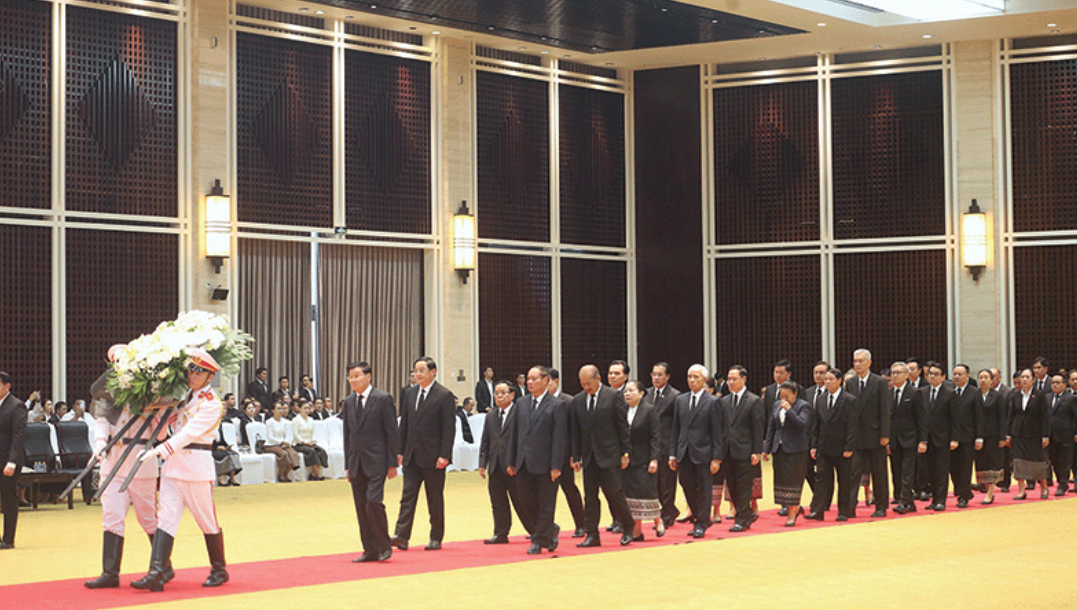
Laos has entered a period of national mourning following the death of National Assembly President Xaysomphone Phomvihane, with Party Secretary General and President Thongloun Sisoulith leading senior government figures in paying final respects at a formal ceremony held at the National Convention Hall in Vientiane on Sunday, August 9. The solemn gathering brought together members of the Politburo, National Assembly deputies, government ministries, civil society organisations and representatives from business and diplomatic circles, all coming to honour a figure whose career spanned several decades of service to Laos's post-war political establishment.
Xaysomphone's death represents a significant transition within the Lao leadership structure, removing from the political landscape one of the Communist Party elite whose family connections placed him at the centre of the country's governance since its founding as a socialist state. As a member of the Politburo and head of the National Assembly, Xaysomphone occupied one of the nation's most important constitutional positions, overseeing legislative affairs during a period when Laos has sought to strengthen institutions and manage economic development amid regional geopolitical shifts. His passing has prompted official recognition of what authorities describe as a profound loss to the party, state and the multiethnic Lao population.
The scale and choreography of the state funeral proceedings reflect the hierarchical structure of Lao political power. Delegations representing each major institutional pillar of the Lao system proceeded in turn to lay wreaths, beginning with the Lao People's Revolutionary Party Central Committee under President Thongloun, followed by representatives of the National Assembly Standing Committee led by Vice President Sounthone Xayachack. Prime Minister Dr Sonexay Siphandone led the government delegation, while Deputy Prime Minister and Finance Minister Santiphab Phomvihane, himself a member of the Party Central Committee, represented the Phomvihane family. This careful orchestration underscores how funeral rites in communist-ruled Laos serve as a reaffirmation of institutional continuity and party authority.
The presence of high-level Vietnamese delegations at the ceremony, including Communist Party Politburo member and National Assembly Chairman Tran Thanh Man alongside representatives from Vietnam's security and defence ministries, emphasises the enduring strategic alliance between Vientiane and Hanoi. Vietnam's declaration of two days of national mourning from August 10 to 11 demonstrates the bilateral significance of Xaysomphone's position and reflects historical ties between the two countries' revolutionary movements. This diplomatic gesture carries particular weight given Vietnam's ongoing role as Laos's closest strategic partner and the complex political economy linking the two nations.
Xaysomphone, born on December 12, 1956, belonged to a generation of Lao leadership forged in the context of Cold War struggles and the transition to single-party rule. He was the son of Kaysone Phomvihane, founder of the Lao People's Democratic Republic and a towering figure in the country's modern history. Kaysone died in 1992, and his political legacy has been sustained through his family members, several of whom occupy prominent positions within the current administration. Xaysomphone's five brothers—Xaysongkham, Santiphab, Thongsavan, Sanyahak and Ounkham Phomvihane—have similarly maintained significant presence in state structures, making the family a fixture of Lao political dynasties that have consolidated power since 1975.
The formal mourning period in Laos extends across five days, from August 8 to 12, during which the National Convention Hall remains open for officials, organisations, foreign envoys and members of the public to pay final respects. This extended duration allows for ritual observance that extends beyond the immediate circle of party and state elites to encompass the broader political community and international diplomatic corps. The continuation of wreath-laying ceremonies through August 11 signals the importance of creating space for symbolic participation across various constituencies, reinforcing the legitimacy of state institutions through public ritual.
Xaysomphone's career within the National Assembly represented a significant chapter in that institution's development as Laos has navigated its position as a small, landlocked state seeking to balance pressures from more powerful neighbours whilst managing internal economic and social challenges. The National Assembly, though formally the supreme legislative body, operates within a system where the Communist Party maintains ultimate decision-making authority. Nevertheless, Xaysomphone's tenure as its president meant he presided over debates on national development, resource management and legal reforms during a period when Laos has pursued economic liberalisation policies whilst maintaining political orthodoxy. His contributions to legislative affairs and broader governance are being remembered in official commentary as instrumental to the country's institutional functioning.
The cremation ceremony scheduled for August 12 at the That Luang esplanade—Laos's most sacred Buddhist monument—will be conducted with full state honours, signifying official recognition of Xaysomphone's status. The selection of this venue underscores how Lao leaders, despite governing under communist ideology, have increasingly incorporated traditional Buddhist practices and symbolism into state rituals, reflecting the complex relationship between secular governance and religious heritage that characterises contemporary Laos. The 1 p.m. start time for cremation proceedings has been publicly announced, indicating that this final rite will be sufficiently open to permit formal attendance by diplomatic missions and senior officials.
The international response to Xaysomphone's death has extended beyond Vietnam to include delegations from foreign embassies stationed in Vientiane, all participating in the wreath-laying ceremony at the National Convention Hall. This diplomatic attendance serves multiple purposes: it acknowledges Xaysomphone's official status and the importance of Lao-international relations, whilst simultaneously allowing foreign governments to demonstrate respect for Lao institutions and their engagement with the country. For smaller nations like Laos seeking to maintain equilibrium in regional affairs, such ceremonial participation by diplomatic representatives becomes a minor but meaningful affirmation of sovereign standing and international legitimacy.
Xaysomphone's death coincides with broader questions about generational transition within Lao leadership and the sustainability of power structures inherited from the revolutionary period. With Kaysone Phomvihane's generation largely departed, Xaysomphone and his cohort have represented the intermediate generation managing the state. His passing invites reflection on succession dynamics within the party leadership and whether institutional mechanisms exist to manage transitions beyond family networks and personalised authority. The positioning of family members in key ministerial posts and party bodies suggests that kinship remains a significant factor in determining political trajectories in Laos, a pattern common across Southeast Asian communist and post-communist states where revolutionary credentials and family connections intertwine to determine political advancement.
For Malaysia and the broader Southeast Asian region, Xaysomphone's death represents a moment of institutional change within one of the region's least economically developed yet strategically significant nations. Laos serves as a buffer state and transit zone between Thailand, Vietnam, China and Cambodia, making internal political stability a concern for neighbouring governments. The ceremonial and orderly nature of the succession process, evidenced by the formal mourning procedures and apparent continuity within state institutions, suggests that Lao authorities are managing this transition through established protocols. How Xaysomphone's replacement as National Assembly president unfolds will offer insights into whether Lao governance is consolidating more merit-based institutional mechanisms or remaining dependent on factional and familial networks that have characterised its politics since 1975.

