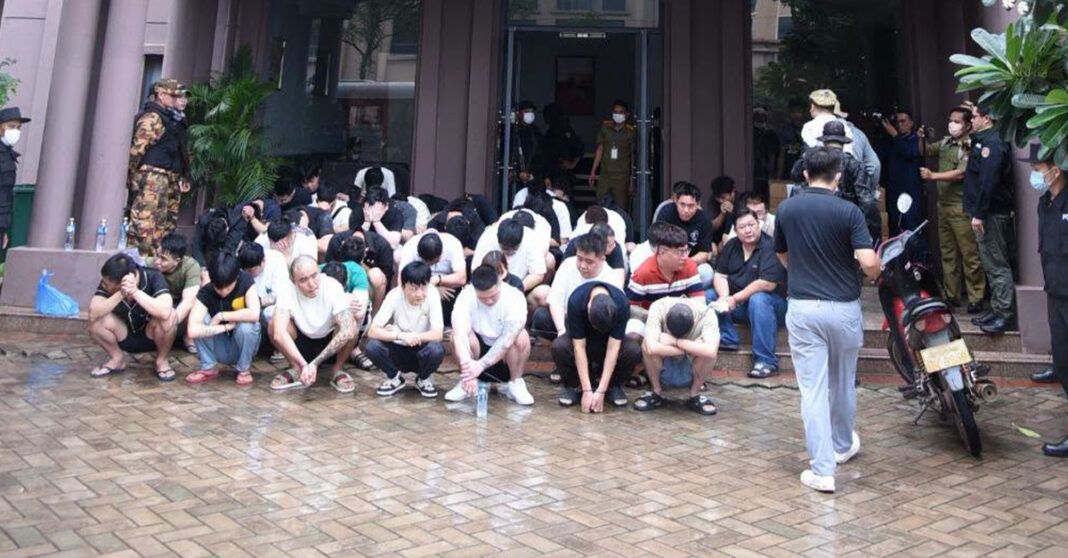
Vientiane authorities have intensified their campaign against international scam operations with a significant enforcement action on 8 August, targeting what police describe as a sophisticated telecommunications fraud and online gambling enterprise operating within the Thatluang Lake Special Economic Zone. The raid resulted in the detention of 261 suspects representing a diverse cross-section of nationalities, underscoring the regional nature of organised cybercriminal networks now operating across Southeast Asia with relative impunity.
The arrested individuals comprised Chinese nationals at 153 persons—the dominant group—alongside 61 Vietnamese nationals, 36 from Thailand, five from Taiwan, two from Malaysia, two from South Korea, and two Myanmar nationals. The presence of Malaysians among those detained signals that organised scam operations have successfully recruited participants from across the broader Southeast Asian region, suggesting these networks possess sufficient operational depth and financial resources to maintain active cells across multiple countries. The concentration of Chinese nationals points to the central organisational role typically played by organised crime syndicates based in that country, which have long been identified by regional law enforcement as the primary architects of transnational fraud schemes targeting consumers throughout Asia.
The scale of equipment seized during the operation demonstrates the professional infrastructure supporting these scams. Police recovered nearly 500 desktop computers and laptops—hardware essential for managing mass communications and coordinating victim targeting across multiple platforms—alongside 2,355 mobile devices used as communication and transaction channels. This technological arsenal reflects the industrialised nature of modern cybercriminal enterprises, which operate less like amateur fraud rings and more like distributed call centres, with workers assigned specific roles within hierarchical organisational structures and provided with prescribed scripts and victim databases.
Authorities have established that the building from which the operation functioned belongs to Lao Thatluang Investment Development Co., Ltd., a detail suggesting either direct corporate involvement in facilitating the criminal activity or regulatory gaps permitting such structures to operate without adequate oversight. Investigators continue pursuing leads to identify higher-level organisers and coordinators who typically remain insulated from direct involvement in the operational mechanics of scam execution, instead managing financial flows and directing strategic decisions from secure locations elsewhere in the region.
This raid represents one element within a substantially broader enforcement initiative that Laotian authorities have undertaken across the nation. The sustained campaign reflects growing regional and international pressure on Laos to address the proliferation of scam infrastructure within its borders, particularly within special economic zones that have become focal points for such operations due to their regulatory peculiarities and limited oversight mechanisms. The timing and scale of enforcement actions suggest coordination between national security agencies and international law enforcement partners concerned about the transnational reach of these networks.
Subsequent to the initial raid, authorities escalated their response through rapid deportation procedures, moving 41 Thai nationals across the 1st Lao-Thai Friendship Bridge to Thai authorities on 10 August, merely two days after the Thatluang Lake operation. This was preceded by an earlier handover of 32 Thai nationals through the same border crossing on 6 August, bringing cumulative deportations to at least 73 individuals. These swift transfers reflect bilateral cooperation mechanisms between Laos and Thailand and demonstrate practical coordination in addressing transnational organised crime that affects both nations.
The Thai nationals deported had been apprehended during an earlier enforcement action conducted on 18 July targeting the ST Vegas complex located in Dongphosy village, Hatsayfong district, within Vientiane. That operation proved even more expansive than the Thatluang Lake raid, resulting in the detention of 589 suspected scammers in total. While Thai nationals comprised the majority of those arrested at ST Vegas, the suspect pool also included Lao, Vietnamese, and Cambodian nationals, indicating the fundamentally multinational composition of these criminal enterprises and the appeal these operations hold for workers across the Mekong region who may be attracted by relatively high earnings compared to legitimate employment.
The pattern of successive large-scale raids targeting distinct locations within a compressed timeframe suggests Laotian authorities are executing a coordinated campaign against multiple nodes within what may constitute a broader, interconnected criminal ecosystem. The strategic decision to conduct multiple operations in rapid succession rather than sequential actions appears designed to maximise disruption and prevent network members from fragmenting and reconstituting operations elsewhere following initial raids.
For Malaysia, the involvement of two nationals in the Thatluang Lake operation raises questions about recruitment and retention mechanisms within international scam networks. Malaysian citizens, many of whom possess banking expertise and digital literacy, have occasionally been identified participating in various capacities within transnational fraud organisations. The identification of Malaysians in Laotian custody underscores the necessity for enhanced awareness among potential recruits regarding the legal consequences of participating in such schemes, particularly given that involvement may expose individuals to prosecution not only in host countries but potentially also under Malaysian law upon return.
The regulatory environment within special economic zones continues to present particular vulnerabilities. While such zones typically attract legitimate foreign investment and generate economic benefits, their often-lighter regulatory frameworks and administrative autonomy have been exploited by criminal organisations to establish operational bases. The Thatluang Lake SEZ incident demonstrates that enhanced monitoring and compliance procedures within SEZ frameworks may be necessary to prevent similar misuse.
Regional cooperation mechanisms will prove essential in disrupting these networks more permanently. Individual enforcement actions, while immediately disruptive, represent temporary interventions unless complemented by sustained intelligence sharing, coordinated investigations, and harmonised prosecution standards across national jurisdictions. The deportation procedures executed between Laos and Thailand demonstrate the feasibility of such cooperation, suggesting a template potentially replicable across other bilateral relationships within Southeast Asia.
The apparent profitability of telecommunications and online gambling scams operating from Southeast Asian bases—evidenced by the scale of operations and the resources committed to equipment and personnel—indicates these networks will likely persist and potentially expand unless countermeasures address the underlying economic incentives. Beyond enforcement actions targeting operational infrastructure, interventions addressing poverty in source communities, improving financial sector defences against fraud, and establishing clearer legal frameworks governing SEZ operations will contribute to more comprehensive solutions.

